


Chapter XIII. Lead Laying (Continued)
Description
This section is from the book "Principles And Practice Of Plumbing", by S. Stevens Hellyer. Also available from Amazon: Principles and practice of plumbing.
Chapter XIII. Lead Laying (Continued)
Step-Flashings, Secret Gutters, and Soakers.
FOR keeping out the rain on the sides of sloping roofs, where the slates or tiles butt against brick walls, or against chimneys, or other wall projections through roofs, Step-flashings are generally fixed. The step-flashing may be complete in itself, i.e., it may, and generally does, return upon the roof, to lay 6 in. upon the slates or tiles, as well as to stand up 6 in. against the wall, with the edges of its steps turned an inch into the joints of the brickwork. Or a step-flashing may simply have to cover the stand-up of a secret gutter, or the turn-up sides of soakers, terminating in these cases about 1/2 in. up from the slates or tiles.
2. Where a side of roof butts against a wall at an acute angle with the ridge, i.e., where the rain in running down the roof runs towards the wall, soakers," or a secret gutter, should be fixed; for no matter what width of lay-down might be given to the step-flashing, it would not be wide enough to keep out the rain which would run under the lead only too readily, to rot the rafters if nothing worse.
3. Instead of fixing step-flashing, with a lay-down upon the slates or tiles, to roofs much exposed to driving rains from the south-west, it is better to fix soakers, with a simple cover step-flashing over them, to all walls, chimneys, and wall projections through roof.
4. The width of the lay-down of step-flashing upon the slates or tiles should be 6 in., and the height of the stand-up against brickwalls 6 in. or 7 in. The height of a stand-up to a stone wall, where the joints are wide apart, should be an inch or two wider, from 7 in. to 9 in., according to circumstances.
5. In rubble-work, where the joints are irregular, and especially where the stones are not faced behind the flashing, it is better to fix the side-flashings in separate pieces, turning each step well into the joint of the stones.
6. Having turned up the side of a piece of lead (which should not be much more than about 7 ft. long) to stand against the wall, leaving 6 in. on the other side to flash the roof, chalk in a line about 2 1/4 in. up to mark the inner edge of the step - the water-channel line; and also chalk in another line, about 3 1/2 in. or 4 in. from the other line, to mark the outer edge. Take the turned-up piece of lead round to its place, and with a straight-edge placed against the face of the stand-up and along the bottom edge of the joint of the brickwork, scribe in a thin line (between the two lines chalked in to show the points of the edges) to mark where each step is to be turned.
Each step in the entire length of the piece of lead having been carefully marked, lay the back side of the stand-up down on a plank, and mark in with the point of one of the legs of a pair of compasses the diagonal lines between the steps. Cut the steps out with a pair of shears or with a sharp pocket-knife, leaving a piece of lead 3/4 in. wide to each step, for turning into the joint of the brickwork. For stone walls - rubble-work - the turn-in of the separate pieces should be more, l 1/4 in. or 1 1/2 in. The edges for turning into the joints can be turned with a small box-wood dresser, dressing and turning the lead back upon a wood dresser; but they are quicker and better turned with a proper turning tool, as fig. 28.
When the flashing has been nicely dressed up and the turned edges of the steps well squared, take the lead to its place and fix it, securing each step with a lead wedge (or with a wood wedge where lead cannot be afforded); but in driving in the wedges be very careful not to knock the faces of the steps with any tool. Turn the lead tacks to keep the lay-down in its place, and come away, for he who dresses step-flashing against the face of a wall to show the irregularities of the brickwork behind it, is a fool for his pains.
7. A secret gutter, fig. 29, is a piece of lead, sometimes nearly invisible, fixed under tiles or slates on the sloping sides of a roof, where they butt against a wall. The sole of the gutter (c g) varies in width from about 1 1/2 in. to
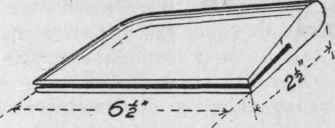
Fig. 28.
3 in., but in the former width it is difficult to get tools into it to form it. The bottom of the gutter on the roof side is formed by turning the lead over a narrow wood-springing or tilting-piece, about 3/4 in. or 1 in. deep, and 1 1/2 in. or 2 in. wide; or it may be turned back upon a rafter and the edge welted, as shown in fig. 29. The lead is turned up against the wall 4 in., 5 in., or 6 in. high, according to circumstances, with a narrow cover-flashing over it, as shown at c f; or where the wall is of brick, it would of course be stepped.
Though a secret gutter be out of sight, it is not always out of mind, for its water-way, or water-course, often gets blocked up with bits of mortar, broken tiles, or other foreign matter, as leaves, etc. In most cases a simple soaker worked in with each tile or slate, and a cover-flashing over it stepped into the joints of the brickwork, or grooved into the stone, is all that is necessary to make a roof sound and water-tight.
8. Soakers are not beer-logged beings, but pieces of lead (or zinc) for keeping out liquid. Quantity surveyors as well as plumbers often make great mistakes in calculating the quantity of lead required for soakers. Where a roof butts against a wall a soaker is used with each slate or tile. The soaker varies in size both in its length and width, according to the character of the roof, and the narrow or expansive ideas of the architects and plumbers concerned in the matter.
The soaker is usually turned up for one-half of its width to go under the slates, and the other half to stand up against the wall, and is cut out long enough to reach the rafter to which it is nailed (by the slater), and sometimes long enough for the end of the soaker next but one above it to lap a little over its edge, as well as to receive the long overlap of its next soaker. Soakers for slates are generally longer than those for tiles. As tiles are thicker than slates, the width of the stand-up of the soakers should be wider for the latter than for the former, even if a little less width be turned under the tiles to make-up for the difference.
Soakers are generally cut out of 4 lb. sheet lead, when they are not of zinc, varying in size from 10 in. by 10 in., 10 in. by 9 in., 9 in. by 8 in., to even 9 in. by 7 in.
The number of soakers required to the side of a roof depends upon the number of the slates, which depends upon the lap to be given to the slates or tiles; and the length of the lap to slates and tiles depends upon the slope of the roof, and also upon the decision of the architect. In high-pitched roofs the laps can be less than in roofs of gentle slope.
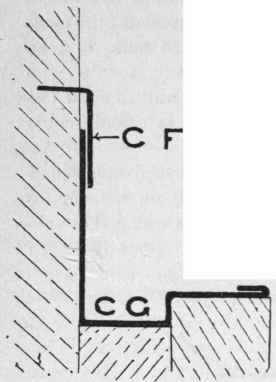
Fig. 29. - Section of a Secret Gutter.
To arrive at the number of soakers required, deduct the lap from the length of the slate or tile to be used, and see how many times half the remainder (the exposed surface of the tile) will go between the ridge and eaves, and the number of times will give the number of soakers; e.g., the length from the eaves to the ridge is 20 ft., and the roof is to be covered with tiles 10 1/2 in. long, and to have a lap of 3 in.: 10 1/2 in. - 3 in. = 7 1/2 in., which / into two equal parts will give 3| in. into 20 ft., will go just 64 times, which will be the number of soakers required. Supposing the roof to be covered with slates 20 in. long with a 2 1/2 in. lap: 20 in. - 2 1/2 in. = 17 1/2 in., the half of 17 1/2 in. is 8 3/4 in., 8| in. into 20 ft. = 27 15/35, giving 27 soakers and nearly the 15/35-th of another - which in practice would be 28 soakers as the required number. The scores of students who attempted this question in my written paper of questions in 1890, if they honour me by reading this, will see how much they were out in their answers.
Continue to:


My Books

