


Chapter XXII. The Loss Of Water-Seal In Traps
Description
This section is from the book "Principles And Practice Of Plumbing", by S. Stevens Hellyer. Also available from Amazon: Principles and practice of plumbing.
Chapter XXII. The Loss Of Water-Seal In Traps
THE sole purpose for which a trap is employed is to prevent any passage of air into a house through a pipe which has been fouled by dirty water, soapy water, or by excrementitious discharges; and he who fixes a trap which does not comply with this essential acquirement incurs a responsibility which, in this enlightened age of anti-syphoning knowledge, no pleadings of ignorance should free him from.
2. The water-seal of a trap may be lost in several ways. It (a) may be forced out by back-pressure; or (6) be syphoned out; or (c) be momentumed out, or momentumed and syphoned out; or (d) it may be lost by evaporation; or (e) it may be blown out, or waved out. But as I have dwelt at great length on the subject of syphonage in my work "Dulce Domum," I need not go into the matter at great length here; and this is to be rejoiced in, for however much I might wish to extend the subject here, there is no space for me to do so.
3. In fig. 91 an illustration is given of a model bath and lavatory, fixed one over the other, which was fitted up for my experiments at the lectures, among other purposes to show how in practice a discharge from one fixture syphoned out the water-seal of a trap fixed under another fixture, when branched into the same stack-pipe, without an anti-syphoning pipe; and after briefly describing the apparatus I will give the results of several tests made in the presence of my audience.
The illustration nearly explains itself. The bath, a, is supposed to be fixed on the 1st floor, and the lavatory, B,'on the ground floor, as so often occurs in practice. The traps under the bath and lavatory are each 1 in., made of glass, in the shape exactly, or as near as may be, of the " Half-S " round-pipe trap. From each trap a lead branch pipe, 1 in.

Fig. 91. - View of Model used for Testing Traps.
bore, is branched into a stack of 1 in. lead waste-pipe. An anti-syphoning pipe, 1 in. bore, is fixed to each trap, nnder the control of clear-way stop-cocks, e and f, for putting it out of use when not required, and the pipe is branched into the main waste-pipe above the highest discharge into it. A stop-cock, J, is fixed in the main pipe just above the highest branch to shut off the ventilation-pipe for certain experiments. A branch pipe, l, with a stop-cock on its end, is also fixed upon the main pipe without an anti-syphoning pipe, for attaching traps to it when so wanted. The bent spiral pipe, m, was only occasionally used, its purpose being to prove that a bent ventilation-pipe on the top of a soil-pipe or waste-pipe, when kept full bore, had but slight influence upon the egress or ingress of air.
"Among other experiments, the following were made, the stop-cocks (e, f, and j) being shut to stop the ventilation.
(la.) "By discharging a small quantity of water from the bath, a, the lavatory trap, d, was unsealed.
(2a.) "By discharging a basinful of water from the lavatory, b, the bath trap, G, above, was similarly unsealed.
(3a.) uBy discharging a small quantity of water out of the bath, and suddenly shutting off the waste-valve, both traps, d and G, were unsealed.
(4a.) "By discharging a basinful of water from the lavatory, b, both the upper trap G, and lower trap, d, were unsealed.
(5a.) "The main waste-pipe was then ventilated full bore by opening the stop-cock J; and, though this prevented the bath-trap, g, from being syphoned by a discharge from the lavatory, it did not prevent the seal of its own trap, d, from being momentumed out.
(6a.) "With the main waste-pipe open at top and bottom, and the anti-syphoning pipe closed by the stop-cocks e and f, the emptying of the bath unsealed the lavatory trap and momentumed the water out of its own trap.
"Some experiments were then made with the D-trap, b, fig. 77, the Bower trap, fig. 92, and the "Eclipse " trap, to show that, though these traps were not syphoned with the ease with which round-pipe traps were, they were by no means proof against the action of discharges sent through them, or through the main pipes into which they may be branched.
(7a.) "The small D-trap, b, fig. 77, was fixed on the un-ventilated branch, l, and the stop-cocks, e, f, j, shut. The bath was then emptied. During the whole time of the discharge the water in the trap, as was readily seen through the cheeks, which were of glass, was kept in a very agitated state, and by the time seven or eight gallons of water had passed through the main pipe the D-trap had lost nearly half its seal.
(8a,) "The Bower trap, 1 1/2 in., fig. 92, was then fixed on the unventilated branch, at L, in lieu of the small D-trap, but before half-a-dozen gallons of water had been discharged from the bath it had lost more than three-fourths of its seal; and after a further discharge of a few gallons more the trap was practically syphoned to the edge of the dip-pipe, which only required the smallest vibration to break the seal."
4. The foregoing experiments proved that two traps fixed on one pipe, like two negatives in a sentence, destroy each other. And they also further proved that those who depend upon the ventilation of the main pipe only, be it a soil or waste-pipe, depend upon means inadequate for the protection of a house from bad air; for, as clearly shown, an air pipe on the main pipe, though of the same size, is insufficient to prevent round-pipe traps, and self-cleansing traps from being syphoned, when large bodies of water are sent through the main piping.
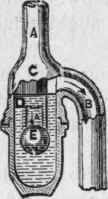
Fig. 92. - "Bower" Trap.
Continue to:


My Books

