


Chapter XXXIX. House-Drains (Continued). Disconnection And Ventilation
Description
This section is from the book "Principles And Practice Of Plumbing", by S. Stevens Hellyer. Also available from Amazon: Principles and practice of plumbing.
Chapter XXXIX. House-Drains (Continued). Disconnection And Ventilation
THE value of disconnection is now so generally understood that it would be a waste of words to discuss the necessity of trapping off sewers and cesspools, and aerating the drains.
"We are now so near to the closing cover of this little book, that there is no space left to discuss the many dis-connecting-traps now in use.
2. Unfortunately several vestry boards still insist upon that obstructional appliance the valve-flap. This flap they require to be fixed upon the end of the drain inside the sewer. Where a flap-valve is insisted upon, the last length of drain-pipe into the sewer should have a sharp fall, even if it entailed less fall in the other part of the drain.
3. Although the manhole drain-syphon, fig. 164, has been superannuated for some years, it is still being used here and there where the light of sanitation has not yet dawned. When such traps are examined, after they have been in use only a short while, they are found to contain pailfuls of filth.

Fig. 164. - Section of a Manhole Drain-Syphon.
In measuring the quantity of water held by a 6 in. manhole drain-syphon, as fig. 164, I have found it to hold more than twice the quantity of water held by my patent discon-necting-traps, figs. 165, 167, 170, and 174. A 6 in. manhole drain-syphon, as fig. 164, holds generally more than two gallons of water. How is it possible to change the contents of such a trap with the flush of water allowed for closets, viz., two gallons? The fact is, such traps are always foul and filthy, whereas such traps as shown in figs. 165, 166, 167, 168, 169, and 170 are readily cleansed.

Fig. 165. - Section of a 6 in. Ventilating Drain-Syphon.
4. Fig. 166 shows a Buchan's "Disconnecting-trap" with a water-drop, and which has been greatly used during the last ten or fifteen years, and with great success.
5. In laying in new drains the value of a water-drop in a disconnecting-trap is not always appreciated. From my point of view it would be better that the house-drain should be laid with a little less fall rather than a disconnecting-trap should be fixed without a water-drop; for besides the advantage gained by a cascade action of water-flushes into a trap for keeping it clean and wholesome, there is the further value of insuring a plug-like seal of water in the mouth of the trap under the greatest backpressure that is ever likely to be brought upon the trap from any barometric change in the sewer.

Fig. 166.
Where a trap has no water-drop, the smallest back-pressure from the sewer forces the water-seal down on the outlet side of the trap, whence, rising up on the inlet side, it flows up into the drain, and in times of great atmospheric pressure the sewer air would readily force its way through the lost or weakened seal of the trap into the house-drains.

Fig. 167.
In addition to the drop of about 6 in. in my trap (fig. 165), there is the extra depth of the water-seal (2 1/2 in.), so that under no back-pressure which such a trap would ever be subjected to would it be left without a water-plug or seal in its dip-pipe to exclude sewer air from the house-drain.
6. Manholes for giving access to the disconnecting-traps cannot always be afforded, but this need occasion no great worry, for pipe-shafts can be fixed at very little expense, either as shown in fig. 167 or fig. 168, illustrations showing the methods I have employed for the disconnection of hundreds of drains with great success.
7. Where existing drains are larger than necessary, and they are not allowed to be replaced by others of smaller size, in fixing a disconnecting-trap it is better to fix the smallest trap suitable for the case, with diminishing pipes, as shown at h and k, fig. 169, the smaller traps being more readily cleared of their contents. In the woodcut, fig. 169, tapering pipes 9 in. to 6 in., and 6 in. to 9 in., are shown for interposing a 6 in. trap to an existing drain 9 in. bore; but supposing the drain to be 12 in., additional tapering pipes could be used, viz., 12 in. to 9 in., and 9 in. to 12 in., and the 6 in. trap still retained.
8. Some years ago I invented the " Drain-sentinel " trap, shown in figs. 170 and 171, for disconnecting drains from sewers, and for affording ready access to both sides of the seal of the trap; to the house-drain, as shown at N, fig. 171; and to the sewer, as shown at d c b, fig. 170; and also at t b, fig. 171. The U-shaped head of the trap affords a better means for connecting a channel-pipe to the trap, where a manhole is formed for giving access to the drain. The trap is made in four sizes, for 4 in., 6 in., 9 in., and 12 in. drains. Special channel-pipes, as shown in figs. 172 and 173, are made for receiving branch drains, and the side inlets, w and Y, are so formed that matters travelling through the main channel shall not flow up into the branches to foul them, and that the matters flowing out of the branches shall be turned into the channel-pipe in the way of the current.
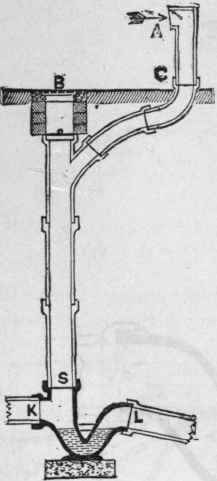
Fig. 168.

Continue to:


My Books

