


Chapter XV. A Neat, Symmetrical Story-And-A-Half House At Moderate Cost. - Description Of Its Arrangement. - Its Advantages Over A One-Story House. - Some Novel Features. Design III
Description
This section is from the book "Our Homes And Their Adornments", by Almon C. Varney. Also available from Amazon: Our Homes and Their Adornments.
Chapter XV. A Neat, Symmetrical Story-And-A-Half House At Moderate Cost. - Description Of Its Arrangement. - Its Advantages Over A One-Story House. - Some Novel Features. Design III
WE present in Figs. 10 and 11, first and second floor plans, with front elevation shown in Fig. 12, of a story-and-a-half cottage. Two of these have recently been completed for the author, for renting purposes, and he considers this design the nearest approach to an ideal neat, cosey, tasty cottage home that he has ever made, for the amount they cost.
The house consists, as will be seen by referring to first-floor plan, Fig. 10, of portico L, vestibule K, 5x5 ft., and opening into parlor A, 12x14 ft., and also to sitting or main living room B, 12x14 ft., which is connected with the parlor by a sliding door four feet wide. Off the sitting-room is a bed-room D, 8x10 ft., and a clothing closet G, under the stairs, for the accommodation of the same.
From the sitting-room, door I opens to an easy stair-way leading to second floor, and the door in rear opens into the kitchen C, 13x14 ft., large enough to use for dining purposes when desired. In one corner of the kitchen is an iron sink with good drip-board at one end and a cupboard under the sink. The chimney shown in kitchen is for the use of both rooms, between which it is located. The kitchen stove can stand well up in the corner and leave plenty of room for tables, etc.

Fig. 10.
F is a pantry, 4x7 ft., of ample size, with one broad shelf, under which is a space inclosed with a door for a barrel of flour, and a small door or top of shelf opening into barrel. Also on the side of this door a tier of three drawers, and plenty of open shelves and cleats, all around the three sides. Door H opens to a stair-way leading down to a neat little cellar, 12x14 ft., the walls of which are made of brick laid open, thereby effectually keeping out dampness and frost. The floor is concreted, and a tile drain connected with sewer laid inside of the walls. The door from the kitchen in the rear opens out to a platform with steps leading down each way, one to the walk around to the front, and the other to water-closet J, which is connected directly with the sewer.
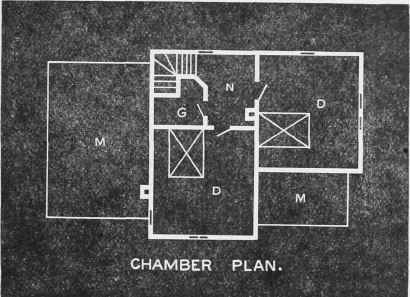
Fig. 11.
On the second floor we have, you will observe by referring to Fig. 11, ample hall room N, with window. The two rooms marked, D, D, are sleeping-rooms, 12x14, and from the hall is one large closet for both rooms. M is an unfinished attic over kitchen, with door from the large closet, and is used only for storing trunks or things not frequently wanted.
The compactness of the house makes it easy of access to the different rooms and easy to warm; indeed, one mediumsize base burner, set in the living-room, will warm the whole house, except the kitchen. In the ceiling, immediately over the stove, we have a register opening into the room above, and one in front room to the chamber over it; these registers can be closed during the day, and in the evening by opening them and running the fire a little more briskly, the sleeping-rooms can easily be made warm enough.
The objection is sometimes made that the sleeping-rooms in a story-and-a-half house are too warm in summer; such, however, is not the case if the windows in these rooms are arranged in the manner shown in Fig. 11, or in a similar manner, with not less than two in a room and always on two sides. If one window can face the south or west, so much the better, as a good ventilation can be had at all times.
The side walls are sixteen feet and six inches high from top of sill to top of plate; the first story is nine feet and six inches between the floor joists, leaving the outside wall of second floor six feet and four inches from floor to where the angle of roof rests on the plates, and in the center the rooms are nine feet high. The rear or kitchen part is twelve-foot studding, thus leaving ample room in the attic for storing purposes. We think the exterior presents nice and graceful proportions.
The design depends for effect as much on the outline and painting as upon anything else. Across the front and sides is a water-table; and from this up to the window-sills, the wall is sheathed with matched sheathing, and the sill course extended around over this and cut into panels with cross-bars in the manner shown in the elevation. The window-casings connect with a band or belt course at the caps, while the double window in the second story is connected on each side with the caps of the two windows below, by a piece cut in a symmetrical form; and in between these the panel is covered with shingles cut in a neat pattern.

Fig 12.
The gable is divided by a band and shingled in the same manner, as is also the end of veranda.
On the top of the roof, over each gable, is placed a neat finial of wood, and the gables are finished with a verge-board of unique design, placed immediately back of the facia. This gives a very pleasing appearance. Tin-front door has glass in top panel to light the vestibule. Steps with rail and posts on each side lead up to the veranda.
We have painted the house in the following manner: The body, or parts of the house clapboarded, and the panels under sill course, are an olive-green; all trimmings, including cornices, window-frames, bands, veranda, and cross-pieces in panels, are a dark chocolate; the cut shingles in gable and veranda are a bright red; while all the trim-. mings of chocolate color have chamfers cut in with vermilion, the sash also being vermilion. The effect and harmony of these colors are very pleasing.
We wish to say a few words, comparing this six-room, story-and-a-half house, costing, in Detroit, thirteen hundred dollars, with a one-story cottage containing the same number of rooms, all on the first floor, and costing the same amount.
In the first place, the cottage must necessarily cover more ground in order to obtain the same amount of room, and this must be in width as well as length; hence the advantage in building on narrow lots; we have much more ground left for a lawn at the side, and also for a yard in the rear, as well as more light and air, which are of consideration.
In the second place, the height of the walls of a onestory cottage must be twelve feet, only four feet less than the other; the amount of roof must be as much more as would be required to cover the amount of two sleeping-rooms on first floor, (and these rooms cannot be as large as those in the story-and-a-half house), usually with one window in a room, or if there are two, they must be on the same side. The result will be small sleeping-rooms that can never be ventilated as well as a room on the second floor, with windows on two sides.
And again, do what you may in the way of embelish-ment outside, you can never produce on the one-story building that symmetry of outline and beauty of proportion so easily obtained in the other; therefore we think that these considerations are decidedly in favor of the story-and-a-half house, and worthy of the careful attention of any one interested in this class of houses.
Continue to:


My Books

