


A Pompeiian Room
Description
This section is from the book "The Art Of Decoration", by H. R. Haweis. Also available from Amazon: The Art Of Decoration.
A Pompeiian Room
In the best examples of Pompeiian walls, there is a gradation of colour from the ceiling downwards, though this is not by any means a fixed law. The gradation downwards from light to deep colour is pleasing, because founded upon the natural law of gravity, such as we might study in a flask of cloudy wine, where the deepest colour would sink and leave a clear pale hue above it. The dado may be black, with red pilasters and frieze, and panels of yellow, white, or blue, on which a small figure of girl or goddess may dance or feed her goat. Above may be a broad band of white or yellow, with decorations upon it in all colours, and really beyond the reach of strict criticism in their capricious independence of art rules - gay, showy, sometimes almost vulgar, could the word be applied to things so attenuated, graceful, and ingenious, and showing such perfect knowledge of proportional areas.
No one should attempt the decoration of a Pompeiian room without experience, or the advice of experienced artists and decorators used to freehand painting; for the whole and sole charm depends upon the painter's facile mode of striking off the arabesques, inventing as he goes, not copying on one side of a pattern the reversed lines of the other. When it is anything short of first-rate, and without the interest attaching to antiquity, Pompeiian art is nothing but fantastic and vulgar.
The common proportions for the decorations are a dado about one-sixth of the height of the wall, on which broad pilasters half as wide as the dado divide the wall into three or more panels. The frieze which unites the pilasters varies in width, but it is often one-fourth the height of the wall from the top. Owen Jones bears out my views in saying that 'the upper space is frequently white, and is always subjected to a much less severe treatment than the parts below' (remember the above-suggested law of gravity), 'generally representing the open air, and upon the ground are painted those fantastic architectural buildings which excited the ire of Vitruvius.'
Colours which do not contrast strongly, such as yellow and red, are divided by shading, an natnrel, and sometimes the inherent Italian love of spectral illusion made the pilasters and friezes of the old world quite deceptive, as in South Italy it still tries to make the walls external and internal; we have all seen false vistas containing ladies sighing on balconies, windows through which peep sly maidens, and scenes with fountains and woods depicted where by no possibility such things could really be. To this style we Britons should be more lenient if we remembered that the school was doubtless founded on the love of air, flowers, and outdoor amusements which the Italians have ever nursed to this extent, that when it was too hot to go forth, the ever-shady garden was to be had within, even in the very bedroom.
In the Roman house of Germanicus, of which the wreck remains within the palace of Tiberius, his son, by whose filial piety it was preserved, we have the finest known examples of the so-called 'Pompeiian ornament' - a name which sounds particularly absurd applied to Rome where it probably flourished best; we ought to give up the name Pompeiian now for Greco-Roman, as the school was probably Greek, and every one knows this decoration was not confined to the fashionable watering-place near Naples, though Greek workmen may have worked there, as they did in Rome.
It is likely that Roman decoration both within and without the house surpassed the Greek in magnificence, if not in purity of taste; and that when the Romans faced their brick and stucco buildings-with marble, and preferred elaborate mosaic to the Greek coloured-plaster floors, they also improved upon the Greek walls and ceilings.
Let us rebuild the rooms in the house of Germanicus from its present relics. How charming they are, in spite of all the art-canons which forbid naturalistic decorations! Deception has clearly been aimed at in the painted pilasters that stand all round the room, and pretend to uphold the roof; also in the framework of a verandah which seems beyond them, supporting rich festoons of flowers and fresh cool fruit, tied with ribbons. The perspective is admirable: the verandah seems closed with silk or linen panels. The pilasters - whose roundness cheats the eye, and extends the apparent area of the room as a modern mirror does - run up into delicately worked capitals; the ceiling is covered with exquisite stucco reliefs, such as Plato speaks of in Greece, white or nearly white. The dado represents a tempting seat, like a broad window-sill; it is about two feet high, supposing the height of the wall eleven, and is broken by the bases of the columns, painted like projecting dragons. The central frieze unites these slender columns by a broad neutral-tinted band a foot and a half deep, on which comic freehand sketches of the life of the time are painted in brownish colour.
The spaces above this frieze, between the columns, might represent the open sky - a common habit - save that grotesque scrolls such as Raphael loved break up the light colour with wavy lines.
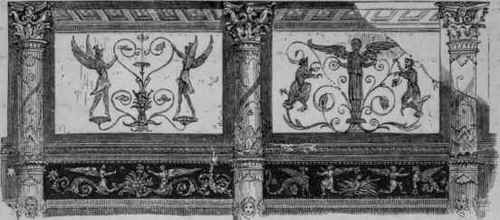
Fig. 30. - Frieze of painted wall, in the House of Germanicus, Palaces of the Caesars.
In another room (fig. 31) the simulation of aerial perspectives is carried still farther. Apparent openings in the walls guarded by half-open shutters (of course glass windows did not exist) discover various domestic scenes: there, in what may seem an upper bedroom, slaves prepare the basins for ablutions; or lovers murmur in their bower; or, strangest of all, glimpses of ruined temples and basilicas natter the Roman sense of power. Why else were ruins painted on these royal panels? These ancient paintings of still more ancient demolitions remind us curiously of Renascence carvings, and Empire sketches, and models, of ruined Rome, proving how history repeats itself, and human nature too. There again, we. catch sight of an apparently neighbouring house (not. at all unlike some of Cubitt's!) on the leads whereof women and children are airing themselves.
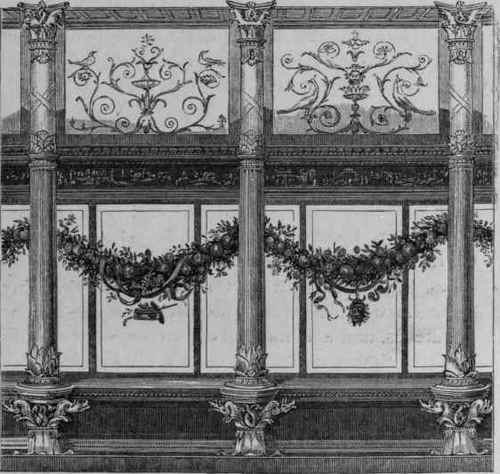
Fig. 31. - Painted wall, from the House of Germanicus, Palaces of the Caesars.
Continue to:


My Books

