


Colour
Description
This section is from the book "The Art Of Decoration", by H. R. Haweis. Also available from Amazon: The Art Of Decoration.
Colour
I have already given a few new ideas for the ornamenting of the frames, introducing new colours and a higher class of decoration. I may now suggest that the colour of the cover of a sofa or chair be never harsh nor even very bright, as it should always be subservient to the various and quite incalculable hues which will be contributed by whoever sits upon it. Helbronner's and Morris's velvets and chintzes are therefore very reliable, as they are always fine in colour, often in pattern; and if the materials sent out by these firms are too dear, even when weighed with their really durable quality, it is a good plan to have old stuffs dyed to match patterns of theirs, which can be done by every sensible dyer, and at a reduced outlay of money.
The recent fashion of covering chair-seats with exquisite antique silks, old brocades, and delicate featherwork, is a waste of good things which were better applied elsewhere. Not that chair-seats may not be beautiful. The delicate Gobelin tapestries which cover Louis XIV. chairs and lounges are quite in place, pictorial as they are, because Gobelin tapestry is a strong serviceable fabric, and soon tones down in flat colour; but if the decoration of the room, as sometimes happens, depends upon the chair seats, if these are gems finer than the robes of the ladies, or the hangings of the wall, there is evident waste of force going on when the room is occupied by guests. In short, people who nurse this hobby forget that chairs are to be sat upon, and that when put to this ignoble use you cannot see the seats.
The form of chairs (i.e. the framework) might be immensely varied, were sculpture and inlaying introduced; and, were the material of the frame handsomer, no doubt improved decoration would follow. But the general form of a chair should be considered before the details, and we may cull new forms from old sculptures and old paintings innumerable if we look about.
The well-known chair in Raphael's Madonna della Seggiola, in the Pitti Gallery - a folding-chair with decorative posts, apparently connected by a handsome strap, not a rail, common in the sixteenth century - has never to my knowledge been copied; it would be a very agreeable seat. The chair of Sesostris is one of the most beautiful designs I have ever seen; its supports, probably of ivory and metal, are far more picturesque and elaborate, and full of more developed thought than any Greek or Roman seats even in the Naples Museum, which offers so many beautiful forms. The main outline of the Greek and Roman chairs does not greatly vary, while the bronze decorations are full of thought, humour, and art-knowledge; but the chair of Sesostris, like all Egyptian art, is, I think, radically superior to the Greek, because the construction is rather architectural than aesthetic. The seat and back, whatever the original was made of, might be exactly reproduced in stuffed velvet or silk; a spring-£eat is not inconsistent, and the supports (they cannot be called legs), representing captives, would admit of an infinite variety in colour and decoration.
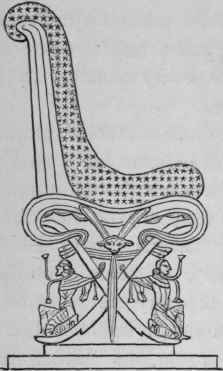
Fig. 55. - Chair of Sesostris.
Continue to:


My Books

