


Weight
Description
This section is from the book "The Art Of Decoration", by H. R. Haweis. Also available from Amazon: The Art Of Decoration.
Weight
The weight of a chair has some bearing upon its comfortableness. Some chairs, for dining-room use, are so heavy that it requires a great effort, or the assistance of another person, to pull them to the table. Others, in the drawing-room, are allowed to be so light that they seem to fall over if your eye strikes them - foolish gilt cane baubles, never meant for use. Such weight and such lightness are a perpetual nuisance. There is no more annoying accident than the oversetting of a chair, and nothing more irksome than imprisonment in a seat which will not obey our wish to shift it. A light chair is in many ways more convenient than a heavy one, but the propensity to fall over is not entirely due to paucity of material. It is often because the seat is too small for its height from the ground, and because the legs are fixed perpendicularly to it instead of at an angle giving more purchase to the floor. A wide square seat will admit of perpendicular legs; but it stands to reason that a small seat upheld by perpendicular legs, without sufficient wood in them to make up in weight what is faulty in construction, must fall over at a touch. Some of the vile parodies of high-backed Stuart chairs fall over whenever the sitter rises, heavy as they look.
The sixteenth-and seventeenth-century chairs on their perpendicular legs were ponderous by mass of wood, and furthermore the seats were large, often concave. Nothing can be steadier. Some fragile 'Chippendale' (?) chairs are steady, but in these cases the legs diverge slightly and the sharp feet stick fast in the carpet. The height of a chair must be proportioned to the plane of its seat in order to afford that security which everyone who trusts his body on it has a right to demand - but this is one of the many secrets hidden from the British upholsterer! The chairs which became fashionable after the Chippendale school of furniture had lost its novelty and its merit too, were heavy enough, with large seats covered with horsehair. Only when the monotony of the few forms and straight lines used had become intolerable, did impatient 'taste' fling itself upon curves for relief, and encourage the 'solicitous wrigglings' of the modern Louis XV. chairs.
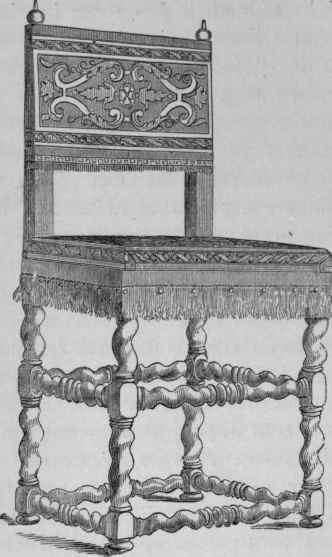
Fig. 56. - Seventeenth-century chair.
Continue to:


My Books

