


Comfort And Chairs
Description
This section is from the book "The Art Of Decoration", by H. R. Haweis. Also available from Amazon: The Art Of Decoration.
Comfort And Chairs
The desiderata in a chair would not seem to be many, but one thing we might fairly suppose indispensable - comfort. Yet this is the last thing chair-buyers think of. They are so ostentatious, or so 'aesthetic,' or so stingy, that they ask 'Is it specious?' 'Is it the newest high art?' and 'Is it cheap?' before they sit down in it and wonder 'Is it comfortable?'
Now, before all things, a chair should be easy. Yet I have known people own a set of chairs for ten years without noticing that they are so high that your feet cannot reach the ground unless you sit on the edge, or so low that the adjoining table almost comes to your shoulder; that the backs are agonising from knobs and excrescences just where they should be kind to your blade-bones, or useless through being set too far from the seat.
Some people never lean back. Either from early old-fashioned 'drilling' or a long-formed habit of self-defence, some ladies sit bolt upright in every kind of seat. To people superior to human weakness, such as those who use kitchen Windsor chairs in their drawing-rooms (a purpose for which Windsor chairs were never intended), I do not address these hints; but to those who love beauty and comfort I say, see that your chairs are easy, and then all other good things shall be added to them.
The form, the colour, the materials ought to be good in themselves, harmonious with their surroundings, and adapted to their purpose. Without these desiderata they can never be beautiful, since beauty means fitness, and fitness implies a useful object.
The shape ought to recall, however remotely, the human form and its requirements of rest and liberty. Arms are good, but not all arms. Last of all the sharp-edged 'Chippendale' or the 'Windsor' kind, which persons who will not accept any easy seats (and perhaps are never tired) profess to enjoy. As to the latter class of chair, Mr. Eastlake was one of the first to assert that the pattern was sound, because admitting no superfluities; but neither he, nor anyone else of a sane mind, ever alleged that they were beautiful, or that they ought to be fetched up from the scullery into the drawing-room. Such chairs are strong, well-pinned, hollowed in places to suit the form, steady, easily cleansed during greasy kitchen service, and the bead, fillet, and hollow mouldings were often effective in good, close-grained wood, hand-carved. But we might as fitly hang frying-pans between our porcelain and water-colours, as associate the hard kitchen chairs with soft carpets and satin dresses. 'A place for everything and everything in its place' is a proverb which is regarded least by votaries of ' high art,' and the modern Windsor chair, manufactured by steam in cigar-box mahogany, and heavily varnished, as we have seen them in the drawing-rooms of weak aesthetics, is an affectation which has not even originality to recommend it.
The exact angle at which the back and the arm-rests jut from the body of the chair must be carefully calculated, and calculated as far as possible to agree with a number of positions, not one only. For instance, a chair stuffed so as to receive the shoulders comfortably, but leaving a hollow in the middle of the spine (a common fault) is adapted to very few positions, and soon so further tires a tired body that he or she soon quits the chair to try another. Again, a chair stuffed to support the small of the back, but too low to receive the thrown-back head, is another imperfect instrument of rest: the positions it accommodates are limited, hence the limit of usefulness, and the chair must be supplemented by other kinds.
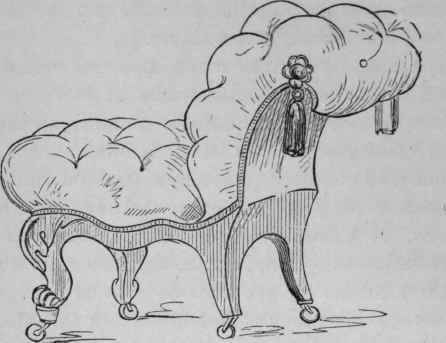
Fig. 46. - The upholsterer's darling.
And both these chairs are sure to be ugly. They are sure to be 'lumpish,' as Caliban's sea-beast, with abrupt, ungainly projections of velvet and buttons, and the legs will surely echo the immoderate curves.
The most useful and comfortable, as well as inexpensive, chair is of a simple form, which by the aid of suspended cushions or other additions can be adapted to a good many needs; and such loose cushions, in lieu of over-stuffing, add to the artistic beauty and variety of the seat, as well as the liberty of him who sits therein.
Arms are a difficult question. They are so ugly as a rule when stuffed in one place only - they are so hard when not stuffed - they hern in one's elbow as one lifts it, they hit it as it returns - that I have come to the conclusion that they are very seldom of service. In modern makes they are perhaps least offensive when in the form of simple square cushions attached to a rail; they are no doubt most beautiful when handcarven, as in the Charles I. chairs. However, in the time of Louis XIV. they managed to attain stuffing without losing the curve within; and I suppose we might again attain it. The Louis XIV. chairs earlier alluded to are comfortable and pretty. So would be this fine chair, dated about 1690, if there were a loose cushion for the back; though the dolphin arms are too suggestive of 'a very ancient and fish-like smell.' There are two fine chairs with delicate dolphin arms in the Cambridge University Library.
For my own part, I incline to think chairs and sofas ought to be made in but one or two forms, with framed seats to admit springs, which, whatever Queen Annites say, are a great improvement on solid though cushioned seats, and do not in any way interfere with the graceful construction: these seats to be wide enough to admit of any change in the fashion of dress. A seat is more picturesque when it extends beyond the body of the seated person, and affords more rest and freedom. This would not, however, apply to dining-room chairs, which we cannot afford to have wide in these days of crush-dinners.
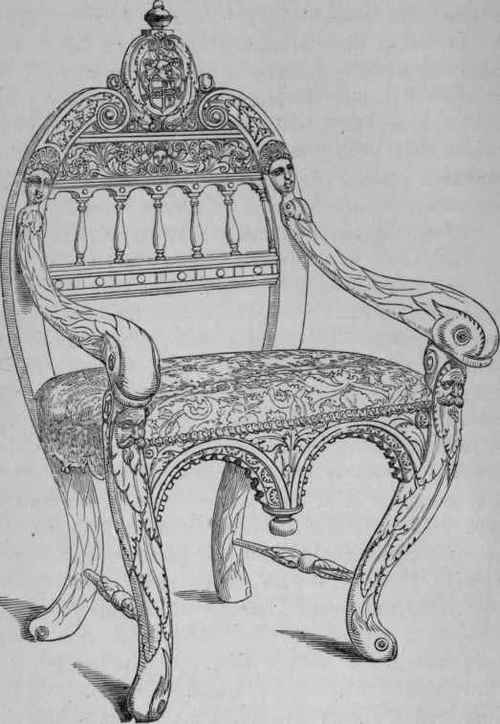
Fig. 47 - Seventeenth century chair.
Continue to:


My Books

