


Pianofortes. Part 2
Description
This section is from the book "The Art Of Decoration", by H. R. Haweis. Also available from Amazon: The Art Of Decoration.
Pianofortes. Part 2
Personal experience of the Euphonicon must admit that the iron frame renders it heavier than an ordinary cottage pianoforte, whilst the exposure of the strings probably renders the tone, though sweet, less powerful than when they are stretched against a sound -board - at least for concerted music.
For drawing-room use, however, and for the voice, the Euphonicon seems to me as much more suitable than a loud Erard, or Broadwood, as it is more graceful: it is in fact an effort of genius, a new and poetic creation, not founded at all on the usual pattern, but wholly distinct.
It is to be hoped that some enterprising firm will one day revive this artistic and neat design, which ought to drive out of the field the vulgarities of the clumsy form we have borne with so long, as we bore all the other eyesores fashionable between 1820 and 1860.
The old spinet was no eyesore: nor were harpsichord, virginal, clavichord, the gentle steps to modern mechanical perfection. Mary Queen of Scots had a virginal made of oak, inlaid with cedar and richly ornamented with gold. Birds, flowers, and leaves were painted on the cover and sides, of which the colours are still bright, and the lid is illuminated with a grand procession of warriors, whom a bevy of fair ladies are propitiating by presents of wine and fruit. How far back the pretty old name carries us, to picturesque times when devout nuns played upon their precious virginal soft minor hymns to Mary Mother, at evensong, unwitting of the almost ferociously loud effects required by future ears ! Queen Elizabeth is described in the ' Memoirs' of Sir James Melvil, as playing ' excellently well' on the virginals, better than her sister of Scotland.
The harpsichord was pretty, too, its two keyboards gave it dignity, though Sebastian Bach liked it less than the clavichord, with its smaller scale but more flexible quality of tone. In 1760 a first-class harpsichord by Rucker cost one hundred guineas.
Evelyn speaks of 'a new invented instrument of musiq, being a harpsichord with gut strings, sounding like a concert of viols with an organ, made vocal by a wheel, and a zone of parchment that rubb'd horizontally against the strings' (1663).
At the South Kensington Museum there are various instruments which might give us hints for clothing a machine to which we owe so much intellectual delight, and which is already worth a large sum, eyesore as it is. We are told that forty-eight different materials are used in constructing a piano, laying sixteen different countries under contribution, and employing forty-two different hands. In the Great Exhibition of 1851 there were some handsomely cased pianofortes: Erard's grand was valued at 1,000l., Broadwood's at 1,200l.; but I have hardly seen any really picturesque case if we exclude Mr. Alma Tadema's and Mr. Burne Jones' pianos and the Euphonicon. Even Mr. Alfred Morrison's inlaid case designed by Owen Jones is rather staring than refined. Indeed, the whole outline requires modification. The pictorial decorations of the old instruments with keys of precious stones and agate, and exquisite inlaying wherein the seams are only visible by a magnifying glass, are the best ensamples for modern skill and daily improving taste.
The old square flat piano of the Empire time is less objectionable than the ordinary one, and I have seen a modern pianoforte of that flat shape, made in light wood, which by comparison is almost pleasing.
A totally novel design for an upright grand pianoforte, and one which has many advantages, is well worth quoting.
The design, which requires further working out, is founded on sound knowledge of the mechanical requirements, and for the first time raises the player upon a platform, which renders him visible as he has never hitherto been in a crowded room, and gives purchase and breadth to the sound. Many pianofortes at chamber concerts have a little platform built for them at considerable expense, but such an instrument as is shown in the diagram would do away with that necessity, the seated player being naturally raised to a proper height for a standing audience, instead of being buried at a breathless level. This piano would also take less room than a grand piano upon a platform: it would occupy the area of a cottage piano. The keyboard is in fact built on a level with the uppermost part of the body; the length of string commonly carried into a bulky obstacle which conceals the player from half the hearers, whether he faces them or not. and must to some extent damage the sound, is here carried down into the platform beneath his feet. It should be strung diagonally.
The square parallelogram is thus of the ordinary scope, but the platform itself is utilised as a sound-board; and this platform may be open or closed, decorated or plain, according to choice, and the portion occupied by the player detached if necessary from the portion required for the sound-board. The effect would be much better than the present unpopular cottage grand, without being as unwieldy as the flat grand. Of course the platform, light, but strengthened by beams, would be furnished with sunk castors.
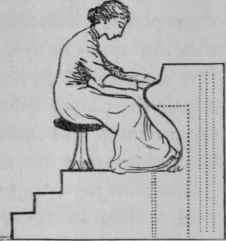
Fig. 66. - Novel design for a pianoforte, side view.
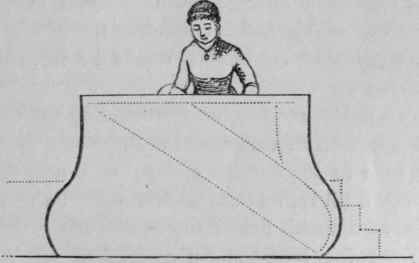
Fig. 67. - Back view of the same.
The smaller stratagems for mending the ugliness of pianos are seldom very successful. Some persons who do not care to incur the expense of a new case, carry bookshelves all round the piano, which then seems set in a deep niche, which has an organ-like effect, the front of the case being replaced by painted or gilt canvas, or embroidery. This usually, however, prevents the lid from properly opening, and deadens the sound.
Others have the whole flat glossy case incised in good conventional patterns, and tinted (no costly process), which simulates inlaid woods and carving. But these are all makeshifts.
Continue to:


My Books

