


Pianofortes. Part 3
Description
This section is from the book "The Art Of Decoration", by H. R. Haweis. Also available from Amazon: The Art Of Decoration.
Pianofortes. Part 3
The shape of a pianoforte ought at least to be as mobile as a sideboard, in which the patterns vary greatly, though all founded on the primal ideal of shelves, drawers, and cellarets.
If we could use the decorative properties of strings as in the Euphonicon, and mount the body, flat or upright, upon supports better than the two, or three, swelled legs, such as well-cut arches, or masterly statuettes, or even mere Doric columns or spirals in sufficient number to form a proper base for so heavy a mass of dark colour - we should already have gained an important victory over the last and most stubborn relic of tasteless vulgarity.
Doors always look better carried up to the cornice, either arched or ending in a well-modelled lintel. Georgian houses have sometimes charming doors of solid mahogany, which compare favourably with our ordinary deal door of poor design, painted white or smeared with stain and varnish to look 'ecclesiastical.' A handsome headpiece can always be added to a mean door with improved effect, such as those bas-reliefs of classic aim we see in last-century houses, and which bear picking out with colour very well. Or a picture may be set there panel-wise, to annihilate the unmeaning space between the top of the door and the ceiling. The picture should be a life-size head (this is a good refuge for a Kneller daub), not some minute landscape which tortures the eye with uncertainty every time it meets it; and a similar moulding to that of the door should form its frame. Down the sides of the door carvings of Gibbons's school may be carried, wreaths or scrolls, heavy or slight, painted or plain.
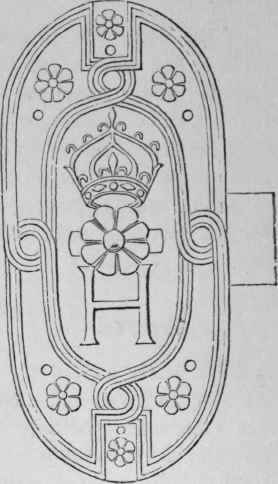
Fig. 68. - Iron bolt, French, about 1550.
In a house with some pretensions to mediaeval treatment the doors may be ornamented with elaborate hinges, or even bolts, a form of decoration so elegant that it is curious how seldom it is employed. These look best on a flat door, and may be underlaid with crimson velvet, the metal being brass or iron, black or parcel-gilt.
The projecting hinges still seen on French doors are, I think, more picturesque than our own, where in strength is sacrificed to neatness; but this is a false motive; it is more honourable to acknowledge the inevitable and make the best of it, even when it is a door-hinge.
Mediaeval carpenters never denied the existence of their hinges, but they made the hinge an ornament, as also the illuminators did not avoid a flaw in the vellum-page, but they made the flaw an excuse for another flower or dragon.
Handles should be small and pretty, worked into the semblance of a conventional rose, or shell, or group - see what the Bernese can do with the subject of a bear, what the Scotch can do with the eagle's foot, and the Romans with the wolf!
A pretty design for door-handles is often seen in old Georgian houses, which is artistically good enough to reproduce, for even in cast metal it would be better than what we now use; in hard, worked metal it might become a gem, in chiselled bone or wood it would be less disagreeably cold to the touch. The union of handle and keyhole in a single frame prettily waved and carried to the edge of the wood, is very happy; the conventional bead and sunflower are well combined. It will be seen that the handle is very small, meet for the grasp of a lady's hand; not a clumsy lump which escapes a girl's fingers and quite defeats a child's.
I believe I was one of the first to show that the panels of doors offer a good field for decoration, and it has become needless to observe that these must receive attention, for people now rather overtrim their doors. Panels of Japanese or English paper of fine design may content those who cannot obtain something better, and I have seen doors very well papered. Others may paint or get artists to paint such panels with flowers in the Japanese style, treating the panels as window-openings behind which the boughs appear, and allowing the jamb to cut through the design where necessary. Gold panels may be treated in a variety of ways; shields of arms are suitable to panels, and so no doubt are 'subjects' of higher pretension - portraits, views, and illustrations from favourite authors.
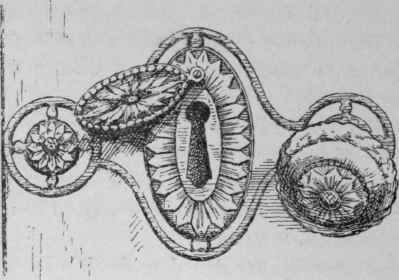
Fig. 69. - Georgian lock.
Many people complain that having made their doors beautiful and having therefore got fond of them, they have to quit them when their lease is up. This, however, is a delusion, as doors are easy to lift off their hinges, and not costly to replace; and, if they were worth it, ought as fairly to follow their owner as his water-colour sketches and carpets. I have seen doors decorated by upholsterers to represent mother-of-pearl inlaying. Why not have the real mother-of-pearl instead of the effete resemblance?
Those whose houses belong to them might take far more trouble with so conspicuous a part of the building than they do. They might indulge in doors such as the late Mr. William Burges designed for his own house, in bronze, with charming bas-reliefs full of humour and grace, which remind one of Florence and Ghiberti. With easy hinges bronze is not too heavy a material for a door, and the effect is certainly extremely fine, the bronze wears into such splendid colouring.
The delicate bas-reliefs on the doors of Pisa Cathedral can never be forgotten by those who have studied them: it is difficult to know which to prefer, the lower part which by constant handling has become brown and gold, or the upper part which has grown green with the gieenness of the summer sea, through never being touched at all - and the designs of home-doors may be of any kind, from small arabesques to the history of England. The bronze may be solid, or applied in thin repousses plates; and when you have accepted the notion of metal ornament, the additional decorations, such as minute quantities of gold or the introduction of crystal, agate, and pebbles, crowd upon the aspiring mind with Aladdin-like splendour. Instead of which, people such as the Italians and Parisians paint deal to look like bronze!
Why people should hang works of art on walls between doors where often they can hardly be enjoyed for the chairs that intervene and the people that scuffle, yet never place them upon doors which must face you, and you only, as you open them, and are always within the line of sight, is one of those many problems for which our century is remarkable. In old days the reverse plan was adopted - but then the benighted folk did not consider that canvas and coloured pastes were the sole vehicle fit for first-class artistic talent, and that every other material was infra dig. I wonder whether Ghiberti, and Rucker, and Vischer, and Krafft, and, Gibbons, would be admitted to the Royal Academy if they sent up their works to-day, or whether they would be ejected as ironmongers and founders and carpenters because they had not used paint or marble? I am sure that very few private persons would employ them - those many brave Britons who go to the Royal Academy with a dealer, and ask him what pictures they shall buy. As a rule, one side of every door should be protected by a curtain for the prevention of those icy draughts which every thoughtful builder constructs for the benefit of his brother the undertaker.
Such a screen increases the comfort of every room, even when the fire is big enough to burn John Huss. It actually saves coal, by dispensing with such a bonfire, and the outlay in a pretty dhurrie or rug for this purpose is the more repaying if it diminishes in any degree the creation of yellow fog.

Continue to:


My Books

