


Chapter VII. On Fire-Places And Fires. Mantel-Pieces
Description
This section is from the book "The Art Of Decoration", by H. R. Haweis. Also available from Amazon: The Art Of Decoration.
Chapter VII. On Fire-Places And Fires. Mantel-Pieces
STOVES are a problem still. How to obtain the maximum of heat with the minimum of waste; how to make the fire-place an ornament as well as a refuge, it is very difficult to say. The handsomest fire-place is no doubt the old-fashioned kind, large, roomy, important, as should be the Englishman's sacred hearth, which is, moreover, the most interesting part of the room for at least two-thirds of the year. Built proudly up to the cornice, or nearly, in finely carved stone or marble, like a shrine, probably enclosing a fine old portrait, the designs found in old Italian and German mansions, and in our own as well, are full of interest and character; those belonging to the Renascence are more or less florid and ornamental, but the carefully-modelled figures and draperies are often grouped with perfect taste. I have seen charming old Jacobean mantel-pieces where the dark oak has framed the fire with small but elaborate carvings of hunting and other scenes, some of the smaller panels forming drawers convenient for cigars, brushes, string, etc, that are wanted always handy; some forming small shelves, on which a blue tobacco-jar or a bit of majolica looks delightful.
But the chimney itself is always of one construction, wide and open, and the fire has to be very large which will warm a big room or hall where there is that tremendous draught.
In the eighteenth century the passion for Chinese porcelain, magots, and the imitations in Delft pottery (a taste imported by William III.), extended the shelves from the walls to the mantel-pieces. At Hampton Court, etc, we see the woodwork adapted to hold these innumerable collections.
In the seventeenth century Old Stone and his father, master-mason to James I., probably worked at mantel-shelf designs. Evelyn says he went 'to Lambeth, to that rare magazine of marble, to take order for chimney-pieces, etc, for Mr. Godolphin's house. The owner of the workes had built for himselfe a pretty dwelling-house; this Dutchman had contracted with the Genoese for all their marble.' Grinling Gibbons carved foliage and busts on chimney-pieces of lime and other white woods; and he founded a school of excellent carvers, who continued, throughout the following century, working in soft woods, which demand great precision of hand, because admitting of no tentative cuts or after-polishing with sandpaper, and in which blunders cannot be amended. The Georgian carvers contemporary with Louis XV. have left many fine chimney-pieces in old houses.
In many old houses a flat panelling in linen-pattern or diaper above a simple shelf has a very good effect, and marks the separation of the fire-place and its whole backing from the remainder of the walls, which I think ought always to be suggested - something of the shrine look. Decorative pillars, which may well be appropriate in supporting the weight of a loaded shelf or chimney glass, might be designed from the Italian spiral columns in the church of Ara Cceli at Rome: fine and elaborate work would be quite in place.
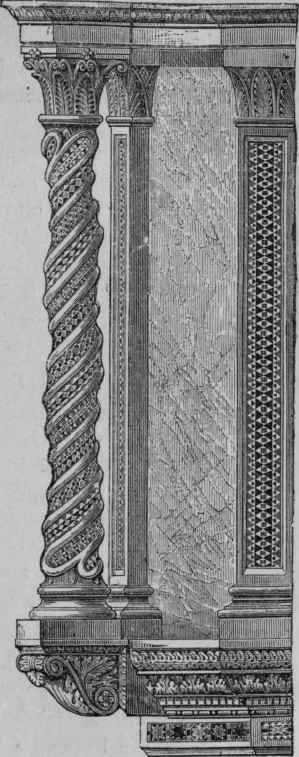
Fig. 70. - Inlaid pillar, in the church of Ara Cceli, at Rome.
A large mirror (pace all Empire-Annites) always looks well above the fire, if the shelf be low, as a window does; and is convenient there, because one can look at oneself and warm one's feet simultaneously; but unless the frame of the glass is truly a work of art it ought to be unnoticeable, and in the latter case it is far better treated as a panel and built into the wall, than laid against it. I incline to think the mirror-frame ought to be of similar material to the mantel-piece and apparently part of it. A bevelled mirror usually looks handsomer than a plain one.
Whilst searching for ideas for a very poor fire-place of my own I vainly overhauled the many manuals of good advice now daily pouring from the press - among them 'House Decoration' in the Art at Home series - a series, by the way, which, considering how good was the primal notion, has been ill-carried out by the writers, and is meagre in suggestions to a miracle. Not a hint for the real beautifying of stoves, nor of the house inside or out, was to be found, save the time worn command to destroy the mirrors and have 'Queen Anne' fenders; and the illustrations, which are peculiarly American in character, better suited the articles in 'Scribner's Illustrated Monthly,' where they first appeared, than the English series, which they probably fettered.
Why will not those who set up to be teachers teach the hungry public something? Why have we no industrious Le Pautre to give us designs which, bad or good, are at least novel for furniture so conspicuous and necessary as the fire-place? Panels of terra-cotta in relief, like Luca della Robbia's, set in dainty oaken mouldings, and divided by pilasters of carved ebony, might be suggested, nay, actually tried; jambs fitted with drawers set with plaques of marble or contrasting wood, or incised metal, might support a superstructure as rich as Giovanni da Nola's work, enclosing pictures, or something less common than blue tea-cups and plates; or tiles home-painted in designs more worthy than seventeenth-century nursery rhymes, illustrated by incorrect fourteenth-century figures, or mottoes better than the senseless 'Ye Pusse inne Bootes,' etc, and set in a framework of bronze - a metal honestly indigenous, and associated with Britain ever since the Phoenicians traded in the mineral ores from Cornwall and Devon a thousand years before Christ.
Ideas come freely as we call them, but money and energy are required to bring them to life. There are infinite possibilities beyond the foolish parallelogram of flat or machine-bevelled marble - and why marble? - a material too conspicuous to be admitted without being 'carried out' by other objects of similar marble. There are possibilities even beyond the solid, often handsome, Georgian wooden mantel-pieces, carved deep for shadow's sake, which gradually deteriorated as Gibbons's school died exhausted, and no other school of art succeeded it. It would be no thankless effort now if some of our Royal Academicians could bring themselves to design fire-places of metal, wood, slate, and terra-cotta which might become 'standard,' and bring grist to the mill as the public found good patterns within reach. Nothing so disfigures a room as a meagre, mean little fire-place - a mantel-piece of marble six inches broad, or black composition polished like the mirror of some infernal goddess.
But, being condemned to some such erection in a leasehold house, let none fear that a fine looking glass is out of place or cannot be well placed where people are most likely to use it. Ability onght to be able to make good use of so fine a potential ornament. Let the clock, too, inhabit the same conspicuous place - it is a nuisance not to know where to seek the time of day - but the clock must deserve its position. Some very fine old Louis XV. and Louis XVI. clocks, brass or gilt, may still be picked up at sales, representing figures of Time, or Phaeton with his horses, or Minerva helmed, all modelled in good, nervous style, very different from the boneless inanities which simper and lollop in clock-shops. A few fine pieces of bronze, china, or damascened work are suited on the mantel-shelf, which may be required for empty tea-cups, etc, and should therefore offer a cranny or two within easy reach, even if the main shelf is high. I wonder that green or streaky slate is not oftener used for mantel-pieces; it is not dear, and would look well in a highly-coloured room.
The ordinary white marble mantel-piece is, as I have said, a most disagreeable object. Not because it is of white marble, but because the machine-carving is disgracefully coarse and inconsistent, and the material, which is very conspicuous, is not carried out by marble anywhere else. Inoffensive plainness is a shade better than offensive ornament: either can be concealed by a covering of embroidery, or velvet, stiff enough not to droop, and stretched flat so as to admit of brushing. Festooned velvet is always dirty, and not fit to be touched; lace, in my opinion, is unsuitable as aforesaid, because it looks like dress-leavings, muslin most absurd of all. The sides of an ugly mantel-piece may be hidden by old bullion embroideries secured on thin wood with very good effect.
I make these suggestions for those who, having their house on lease, do not choose to make the landlord a present of a new mantel-piece. For those who do, I suggest carrying the marble jambs up the wall to enclose the looking-glass.
Continue to:


My Books

