


Spanish Metal Work
Description
This section is from the "Historic Ornament - Treatise On Decorative Art And Architectural Ornament" book, by James Ward. Also see Amazon: Historic Ornament - Treatise On Decorative Art And Architectural Ornament.
Spanish Metal Work
During the Arab rule in Spain metal work was an important branch of the Moorish arts. The Arab rulers had in their train many accomplished Eastern artists in metal work, and such objects as caskets, jewellery, bracelets, rings, sword and dagger handles, and scabbards.
The Moorish Caskets
The Moorish Caskets are often made of wood, covered with silver or gold plates, the ornamentation being similar to that of the ivory carvings. The Arab or Saracenic metal work of Spain is executed in repouss*š, or is chiselled niello work, filigree, or enamelled, and the ornament is usually mixed with the Arab laudatory inscriptions.
The treasure found at Guarrazar, already noticed, shows something of the early metal work of the Spanish Visigoths.
Moorish Arms
Moorish Arms, such as sword sheaths and hilts, are very artistic, as may be seen in the illustration of the sword of Boabdil (Fig, 143), the last of the Moorish kings. The hilt of this sword is made of solid gold, and is enamelled in blue, white, and red. The axle is made of ivory, and is elaborately carved.
Triptychs, Altars, Processional Crosses, And Other Church Furniture
Triptychs, Altars, Processional Crosses, And Other Church Furniture were made in Spain in the thirteenth and fourteenth centuries, of Gothic design.
In the fifteenth century there was an astonishing quantity of silversmiths' work produced. This was owing to the discovery of America and the consequent power and wealth of. Spain at this time. The silver throne of the King Don Martin de Aragon belongs to this period, which still exists in the Cathedral of Barcelona. It is covered with a chased ornamentation in the metal work, and has rich embroidered work of gold and precious stones. Many silversmiths came from Italy, Germany, Holland, and France at this period and settled in Spain owing to the great demand for their services. Ria¤o gives the names of Enrique de Arphe, Jacome Trezzo, Mateo Aleman, Hans Belta, and others who were employed at this time, besides many Spanish goldsmiths.
A special feature of church furniture of this period in Spain was the Monstrance, or Custodia, an object of architectural design made in gold, silver, or bronze-gilt metals, which has a central part - the lumule or viril - generally made of rock-crystal, in which the sacrament was exposed; sometimes a sun with rays is represented on the monstrance, and usually it is surmounted by a cross in gold and set with jewels (Fig. 144). The designs are in the Renaissance and sometimes in the Gothic style, and they are often eight feet in height. Some of them are carried in procession on Corpus Christi Days. Many works in gold and silver are in Spain that have been made in Mexico, but of Spanish design, in which forms of American flora and fauna are worked into the designs.
A Spanish Chalice Of Gothic
A Spanish Chalice Of Gothic outlines with some Renaissance details is shown at Fig. 145. A beautiful pax of Renaissance design in the Kensington Museum is shown at Fig. 146.
The pendant jewel of the seventeenth century shows the beginnings of the decadence in design (Fig. 147), and the silver dish (Fig. 148), though very rich in effect, is a pronounced step in the direction of unrestrained space-covering that characterizes the design of the late seventeenth century in Spain as well as in other European countries.
Bronze-Casting
Bronze-Casting was practised in Spain by the Moors as well as the Spanish themselves. The Moorish hanging lamp (Fig. 149) is a beautiful specimen of bronze-working in pierced open-work. It bears the date of the Hegira, 705 (A.D. 1305). Important works in bronze of the Renaissance period, such as candelabra, monstrances, etc, are still preserved in many of the churches.
From the earliest historic times Spain has been celebrated for the excellent quality of its iron and steel arms and armour. The Romans patronised the Spanish armourers extensively for their swords and other arms after the Carthaginian War. The best swords were made at Bilbilis or Calatayud in Aragon, and were short and wide, with double edges - about 15 to 19 inches in length. A sickle-shaped sword was also made 22 inches in length.
Toledo Blades
Toledo Blades were proverbial for their excellent tempering, and were famous as early as the days of the Romans. Seville was also noted for the excellence of its steel blades, and the Arabs, as we have seen, were highly skilled in metal working, and especially in the making of all kinds of arms and armour, including its ornamentation.
The celebrated sword of Boabdil had a Toledo blade, and including the hilt was 39 inches in length.
The Spanish warriors of the eleventh century had dresses, arms, and armour not unlike the Normans, as represented on the Bayeux Tapestry, which were in imitation of or borrowed from the military habits of the Saracens. The sword manufactory at Toledo was in its most flourishing state during the fifteenth and sixteenth centuries; it was re-established in the last century, and is in existence at the present day.
Two rapiers of the sixteenth and seventeenth centuries are represented at Fig. 150.
Muskets, crossbows, saddles, coats of mail, knives, scissors, and many other objects in steel have been made in Spain from the earliest periods, and many Spanish goods in manufactured steel even at the present day still preserve the Moorish forms.
Fig. 143. Sword of Boabdil, Madrid. (R).
Fig. 144. Spanish Monstrance, 1537. (S.K.M).
Fig. 145. Spanish Chalice. (R).
Fig. 146. Spanish Pax. (R).
Fig. 147. Spanish Jewel; Seventeenth Century. (R).
Fig. 148. Spanish Silver Dish; Seventeenth Century. (R).
Fig. 149. Moorish Lamp, Bronze; Fourteenth Century. (R).
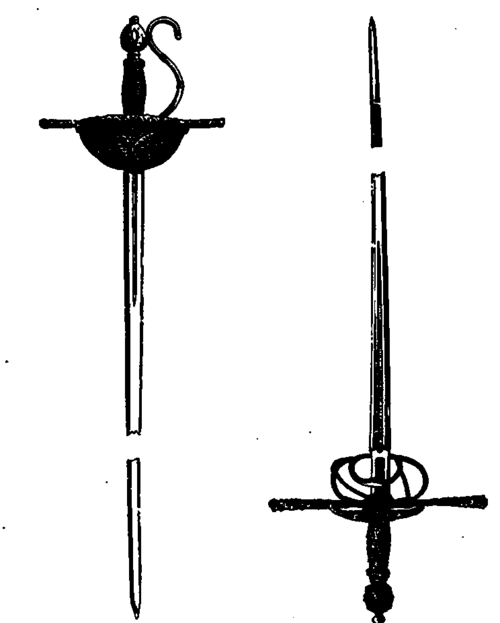
Fig. 150. Spanish Rapiers. (S. K. M).
Continue to:


My Books

