


The Library, Smoking-Room, And Den. Continued
Description
This section is from the book "The Decoration Of Houses", by Edith Wharton, Ogden Codman Jr. Also available from Amazon: The Decoration of Houses.
The Library, Smoking-Room, And Den. Continued
When there are books enough, it is best to use them as part of the decorative treatment of the walls, panelling any intervening spaces in a severe and dignified style; otherwise movable bookcases may be placed against the more important wall-spaces, the walls being decorated with wooden panelling or with mouldings and stucco ornaments; but in this case composition and color-scheme must be so subdued as to throw the bookcases and their contents into marked relief. It does not follow that because books are the chief feature of the library, other ornaments should be excluded; but they should be used with discrimination, and so chosen as to harmonize with the spirit of the room. Nowhere is the modern litter of knick-knacks and photographs more inappropriate than in the library. The tables should be large, substantial, and clear of everything but lamps, books and papers - one table at least being given over to the filing of books and newspapers. The library writing-table is seldom large enough, or sufficiently free from odds and ends in the shape of photograph-frames, silver boxes, and flower-vases, to give free play to the elbows.
A large solid table of the kind called bureau-ministre (see the table in Plate XLVII) is well adapted to the library; and in front of it should stand a comfortable writing-chair such as that represented in Plate XL1X.

PLATE XLVII. LIBRARY OF LOUIS XVI, PALACE OF VERSAILLES.
(LOUIS XV WRITING-TABLE WITH BUST).
The housing of a great private library is one of the most interesting problems of interior architecture. Such a room, combining monumental dimensions with the rich color-values and impressive effect produced by tiers of fine bindings, affords unequalled opportunity for the exercise of the architect's skill. The two-storied room with gallery and stairs and domed or vaulted ceiling is the finest setting for a great collection. Space may of course be gained by means of a series of bookcases projecting into the room and forming deep bays along each of the walls; but this arrangement is seldom necessary save in a public library, and however skilfully handled must necessarily diminish the architectural effect of the room. In America the great private library is still so much a thing of the future that its treatment need not be discussed in detail. Few of the large houses lately built in the United States contain a library in the serious meaning of the term; but it is to be hoped that the next generation of architects will have wider opportunities in this direction.
The smoking-room proper, with its mise en scene of Turkish divans, narghilehs, brass coffee-trays, and other Oriental properties, is no longer considered a necessity in the modern house; and the room which would formerly have been used for this special purpose now comes rather under the head of the master's lounging-room, or "den" - since the latter word seems to have attained the dignity of a technical term.
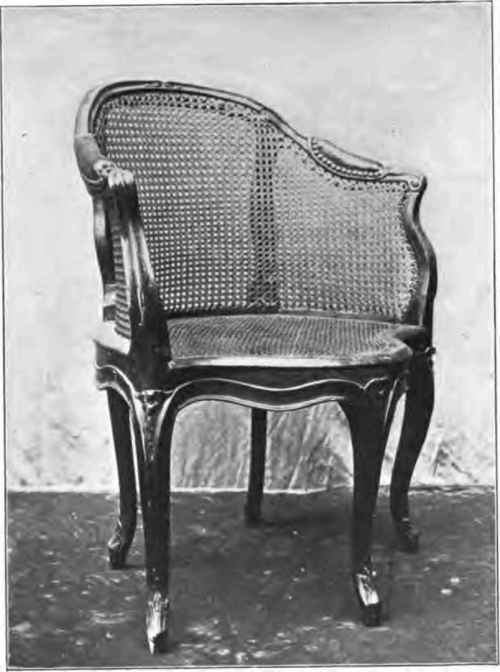
PLATE XLIX. WRITING-CHAIR, LOUIS XV PERIOD.
Whatever extravagances the upholsterer may have committed in other parts of the house, it is usually conceded that common sense should regulate the furnishing of the den. Fragile chairs, lace-petticoat lamp-shades and irrelevant bric-a-brac are consequently excluded; and the master's sense of comfort often expresses itself in a set of "office" furniture - a roller-top desk, a revolving chair, and others of the puffy type already described as the accepted model of a luxurious seat Thus freed from the superfluous, the den is likely to be the most comfortable room in the house; and the natural inference is that a room, in order to be comfortable, must be ugly. One can picture the derision of the man who is told that he might, without the smallest sacrifice of comfort or convenience, transact his business at a Louis XVI writ-ing-table, seated in a Louis XVI chair! - yet the handsomest desks of the last century - the fine old bureaux & la Kaunitz or a cylin-dre - were the prototypes of the modern "roller-top"; and the cane or leather-seated writing-chair, with rounded back and five slim strong legs, was far more comfortable than the amorphous revolving seat Convenience was not sacrificed to beauty in either desk or chair; but both the old pieces, being designed by skilled cabinet-makers, were as decorative as they were useful.
There seems, in fact, no reason why the modern den should not resemble the financiers' bureaux seen in so many old prints: rooms of dignified plainness, but where each line of wall-panelling and furniture was as carefully studied and intelligently adapted to its ends as though intended for a drawing-room or boudoir.
Reference has been made to the way in which, even in small houses, a room may be sacrificed to a supposed "effect," or to some inherited tradition as to its former use. Thus the family drawing-room is too often made uninhabitable from some vague feeling that a " drawing-room " is not worthy of its name unless too fine to sit in; while the small front room on the ground floor - in the average American house the only corner given over to the master - is thrown into the hall, either that the house may appear larger and handsomer, or from sheer inability to make so small a room habitable.
There is no reason why even a ten-by-twelve or an eight-by-fourteen foot room should not be made comfortable; and the following suggestions are intended to indicate the lines on which an appropriate scheme of decoration might be carried out.
In most town houses the small room down-stairs is built with an opening in the longitudinal wall, close to the front door, while there is usually another entrance at the back of the room, facing the window; one at least of these openings being, as a rule, of exaggerated width. In such cases the door in the side of the room should be walled up: this gives privacy and provides enough additional wall-space for a good-sized piece of furniture.
The best way of obtaining an effect of size is to panel the walls by means of clear-cut architectural mouldings : a few strong vertical lines will give dignity to the room and height to the ceiling. The walls should be free from pattern and light in color, since dark walls necessitate much artificial light, and have the disadvantage of making a room look small.
The ceiling, if not plain, must be ornamented with the lightest tracery, and supported by a cornice correspondingly simple in design. Heavy ceiling-mouldings are obviously out of place in a small room, and a plain expanse of plaster is always preferable to misapplied ornament.
A single curtain made of some flexible material, such as corduroy or thin unlined damask, and so hung that it may be readily drawn back during the day, is sufficient for the window; while in a corner near this window may be placed an easy-chair and a small solidly made table, large enough to hold a lamp- and a book or two.
These rooms, in some recently built town houses, contain chimneys set in an angle of the wall: a misplaced attempt at quaint-ness, making it inconvenient to sit near the hearth, and seriously interfering with the general arrangement of the room. When the chimney occupies the centre of the longitudinal wall there is space, even in a very narrow room, for a group of chairs about the fireplace - provided, as we are now supposing, the opening in the parallel wall has been closed. A bookcase or some other high piece of furniture may be placed on each side of the mantel, and there will be space opposite for a sofa and a good-sized writing-table. If the pieces of furniture chosen are in scale with the dimensions of the room, and are placed against 'the wall, instead of being set sideways, with the usual easel or palm-tree behind them, it is surprising to see how much a small room may contain without appearing to be overcrowded.

PLATE L. DINING-ROOM, PALACE OF COMPIEGNE. LOUIS XVI PERIOD. (over-doors and over-mantel painted in grisaille, by sauvage).
Continue to:


My Books

