


Chapter II. Actual Furnishing Of The Most Inexpensive Character
Description
This section is from the book "The Practical Book Of Furnishing The Small House And Apartment", by Edward Stratton Holloway. Also available from Amazon: The Practical Book Of Furnishing The Small House & Apartment.
Chapter II. Actual Furnishing Of The Most Inexpensive Character
The Hall
AT the very entrance we find a marked difference between the small house and the apartment. No furnishing can be satisfactory without an entire realisation of the purpose for which a room is used, and in these two sorts of abode the Hall plays a very different part.
In the house of moderate dimensions the usual hall is architecturally and practically but a public entrance and passage to the rooms beyond and to the stairway. Particularly in the city, the doorbell is continually rung by promiscuous people. In the modern apartment, on the contrary, packages and messages are taken in at the office or by the elevator attendant, the names of callers arc telephoned up in advance. Where there is janitor-service only the conveniences arc fewer, but even then privacy is almost complete, and the hall, while retaining its use as a passage, becomes very like the other rooms, and may be treated nearly as intimately.
In any case the hall is an index to the premises, and it will not fulfil that office if it be either distinctly handsomer or meaner than the remainder or if it be incongruous with it.
The furniture for the hall of the small house should, because of its purpose, be very practical - an umbrella stand, a hat-table and two chairs, with the addition of a few other pieces, such as a bench, cupboard or chest, if there be sufficient room. If the telephone be here a stand and chair will be convenient. The side-table on Plate 14 or the long Davenport table on Plate 17, accompanied by mirror, umbrella-stand and chairs of appropriate design from the same stock would be excellent. Telephone-sets and benches are also supplied therein; and indeed a whole house may be furnished from this stock if desired. If the floor is in good condition, either a runner or small rugs may be used; if it is not, then the tiled or Jaspé linoleum, mentioned in Part IV, are worth considering.
And now for some colour. For it is colour that gives distinction to such interiors. And it is to be remembered that in beginning with the hall we are also beginning the furnishing of two other rooms at least - the living-room and dining-room - which open from it. Particularly if there are guests, one scarcely cares to have a messenger-boy, for instance, waiting in the hall, gaping in upon them; and therefore door-hangings are required. These may of course be double, showing a different colour upon each side, but this is needless. Alternatives of colour arrangement for the entire house will be provided, the triad plan described in the section on colour-schemes being adopted.
The wonderful array of textiles now available both in Europe and America would have made our forefathers sigh with envy. It however, occurred to the writer that where prices must be low it might not be so easy to secure good colourings as where the latitude is greater, and that this would be the case with stripes particularly. In order to be sure that any colour-scheme suggested here could be carried out by the householder without difficulty, the writer looked into the supply in his own city, and usually found a fair assortment of inexpensive goods in the large stores.
He furthermore finds all that is necessary for this furnishing in the well known "Colony" and "Canterbury" lines (Marshall Field & Company, Distributors, Chicago and New York) so that anything needed may easily be ordered by dealers in case they do not happen to have it in stock. It is absolutely necessary that the writer should be specific in the first furnishing described, for it is not only the choice of colours which is essential but the degree of intensity and the tones of these colours. Those mentioned here are of middle intensity - neither too bright nor too dull.
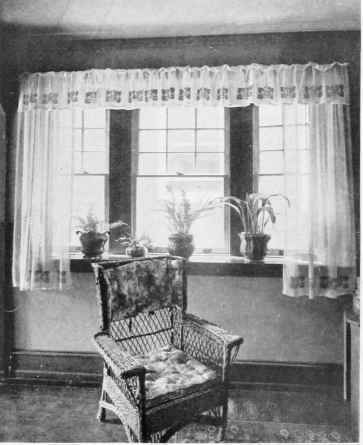
PLATE 35. ARRANGEMENT OF THIN CURTAINS WITH VALANCE.
Curtains of below-the-sill length do not readily blow out of the opened window and do not shrink too short.
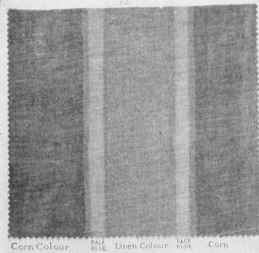
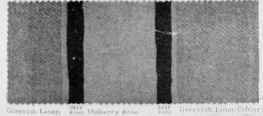
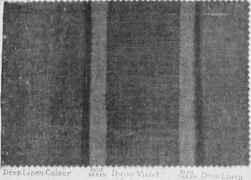
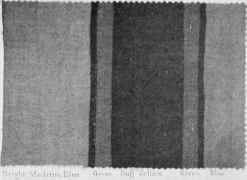
PLATE 36. COLONIAL ELWOOD CHINTZ DUO-STRIPE, NO. 92262.
About one-third actual size.
Marshall Field & Co., Distributors, Chicago and New York.
There are also very desirable denims, casement-cloths and sun-fast materials of many manufactures in the various shops. The solid-colour denims with small designs in the weave make excellent coverings for the seats of chairs and settees. It is a mistake to suppose that nothing can be attractive unless it is expensive. Such materials as those mentioned here are decidedly smart and tasteful when the right colourings are chosen. We shall begin with the triad of modified yellow, red, and blue.
It is to be understood that these details are suggestive and not obligatory in any way. It is necessary to be concrete in order to explain the plan in full; when that is understood it will be realised that changes in details may easily be made.
Blue is a good general colour for hangings, and a heavy ribbed rep is one of the best materials in this scale of furnishing. (Such a rep in a medium shade of blue, not too bright, and darkish rather than light, 45 inches wide, is found among the "Canterbury" fabrics No. 1708).
For windows there is nothing more charming throughout the whole small house than ruffled white muslin curtains. These are bought ready made, and so are also most convenient. They are of good length, and when the windows are short the pieces cut from the top may be made into valances. Plate 35 shows the proper arrangement of thin curtains. If heavy inside curtains are also to be used these should usually be of the same rep as the door-hangings.
Ready-made floss cushions are also to be bought in various sizes. Obtain these for the chairs and cover them with the striped covering shown in Plate 36 lower left. This is of a greenish linen shade with bold stripe of mulberry-rose edged with deeper shade of the same. The three colours are already established. If there is a bench a long cushion may be made and covered with a solid colour mulberry-rose rep with the stripe just mentioned (there is a mulberry-rose rep in the same line as the blue.) But if the bench is placed at the window and blue curtains are there used then the bench-cushion should be blue.
The wall of a narrow hallway is subject to considerable wear; so, if desired, it may be given a dado of warm grey, darker than the wall and three-eighths of the wall height, of either paint or paper according to the existing surface, and this banded broadly at the top with black.
If a further decorative touch be desired a small hanging may be placed back of the mirror over the table. There is a "Colony Furniture Covering" No. 1697, in quiet dark blue and tan in a very good design, and another in two shades of soft brownish fawn. The furniture might be in the fumed oak or one of the dark shades.
The alternative triad is violet, blue-green and orange, or approximate tones of these. The striped goods at upper right on Plate 36 has a ground of deep linen colour with broad stripe of dusky violet and inside edging of blue-green. This may be used for the chairs and bench. The door hangings might be a combination, and in the "Colony Furniture Coverings" referred to just above there is one of brownish violet and grey which goes beautifully with the stripe.
A quaint formality may be given such a hall by a couple of stiff little bay-trees in painted pots or square boxes. In the first scheme pure white with band at top and bottom of deep rose will contrast with the green of the trees. In the second, white and bright orange.
With the abundant plain surface of a quiet, light, warm grey wall the striped materials will not be found to give so bright an effect as might be supposed, but if one's taste is very quiet then solid colour goods may be substituted for the stripes. These, however, give much distinction and very little of this material has been prescribed; so that their use should by no means lightly be foregone.
In apartments the same colourings may apply, but the furniture and furnishings may be very different and much more intimate. There should be the usual table and chairs on which callers may lay hats and outer garments. Instead of a stiff bench a settee with cushions may find its place; bookcases and highboys, cabinets, and the like are quite in order. In the former hall the usual light is perhaps a hanging lantern or bulb-fixture covered with silk; here an attractive lamp upon a small table will be excellent. Pottery, plaques, candlesticks, and a very few good pictures add the decorative touch.
The architectural hat-and-clothes rack is a thing of the past in any hall, but if possible there should be some facility provided for heavy wraps. In the house there is usually a closet or recess under the stairway and the latter should be curtained. Apartments are very various in their arrangement and so there is no rule. Sometimes such garments may necessarily have to be taken into the bedrooms, but frequently there is some sort of out-of-sight corner or recess which may be curtained off, or where one of those small affairs of hanging framed mirror with a few hooks may be placed without disturbance.
Continue to:


My Books

