


Chapter III. Modern Furnishing Of Broader Scope And Somewhat Greater Expense
Description
This section is from the book "The Practical Book Of Furnishing The Small House And Apartment", by Edward Stratton Holloway. Also available from Amazon: The Practical Book Of Furnishing The Small House & Apartment.
Chapter III. Modern Furnishing Of Broader Scope And Somewhat Greater Expense
WE may now procede to use the facilities so far considered - or rather some of them; for enough has now been mentioned in the way of varied wall-treatments, textiles, furniture and colourings to furnish a large number of homes or apartments.
Reception-Living-Room
We will begin here as the key to the rest of the premises, making several suggestions to meet various necessities.
These two purposes may be combined in the one room; or the reception-room used as the more formal room, and treated as will be mentioned, and another selected as a combined living- and sewing-room. The latter would then contain some wooden furniture and some wicker, with chintz or printed linen for the wicker and plain colouring for the wooden seating-furniture. Comfort should particularly be considered here but the room may be made charming and bright as well.
In either case for the reception-room we may use some such furniture as the upholstered pieces in Plate 60 or those of walnut of Dutch origin pictured in Plate 125. Upholstered furniture is generally sold in denim, the handsomer covering and the labour of putting on being extra. Furniture manufacturers of the best class are in close touch with the distributors of fine fabrics and naturally take much interest in the coverings that are to accompany their product. Or, the pieces may be bought in denim and the householder make his own purchases of textiles, having the upholstering done by his usual local man.
In the case of the three lower pieces on Plate 125 the covering shown is a fine English linen with black ground, rose and cream hawthorne blossoms, and rose piping on all seams. Nothing could well be more charming. The manufacturers also use on these pieces cretonne or chintz, small-figured or plain silk or taffeta, or glazed English chintz. All are appropriate. For this scheme the first would be very attractive; or, if a chintz is chosen, then one which contains blue and some shade of modified red. It would be almost sure to have also some green and tan in the foliage.
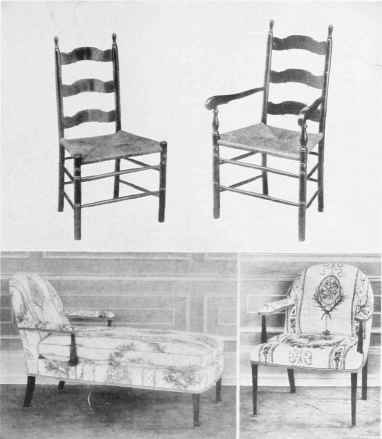
PLATE 60. EARLY COLONIAL SIDE AND ARM CHAIRS IN MAHOGANY.
WALNUT CHAISE LONGUE AND ARM CHAIR, EARLY COLONIAL MOTIF.
This style is sometimes called Pilgrim Furniture.
Dutch origin Side Chair, Height 39 in., Width 21 in. Arm Chair, Height 35 in., Width 22 in.
Down Cushions Chaise Longue, Height 35 in., Length 60 in., Chair, Height 31 1/2 in., Width 25 in.
Manufactured by Century Furniture Co., Grand Rapids, Mich.
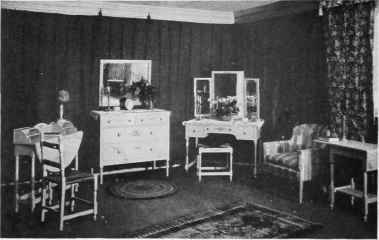
PLATE 61. "TYROL" BEDROOM SET.

>PLATE 61. "SPANISH PEASANT" BEDROOM SET.
Made and Sold by Erskine-Danforth Corporation, New York.
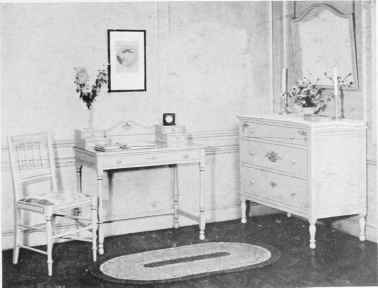
PLATE 62. "CARLTON" BEDROOM SET.
Made and Sold by Erskine-Danforth Corporation. New York City.
As there would already be a sufficiency of pattern in either of the above, the arch-back chairs and wing-chair in Plate 112 should if used be in plain colour - in the first instance a rose velour that would properly accompany the rose of the hawthorne linen. Pursuing this keynote we may employ solid black rugs, carrying out the background of the linen. These black rugs are very smart.
In any case, the wall-treatment suggested for the entire premises is, this time, a straw-colour; and for this room let it have ivory white woodwork and perfectly plain ivory white panels like those in Plate 71 with a wide band of the same to mark off a dado, the latter being of the plain straw-colour. This may be either in paint or paper, preferably the former. If the reader does not care to "go in for" even so simple a treatment, the walls may be papered a perfectly plain straw-colour, or a straw and ivory white perpendicular stripe of fair width - say two inches. As we have an abundance of rose, the hangings at doors and windows would better be of quiet old blue damask or velour. The lamp shade may be of champagne silk with black edging (see that in Plate 2) or of parchment with rose, dull blue, and black, or rose and green decoration - this being very simple and conventional, so as not to conflict with the strong pattern of the hawthorne design. If chintz with blue and any modified red is employed then the other chairs may be in solid blue and the hangings of a quiet old gold. Black rugs would still be excellent - or a warm dark shade of taupe. With either furnishing use brass candlesticks, cream candles and creamy yellow pottery.
Another scheme, totally different in every respect expect the walls, will now be provided for the second triad.
Turning back to Plate 14 the simple furniture there shown may be made handsome by appropriate treatment. It may be stained "silver grey", which, as mentioned, is notwithstanding the term, in these stains warm in tone. On this may be used the Chase Mohair Velvet of a background shading from quiet orange to a lighter and yellower tone and with a broad black stripe (Plate 55). An alternative is burnt-orange or copper-colour in the same goods. With either use cushions of plum-coloured velour and the same for hangings. Let the rugs be of sage green and use several copper bowls as accessories. If not readily obtainable, then orange pottery, candlesticks with cream-coloured candles and an orange bowl filled with natural or artificial nasturtiums. This will make a decidedly rich and unusual room for the reception of one's guests.
The Hall
The hall being the entrance to the room above considered as the keynote, it should partake of the characteristics of whichever scheme is selected. The hangings suggested will in each case provide one of the colourings and the others accompanying them should be added in the remaining furnishings and accessories. The procedure was shown in the first hall described in inexpensive furnishing.
Continue to:


My Books

