


Oak Or Mahogany?
Description
This section is from the book "The Practical Book Of Furnishing The Small House And Apartment", by Edward Stratton Holloway. Also available from Amazon: The Practical Book Of Furnishing The Small House & Apartment.
Oak Or Mahogany?
Let us assume that the householder has read the Introduction to this volume, discussing the uses of both the Modern and the Liberal Period methods of furnishing and, having considered their relative advantages, has decided that for his own purposes he prefers the latter mode. Having arrived at this point he frequently, however, makes use of some expression resembling the following: - "We do not know whether we want oak or mahogany furniture or whether we want both".
Now it so happens that, without his being aware of it, these few words open up the whole field of such furnishing not only the furniture itself, but the walls, woodwork, floors, textiles of every kind, and accessories to be employed; yes, sometimes even the sort of house he is to live in. And he must be given the information which will enable him to decide the question to his own best, permanent satisfaction - for he may have oak furniture or he may have mahogany, but he certainly should not have both.
In a studio, or in elaborate premises where is employed antique furniture, toned in colour and especially in finish by the touch of time, both the effect of space and the patina of age unite the two to a degree admitting the association, particularly when aided by a judicious choice of wall-surfaces and textiles. This is also true of handsome modern furniture which has been treated as "of its period", but in small premises and with the usual commercial finish, oak and mahogany are too diverse in themselves and in the settings they demand to be used together.
As will have been seen, the writer is in no sense a purist, but we should not be blind to intrinsic differences, and this point of view has not been overlooked by the alert Manchester Guardian, which, writing of the "American outlook on Old-World belongings", remarked: "Over there they see our furniture as objects of art and craftsmanship in themselves, apart from history and associations. They can note a baroque or neo-classic influence running from country to country in a way we do not often realise. They see affinities and repulsions of which we are not actively aware".
But, the attitude of many a householder is: "I care nothing about period and that sort of thing. I like a certain kind of furniture because it suits me; not because it represents something that I know or care nothing about. What I wish is an appropriate home without any nonsense." Quite so! Of course it might be intimated that when men now dead gave the efforts of a lifetime to the designing and making of beautiful things and the best way to use them, thus saving us an infinite deal of time and trouble, it might be rather decent at least to glance at their point of view; but all that, nowadays, is labelled with the dread word Archce-ology, and, "anyhow", our generation is not noted for respect either for our forbears or their works, and prefers to "dig it all out for itself." Very well, then, let us dig.
Is there any other word in the language which so implies sturdiness as the word oak! Commercial oak furniture is not so heavy as that of yore - "the economies of mass-production" have seen to that - but it is good and solid. It is an open grained, shall we say big-hearted, sort of wood; it is not capable of small things or of "frills". It may not have the extreme refinement of some of its neighbours, but it is thorough-going, straightforward, sterling, and mightily worthy of honour.
Such is the wood and the furniture intelligently constructed from it. Nothing is viler and more intrinsically oppos-ed to the character of the material than a golden colour and hard, varnished surface. Such furniture is the bête noire of the decorator or the house-furnisher. It should be fumed or in darker shades, and of soft, dull, wax-like finish.
What is the appropriate covering for such furniture and what goods should be used as curtains in the rooms containing it? Certainly not the smooth, thin silks, damasks in small, fine designs, and the like. Velvets, plain or cut, or the excellent modern mohair-velvet, heavy brocatelles and brocades, are plainly indicated. There are excellent brocades made now-a-days at moderate figures in linen or cotton with silk facing. Gros point and petit point embroideries were much used in earlier days and are reproduced now, but as these too are expensive, a well-designed tapestry in good colourings or the Mohair Super-tapestry may admirably supply their place. When patterned materials are chosen the designs need not be large and splurging but they should not be "niggling". Weight and good texture naturally go with such furniture.
It is not in most cases possible to introduce panelling in the usual small house or the rented apartment, but there is always woodwork, and perhaps this is accompanied by such built-in features as window-seats, book-cases, china-closets or dressers. Everyday common-sense would indicate that such woodwork be like the furniture employed with it, and not of some alien material or finish. Satin-smooth walls would hardly occur to anyone as an appropriate background - texture is required here also. Plaster or sand-finish in attractive shades of fawn or buff immediately suggest themselves. If the walls are papered, a perfectly plain effect in a heavy felt with some roughness or a surface resembling plaster should be used.
Our rooms should have cheer - plenty of good daylight! Where rather dark furniture and woodwork are employed then give us windows! A range of casements is best, and there is nothing more attractive.
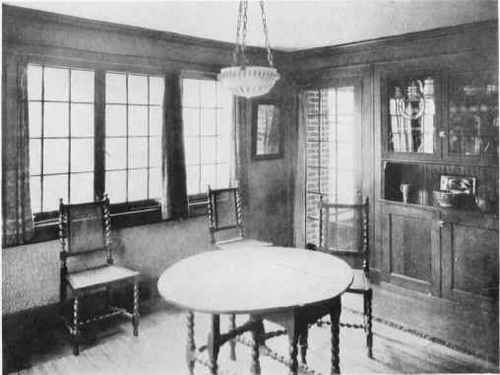
PLATE 96. A ROOM CONSISTENT WITH OAK FURNITURE.
Frank Chouteau Brown, Architect.
An excellent example of an oak room intelligently handled is shown in the illustration herewith, (Plate 96). The chair-seats and backs are cane (also appropriate) and, as there is no handsome upholstery properly to be accompanied, a rag rug is used upon the floor. Such a rug has appropriate unevenness of surface. Good heavy woolen rugs are admirable either in one tone or two tones, or plain centre with bold line border.
Continue to:


My Books

