


The Practical Use Of Renaissance Furnishing Today
Description
This section is from the book "The Practical Book Of Furnishing The Small House And Apartment", by Edward Stratton Holloway. Also available from Amazon: The Practical Book Of Furnishing The Small House & Apartment.
The Practical Use Of Renaissance Furnishing Today
THESE centuries comprise the Renaissance movement and the Baroque (pronounce Barok, not Baroak) to its end in Continental Europe and down to the homelike Dutch influence in England.
The "Revival of Learning" originated in Italy during the Fourteenth Century. All of the arts were stimulated by its influence and hence arose what is commonly known as period furnishing. By the middle of the Fifteenth Century furniture-making had reached an advanced stage of perfection. Now this Italian furnishing vastly concerns the American, or the Englishman, or the Colonial, and for several reasons. It was first in point of time: it eventually affected all civilised Europe, so that without it the furnishing of Great Britain, France, or Spain would not have been what it became: it is a living style, one of the leading modes to-day. In America, Italian furniture is also extensively used in connexion with that of England in the Liberal Period method we are to discuss, and, considering the appreciation of things Italian always met with in Britain, it is unfortunate that the like custom does not also to a greater degree there prevail. The use of the furniture of other nations of the same influence, grouped with its own, is specially commended to British readers as a means of securing relief to their own furnishing.
The First And Second Movements The Renaissance And Baroque
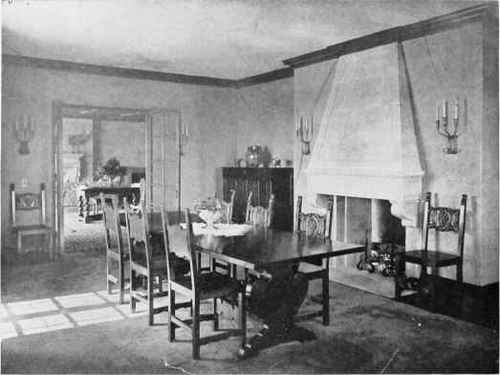
PLATE 98. A FINE MODERN RENDERING OF A SIXTEENTH CENTURY ITALIAN INTERIOR IN AN AMERICAN HOUSE.
M. B. Schmidt. Architect.

PLATE 99. AN ENGLISH RENAISSANCE HALL SHOWING APPROPRIATE PANELLING AND FU RNITURE.
Mellor, Meigs & Howe, Architects.
For Americans there is also a practical consideration of great moment. Our summer climate very much more resembles that of southern Europe than that of England: a realisation of this and the advance of concrete construction will probably stimulate the already frequent erection of Italian-American or Spanish-American houses, and these homes must be appropriately furnished.
The Renaissance
Plate 98 is an excellent example of both the interior architecture and furniture of the Italian Renaissance as employed in an American dining-room of medium size. The mantel, the dignified simplicity, and the absence of overcrowding are all typical of the mode.
The Revival of Learning was a newly awakened interest in the literature of Greece and Rome and in all that pertained to those civilisations; so that, naturally, the basis of Renaissance architecture and decoration was Classic, though much Oriental influence came through channels of trade. Straight lines and the arch therefore prevailed in the construction of furniture: the other curves mostly appear in ornament though in some contours also.
Furnishing is more than furniture. In every period that furniture was accompanied by its appropriate textiles, accessories and - first of all - by its permanent background. Many of these wall-surfaces, particularly of later times, when now adopted require the professional aid of an interior-architect or decorator. Some of them are not suitable for premises of modest dimensions, and, under modern conditions the historic wall-treatments are frequently not feasible. These matters will be discussed as we procede. In any case, however, their leading features are described, as furniture should not be used without some understanding of the spirit it represents and the surroundings appropriate to it. Details are nevertheless avoided; because, if such walls are used the decorator is familiar with them, and if they are not literally employed then a mass of particulars would prove a burden.
Waiving exceptions, then, as we shall do here, the normal wall-surface of the more strictly Renaissance period in Italy was plaster, plain or sand-finished: in France it was stone or plaster: in England small panelling of oak, square or rectangular (Plate 99) the wall being entirely so covered, or with plaster appearing above it. In the less pretentious homes and cottages, or in their less public rooms at least, the walls were quite frequently of plaster only. In Spain they were of plaster, often with a dado of tile, painted canvas, leather, or fabric. Diapered and other decorated walls were used to a considerable extent in Italy, particularly toward the latter part of the age.
If, then, the Renaissance period be chosen for modern furnishing and the basis be English, small oak panelling, either alone or with plaster above, will be the natural background if this be feasible: if, owing to circumstances to be recited later, it is not, then plaster will be appropriate, especially as it is a general Renaissance background. If, again, this is found impossible, then a paper with considerable roughness of appearance, resembling plaster, should be employed. Sand colour or pale neutral grey would be the best tone.
The main characteristic of most of these walls of the early period was simplicity; but it would be a great mistake to consider them devoid of interest, for, as we shall see, they were abundantly relieved. In small rooms they are particularly valuable as adding to the effect of space; and plain or nearly plain walls are from choice often employed by eminent decorators in schemes of otherwise considerable elaboration.
Continue to:


My Books

