


The Practical Use Of Renaissance Furnishing Today. Continued
Description
This section is from the book "The Practical Book Of Furnishing The Small House And Apartment", by Edward Stratton Holloway. Also available from Amazon: The Practical Book Of Furnishing The Small House & Apartment.
The Practical Use Of Renaissance Furnishing Today. Continued
Appropriateness allows the use of other materials evidencing the correct spirit, and so the Caen-stone of the hall in Plate 10 forms an excellent background to the Italian furniture. The antique red damask portiere here seen brings us to the subject of colour.
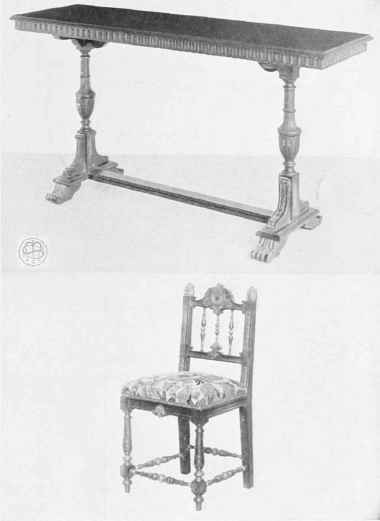
PLATE 102. LIVING-ROOM TABLE DECORATED IN GOLD AND POLYCHROME.
M. Schlesinger. Inc., Manufacturers, New York City.
Height 31 in., Length 60 in., Width 18 in. Also similar design. Height 24 in., Length 26 in., Width 16 in.
ITALIAN CHAIR IN WALNUT AND GOLD.
Height 34 in., Width 17 in., Depth 15, in.
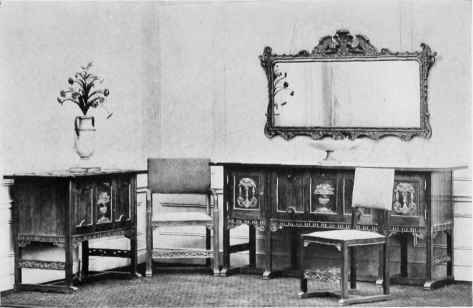
PLATE 103. "GIOVANNI" DINING-ROOM SUITE OF ITALIAN RENAISSANCE TYPE.
Manufactured by Wm. a. French Furniture Co., Minneapolis, Minn.
Bleached Walnut of soft, warm colour, band-carved and with polychrome decoration.
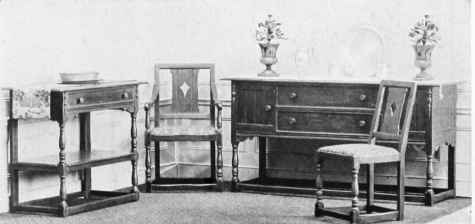
PLATE 104. "WALPOLE" DINING-ROOM SUITE IN SIMPLE JACOBEAN STYLE.
Manufactured by Wm. a. French Furniture Co., Minneapolis, Minn.
Antiqued in colour and finish to resemble Seventeenth Century Oak.
For the relieving of large, plain surfaces the hues sensibly everywhere employed were full-bodied - rich crimsons, purple, blues, and greens, very frequently with an abundance of gold galons. Plain and cut velvets, brocades, and brocatelles, often in a combination of colours, or beautiful needlework, were the coverings of the seating-furniture. Tapestries, or other handsome hangings upon the walls were typical in all countries during this period. Plate 100 illustrates a fine modern use of an Italian picture and frame upon a beautiful hanging as an overmantel decoration, with a tapestry upon the main wall-surface.
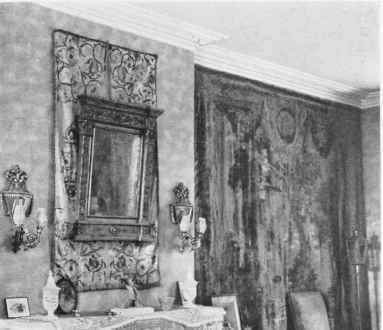
PLATE 100. AN OVERMANTEL ARRANGEMENT IN ITALIAN STYLE.
By Courtesy of George Howe, Esq.
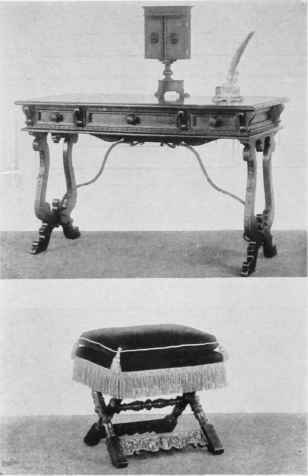
PLATE 101. FLORENTINE CINQUECENTO TABLE WALNUT.
Height 30 in., Top 48 x 24 in.
ITALIAN XVI CENTURY STOOL.
Height 20 in., Top 19 x 15 1/2 in.
Manufactured by Century Furniture Co., Grand Rapids Michigan.
It should be remembered that in early times the poor had little furniture of any kind, and that it is mainly to palaces and villas that we have to look for our information. One not informed upon the subject would be amazed at the small amount of furniture used in the mansions of England even in the days of Elizabeth; this consisting largely in handsome wall pieces such as cupboards, chests and buffets. There were refectory tables, but boards upon trestles were commonly seen. There would be a wainscot chair of heavy proportions and panelled back for the master, while others sat upon stools or benches. During the succeeding reigns comfortable furniture greatly increased in use. The beds were magnificent affairs with testers and huge bulbous posts.
In Italy furniture was likewise sparse but was of wonderful beauty. As the rooms were of immense size the furniture was correspondingly massive and heavy. The chests or cassoni were particularly notable, often being magnificently carved and frequently with the addition of polychrome and gilding. Plate 121 shows a small credence of this period with a polychrome shrine above, against rough plaster walls. All these are typical. The credenza was usually of this general form but longer, and was used as a buffet in dining-halls and as a cabinet or cupboard in other rooms. It was made both with and without drawers. The madia was another interesting piece, being a small cupboard or desk raised upon shaped flat supports at the two ends. One of the most characteristic forms of chairs was that with a base-stretcher or runner, like those in the furniture in Plate 103. The two supports of the back extended above it in carved finials, usually gilded. Another typical chair is shown in Plate 102. There were of course many variations in these forms, some being very ornamental and others plain. The tables with legs often had the stretchers set slightly higher up than the first example (see Plate 98). The lyre form (a classical motif) of table-end (Plate 101) was a great favourite and was used in infinite variety. Baluster bases and Pedestal (Plate 105) bases were also frequent.
Practically all of the above exist in American reproductions, though the most elaborate are necessarily expensive.
Comfortable adaptations of Italian Renaissance pieces for modern homes of moderate size are shown in Plates 101, 102, 103, and 105. There is much furniture of this type upon the market and the householder will have no difficulty in supplying his needs. Plate 103 illustrates a dining-room suite of Italian Renaissance derivation and Plates 104 and 106 two of English type. Such things as suites were of course unknown in those times, but it is only the few now-a-days who care to be archaeologically correct and for those who do not the anchronism will prove no objection. The furniture in both cases is decidedly handsome, and it will be interesting to note that the general contours of the two types closely correspond. Plate 42 shows a dining-room with furniture of a simplified type which will interest English readers as it is on sale in London.
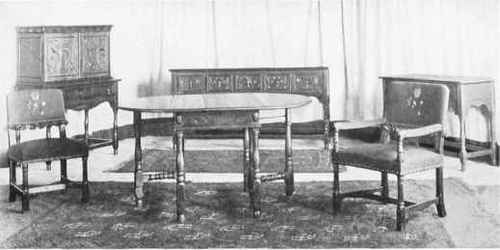
PLATE 106. JACOBEAN 10 PIECE DINING-SU1TE IN ANTIQUE BROWN WALNUT.
Manufactured by Century Furniture Co., Grand Rapids, Mich.
Sideboard 66 inches, with velvet-lined silver-drawer and long linen-drawer.
Table with 3 extra leaves, closed 42 x 54 in., extended 42 x 78 in.
2 Arm chairs and 4 Side chairs.
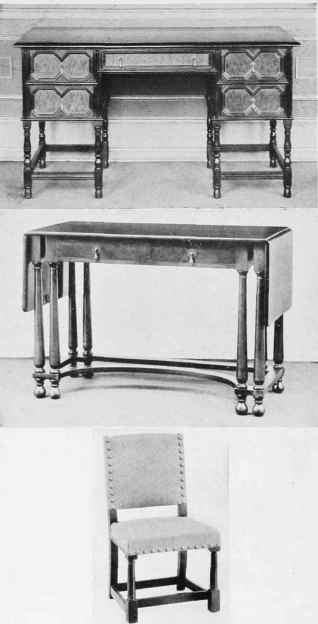
PLATE 107. LATE JACOBEAN TABLE-DESK, WALNUT.
Top 28 x 54 in., Height 31 in.
DROP-LEAF TABLE, MAHOGANY.
Top 20 x 70 in., Height 30 in.
FARTHINGALE CHAIR OF 1612. REPRODUCTION.
Height 36 in., Width 21 in. OAK OR MAHOGANY.
Manufactured by Century Furniture Co.. Grand Rapids, Mich.
Unfortunately there are practically no reproductions of French Renaissance pieces to be found among American commercial furniture. Here, too, most of them were large and formal, but smaller sizes could readily be made. Though France received its inspiration from Italy, its furniture was in no way inferior, and the fineness of proportion and ornament so characteristic of French design and workmanship in later periods was already then manifest.
The characteristics of Spanish furniture will be discussed later.
During the Sixteenth Century an increasing desire for magnificence on the part of the Italians eventually led to a decorative development which, like the Renaissance movement, in time influenced all Europe as well. Both architecture and furniture grew more ornate, ornament became exaggerated in scale, heavy, and pervasive, and the curve everywhere asserted its dominance over the straight line. This influence - especially noticeable after about 1570 - is called the Baroque.
Continue to:


My Books

