


Liberal Period Furnishing
Description
This section is from the book "The Practical Book Of Furnishing The Small House And Apartment", by Edward Stratton Holloway. Also available from Amazon: The Practical Book Of Furnishing The Small House & Apartment.
Liberal Period Furnishing
Liberal, or International-Inter period, or Catholic, furnishing consists in the use of the furniture, textiles, and accessories of various nationalities or various periods, or both, in combination. Usually some one nationality is chosen as a basis, the other pieces being introduced to give interest and variety. The background should be one appropriate to the basis chosen, or appropriate to all.
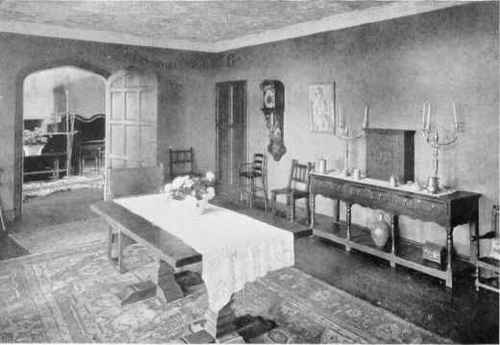
PLATE 118. LIBERAL PERIOD RENAISSANCE FURNISHING IN A COUNTRY-HOUSE AT WHITEMARSH, PENNSYLVANIA.
Cope & Stewardson, Architects.
The table is Italian, the sideboard English, and the chairs toward the corner Spanish.

PLATE 119. LIBERAL PERIOD FURNISHING EMPLOYING BAROQUE, ROCOCO, AND NEO-CLASS1C ELEMENTS.
See text.
It will be evident that very ornate and very simple, or very heavy and very light, pieces should not be commingled. A review of the American interiors illustrated here will bring out other principles to be remembered.
In many of the examples of Liberal furnishing given through this portion of the volume, it has been necessary to show large properties, where their owners or occupants have had the advice of eminent architects or decorators, or where they have individually given close study to the furnishing of their homes. The usual householder has not availed himself of the opportunities offered to anything like the degree which lies in his power.
In the Renaissance dining-room shown in Plate 118 the plain walls and ornamented ceiling afford an excellent background. The table is Italian, the sideboard English, and the chairs in the farther corner Spanish. Colour is given by the large oriental rug. A hanging might well have been employed against the wall-surface behind the sideboard. This is an exceedingly reposeful, harmonious and dignified interior.
The same qualities are apparent in Plate 9 - a hall of faultless arrangement and carefully studied light and shade. The chairs here are of a form common to both Italy and Spain.
The new Turtle Bay district of New York City has recently been described by the always alert Good Furniture Magazine, to which the writer is indebted for the four illustrations here shown. The Fifth Avenue neighbourhood is being abandoned by many cultured people in favour of these quieter sections, where more individuality may be shown, and an entire block on 48th and 49th Streets has here been remodelled, a wonderful Italian garden taking the place of the former back yards. These views are in the home of Mr. Edward Clarence Dean, he and Mr. William Lawrence Bottomley being the associated architects of this development. The rough plaster walls of the Renaissance form the background of this very cosmopolitan furnishing. In Plate 121 the credence is Italian and the chair Louis Seize. Though both periods are of Classic influence, the two do not usually well accompany each other because of the great difference in bulk and weight: in this case the credence is small and the chair large, thus well equalising matters. The agreeable composition of the lantern between the whorled ends of the curtain-supports and in connexion with the shrine below should be noted. Plate 122 gives a good idea of the colourful character of this decoration. A room of this type partakes largely of the nature of a studio: in usual practice the Louis Quinze chair and bombé chest of drawers would be too light and too late for the character and the time of the ornamental fireplace. The Spanish Renaissance and Baroque furniture in Plate 120 is entirely consistent with its background, as are also the Italian Renaissance chairs in another portion of the room not visible here. In Plate 123 the furniture is again light and late. The door and blue-tiled fireplace are excellent, and special attention is called to the very interesting arrangement of hanging-closet, shelf and sewing-table in the recess to the right. It is this sort of thing that shows the real individuality in which the private householder seems usually so deficient.
In Plate 119 we see a comfortable, generally attractive room in which styles are again commingled. The Baroque fireplace-bench and settee are here heavy for companionship with chairs and tables of the two Louis. Space is a great harmoniser of differences but even in this large room it has not proved sufficient.
Plates 120-123. Liberal Period Furnishing In The Apartment Of Edward Clarence Dean, Architect, Turtle Bay District, New York City

PLATE 120. THE DINING ROOM.
By Courtesy of Good Furniture Magazine.
The Furniture here is Spanish, elsewhere in the room Italian.
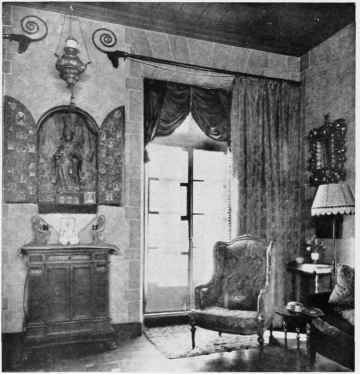
PLATE 121. THE END OF THE LIVING-ROOM.
Rough plaster walls, polychrome Italian Shrine and Credence, Louis XVI chair.
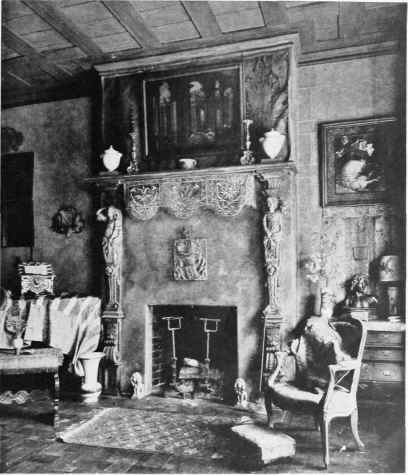
PLATE 122. THE MANTEL IN THE LIVING-ROOM.
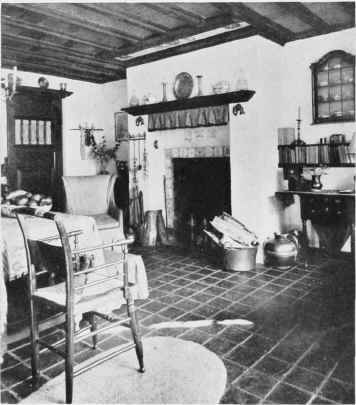
PLATE 123. TILED FIREPLACE AND FLOOR.
Note the convenient arrangement of the alcove to right.
As a general principle, then, it may be said that, notwithstanding their difterent inspiration, Renaissance and Baroque pieces usually go well together because of their likeness in size and weight: the furniture of later periods does not generally pleasantly accompany these because of their great dissimilarity in these respects as well as form.
The attention of those desiring very simple furnishing of this epoch is especially directed to the upper illustration in Plate 4. It is to the last degree cheerful, homelike, and reposeful.
Qualities And Adaptability Of The Styles
Before deciding upon the adoption of the decoration of any period, appropriateness should be considered - appropriateness to personal characteristics and manner of life as well as to the premises to be furnished and adorned. Each period possesses its own qualities, and it is unfortunate indeed when these disagree with those of the occupant. The decoration of these movements was formal and dignified and the effect of spaciousness was always preserved. It is not therefore adapted to really small rooms, though it may well be employed in apartments containing few but fairly large rooms, or in remodelled old houses where there is usually an abundance of space. Nor is the mode likely to be chosen by easy-going, amusement-loving people, or by those who with all their attainments in literature and art, prefer lightness and grace. It will delight many who desire a scholarly repose with richness and dignity of life. Its general characteristics may be observed and yet (as we have seen in Plate 4) this decoration be rendered exceedingly homelike. During the later years of the Baroque movement greater lightness in form and expression was manifest; so that William and Mary or late Seventeenth century Italian furnishings may be employed where the earlier mode would be inappropriate.
Continue to:


My Books

