


Particulars And Materials Applicable To Any Scale Of Furnishing
Description
This section is from the book "The Practical Book Of Furnishing The Small House And Apartment", by Edward Stratton Holloway. Also available from Amazon: The Practical Book Of Furnishing The Small House & Apartment.
Particulars And Materials Applicable To Any Scale Of Furnishing
THE general principles of furnishing have been most carefully elucidated and practically applied to inexpensive interiors in the previous portions of the volume. This now seems the appropriate place to expand somewhat in the direction of additional hints and the mention of materials valuable in our procedure, and, in order to avoid repetition, to include elements and suggestions applicable to all scales of furnishing.
It is to be mentioned that, owing to the many various characteristics of rooms and their occupants, only the main articles and their colourings could be provided for in Section I. As intimated, it is desirable to accompany these with objects of more neutralised tones in the subsidiary things necessary to our daily life. Stronger accents, when desired, may be introduced in the same manner.
Much aid is given in both these directions, in addition to the joy of colour which they afford, by objects and fabrics of composite hues.
It may have been noticed that in the scheme just provided cretonne found no place! That material is a valuable asset - but so woefully overworked! It was quite worth while showing that a house or apartment could be furnished without its aid and be more individual that if it had been employed. The writer does not wish to be considered as belittling cretonne and chintz; his point is that when it is used the more unusual designs and hues should be selected in order to avoid the commonplace. Nor does this mean that they must necessarily be "stunning", for many of the most beautiful are in odd, soft tones and of refined design.
The printed linens and other fabrics are often still more desirable, and the patterns are not only of the utmost variety but are very different from the cretonnes (see Plates 37A-40, 13646 and 47, and 55). All these textiles are valuable in furnishing not only for their own decorative qualities but because when properly chosen they link together the hues appearing in other fabrics. When used in any quantity they should indeed be made the keynote of the room, the materials in solid colours being purchased to agree in hue with those most prominent in the composite fabric.
Plates 37a-40. French Printed Linens

PLATE 37 A. Background of quiet bluish green, medallion black, figures, etc. in rose-red, tan, cream, and other tones.
Full width shown.
Desfosse & Karth, Paris.
A. L. Diament & Co., Philadelphia and New York.
American A cents.
Some of these linens are also made in other colourings.
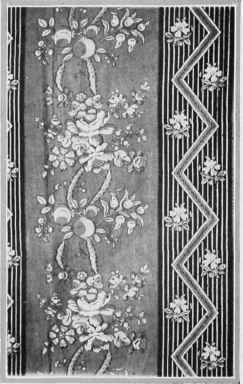
PLATE 38. Ground, strong, rich blue. Band, a black-and-white stripe with zig- zag in blue outlined in white.
About half breadth shown.
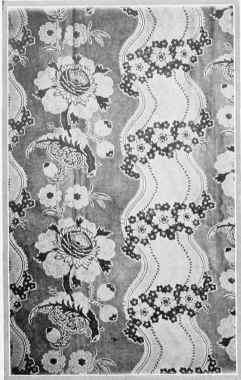
PLATE 39. Quiet rose-pink with flowers and waved band in cream, buff and brown.
Half breadth shown.
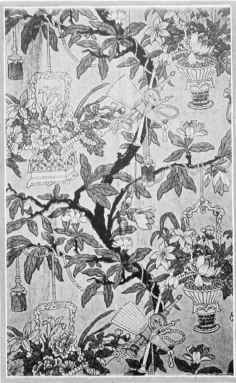
PLATE 39. A symphony in buff, tan, and yellow with branch in black and other touches of grey-blue and green.
Full breadth shown.
This method of deriving a colour-scheme from embroideries, tapestry, brocades, Japanese prints, Chinese vases or a particularly harmonious bowl of flowers is often practised.
Oriental, braided, and rag rugs come under the same head as the before mentioned fabrics; whether any of them constitute the foundation scheme or whether they are afterwards purchased, their main colouring should be that of one or more of the textiles in solid colours.
Not only should none of these composite materials be used to excess, but it will be found that their decorative value is much greater when a proper proportion is observed. The bungalow living-room (Plate 37) is a good, example of the employment of cretonne, and Plate 2, where there is much plain surface, shows a judicious use of stripes.
There are other methods of pulling hues together and all should be considered and that selected which will best answer the particular purpose. Lamp-shades of decorated parchment, Chinese embroidery, or brocades of varied tones will often be useful. Shades of plain colouring with fringe or trimming introducing other hues or black (Plate 2) may be provided. A blue or green lamp may have a shade of orange (Plate 71) or buff, or rose, or one containing them. Curtains may have an appliqué of a design or bands; vari-coloured tapestries or other hangings may be given a plain border of velvet or other material carrying- out one of its principal hues. Plain curtains with a decorative valance and looping bands are quite in order. It has already been shown what relief may be given by cords and tassels of another colour than the cushions on seating-stools and chairs. The small objects used in our daily life are numerous and these give us another resource. A few of these will be considered later.
Continue to:


My Books

