


Living-Room Furnishing
Description
This section is from the book "The Practical Book Of Furnishing The Small House And Apartment", by Edward Stratton Holloway. Also available from Amazon: The Practical Book Of Furnishing The Small House & Apartment.
Living-Room Furnishing
Let us begin with the living-room illustrated in Plate 2. Its equipment is inexpensive, and but for a few items it might have been included in the previous division. In the chapter on "Arrangements Suggested by Use" the furniture advisable for a living-room of fair size was considered and a floor-plan of its placement made. This illustration shows one possible treatment of its decoration. While the room is therefore designed and imaginary its individual contents are not. The writer's desire is to be practical and helpful and to show furnishings which are actual and purchasable in the open market - not things that may appear very desirable but which on attempting to secure it is found cannot be obtained, or which would prove too expensive.
As with all other schemes, this is suggestive, but it is made concrete so as to be of value. The keynote of the decoration is the covering of the pillows: this is the French Silk Poplin (irridescent), the second shown on Plate 47. The same colouring with the addition of other hues is carried out in the wall-hanging with a black ground - "Canterbury Jacobean Tapestry No. 5556," colour 18. The curtains and coverings are of the blue rep mentioned in the preceding section. The rugs are the Seamless Chenille, Moresque Effect, Mulberry (W. & J. Sloane, New York).
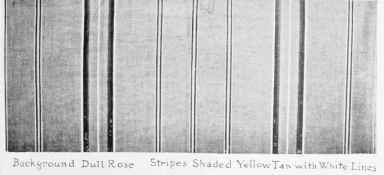
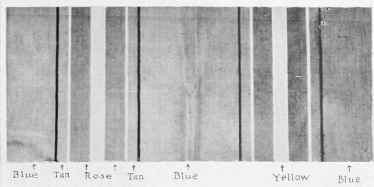
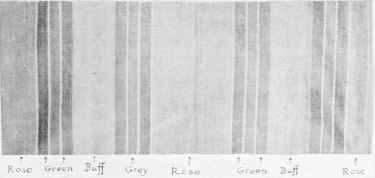
PLATE 47. FRENCH IRRIDESCENT POPLINS IN SOFT COLOURINGS.
Sold by A. L. Diament & Co., Philadelphia and New York.
Width 48 and 50 inches Half breadth shown.
Now the furniture. The window seat would be a strong box made by a carpenter - or a box-factory for that matter. Around it would be put a valance of the rep, and a tufted squab cushion, to be made by an upholsterer, would be placed on top. The plain two-drawer desk, wicker chair, and simple table at the back of the room are purposely introduced here because many families will already possess just such articles which they will wish to use in the living-room. If these are of medium or dark oak this may be done. If highly varnished this surface should be rubbed down with powdered pumice-stone and linseed oil, wiped off well, and oiled with the rubbing-oil to be obtained of any good cabinet-maker.
The settee is a representative piece from an attractive group of furniture which might well find its place in such a room. It is more ornamental than that previously considered, yet simple, of excellent design, and finished in a rich, warm brown, rubbed here and there in an effect of the mellowness of age and use. This furniture is manufactured by Messrs. L. & J. G. Stickley, Fayetteville, N. Y., and comprises such pieces as end-table to adjoin the settee, table, bench, drop-leaf desk, an attractive mirror, slat-back chairs, a small stand and a magazine rack. There is also a small table with waved stretcher.
The octagonal table and chair illustrated in Plate 111 could also well be used here. An arm-chair is provided in addition. These pieces are of walnut, which would sufficiently well accompany oak. As mahogany and oak do not go well together the reader will probably be surprised at a mahogany piano appearing here. An oak case would be much better, but the writer was again remembering practicability: oak may be secured, but the supply in inexpensive instruments is not so large as in mahogany. This was painted from an illustration of a 1ow-priced piano kindly furnished by Messrs. C. J. Heppe and Son, Philadelphia. It will be seen how concrete this example of furnishing has been made. Pictures for such a room should be of decorative character.
While the effect is secured mainly by the textiles employed, the walls have their share in producing it. No decoration could well be simpler. A painted surface would be best, and the panelling could be carried out by any really intelligent painter. It could also be realised in wall-paper. In either case the householder who might care to adopt this scheme should see to it that the rose matches that of the pillows - or, if another colouring is preferred, that it precisely accompanies the tone of the hue chosen. The marking off of the wall-spaces should also be well looked after. The "nagging" of workmen is to be avoided but they will almost invariably bear watching - hence the advantage of a professional decorator in cases where there is any complexity of design.
The floor would be painted dark grey and given three good coats of Valspar.
In this room the "balance" has been noted but may be repeated. The furnishings on each side of the window are of equal weight of effect: the top of the hanging to the left is precisely the height of the top of the picture on the right; that of the Japanese panel is centred on that of the mirror.
This scale of furnishing will now be carried out in other rooms.
Continue to:


My Books

