


Particulars And Materials Applicable To Any Scale Of Furnishing. Part 3
Description
This section is from the book "The Practical Book Of Furnishing The Small House And Apartment", by Edward Stratton Holloway. Also available from Amazon: The Practical Book Of Furnishing The Small House & Apartment.
Particulars And Materials Applicable To Any Scale Of Furnishing. Part 3
If the man be a smoker, let him beware of many of the commercial sets and humidors which are vulgarly ornamented. Ash-trays of Benares beaten brass, Japanese porcelain, and the like, may be bought for very little at the more unusual and oriental shops. Medallion-ware hop-toy cylindrical jars with lids are excellent for cigarettes, and larger jars or attractive boxes for cigars.
The desk of "the plain man" (he thus characterises himself) may be as simple and business-like as he pleases. A square glass inkwell on a plain base is certainly better than some of those trencher-like affairs, though there is no reason why he should not have something savouring less of the office, provided it be tasteful. With paper-knives and paperweights "watch your step" - they are often anything but simple, and the designers of some of them deserve hanging. A good ivory paper-knife is excellent. There is no need for a man's possessions to be either dreary or greatly ornamented; there is no excuse for their being flashy or ugly.
A woman will probably find it more difficult to keep small objects out of her room than to introduce them. An occasional-table with a few articles, such as a work-basket or ornamental bag, a candlestick, vase, plant, or the like, will be homelike and supply touches of colour. Nothing of course adds so much to the appearance of a room as well-chosen flowers. There may be a bird-cage at the window, and an imitation canary does not wake one up at daylight. In every bedroom there should be a screen as a protection from the direct draft from the widely-opened window at night and sometimes to shut out the glare of the too adjacent electric street-light. Caution is necessary in choosing just the right thing for the particular room, as it may be either a delightful accessory or quite the reverse. This is especially true of waste-baskets.
A full-length mirror is almost a necessity for a woman, yet if the room be small a cheval-glass is much in the way. Mirrors are frequently set in the backs of closet doors, and if not existent in any particular case a sheet of plate-glass edged with narrow moulding may easily be adjusted. But why not hang such a mirror in a plain frame directly on the wall in a good light and at a convenient spot? It may be suspended from the picture rail by strong wires from each upper corner, as is a picture, and reach to the baseboard.
A plate-glass top is a protection to the dressing-table or bureau, and a piece of silk or brocade is often placed beneath it to give attractive colour.
Regarding white curtains it may be said that some, who extensively advocate the "relating" of one thing to another, advise that with cream walls the woodwork be a lighter cream and the curtains a cream white, pointing out that these completely harmonise. So they do. And if the walls are cream and with them are chosen pure white enamel and pure white curtains, then the cream and the white contrast, thus enhancing the decorative value of both. So there you are! Choose harmony or contrast; whichever will best answer the particular purpose.
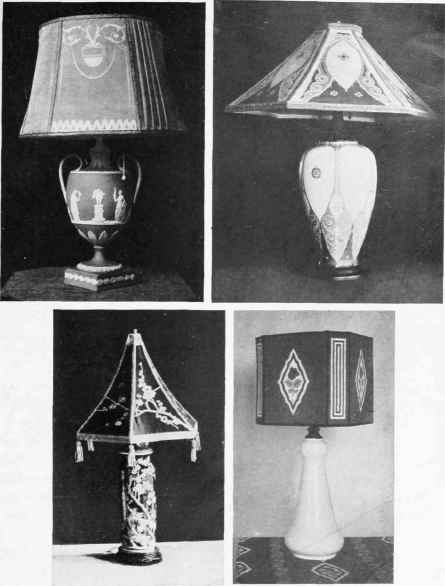
PLATE 41. LAMP SHADES IN BATIK SILK DESIGNED TO MATCH THE LAMPS.
The Aschermann Studio, New York.

PLATE 42. AN ENGLISH DINING-ROOM WITH SIMPLIFIED JACOBEAN FURNITURE.
Furniture Manufactured and Sold by Oetzmann & Co., Ltd., London.
The walls, ceiling, and window-arrangement are all excellent.
The materials suitable for thin curtains are numerous. It seems a far cry from unbleached muslin to silk gauze, yet each is excellent in its place. Select what is appropriate to the scheme of furnishing and that will give the desired effect. If there are patterned over-curtains it is plain that the thin curtains should be simple. If there are no over-curtains and the room is handsome a fine quality of net or madras may be selected with an attractive design of considerable boldness. Scrim, swiss, curtain-lawn, marquisette, Brussels and fish nets, voile, and gauze are among the materials, and stripes, blocks, dots, and figures among the designs. Some are self-bordered, some may remain plain, and others be given edgings of lace, insertion, or hemstitching. Many of the madrasses with colour are very attractive, especially for bedrooms and bathrooms. In one of the bedrooms of the beautiful home of which the living-room is illustrated in Plate 150, the curtains are of pink organdie bound with rick-rack. Dotted Swiss with ruffles and flounced valance is also excellent.
Many materials for over-curtains will be noted as we proceed through this volume. An excellent arrangement appears in Plate 42.
Much individuality may be shown in table-strips or runners, from canvas, poplins, and silks with or without appliqué or borders, to rich brocades, oriental fabrics and the like. Some very beautiful brocaded damasks and tapestries are now provided in various sizes for this special purpose among the Orinoka products. All these things are very useful in introducing or carrying through certain desired notes of colour.
Strips are now of such universal use that it seems a relief occasionally to see again the table-cover. These are particularly valuable where the table itself is not especially beautiful; but some smart decorators are occasionally employing, large, rich coverings on handsome furniture.
Wall-hangings should neither be overdone or overlooked. They are a valuable asset, and may range, according to the scale of furnishing, from the simple fabrics already provided through printed linens and the handsome cotton tapestry in the living-room in Plate 2 to valuable brocades, velvets, historic tapestries, oriental fabrics and French, Italian or Spanish Armorial hangings. Many odd things at reasonable prices may often be picked up by one alert in such matters - the writer recently saw in one antique shop a hanging of China silk, plain except for a rich, wide border of small crimson roses, resembling but bolder than the Cashmere designs, and in another a shawl in beautiful colourings that would well answer as a drapery on a small grand piano. The price of the latter was but $5.00, so it may be seen that attractive things are not always expensive.
Part IV should be consulted for such important matters as floors, lighting, and pictures, but it should be mentioned here, because it is so often forgotten, that there are many other things that may act as wall-decorations besides pictures. Plaques, carvings, panels, samplers, framed old embroidery pictures, Oriental flower-pockets, plaster bas-reliefs and mirrors of many descriptions immediately occur to the mind.
Painted and other decorative boxes, caskets, old snuffboxes, single odd tiles, statuettes, porcelain, Chinese, Japanese, and other figures, jars, vases, Venetian and Bristol glass, gold-fish bowls, maiolica and many other kinds of plates, trays of pottery or metal, and incense burners are among the various small objects that may find appropriate places as decorative accessories.

PLATE 43. SMALL FURNITURE AND DECORATIVE ACCESSORIES APPROPRIATE TO MODERN FURNISHING.
By Courtesy of A. L. Diament & Co., Philadelphia and New York.
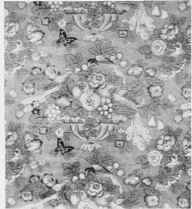
HARWICH BOWL.
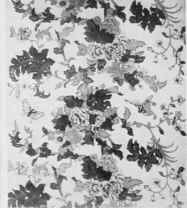
CARLISLE BUTTERFLY.
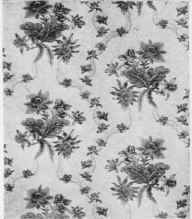
QUEEN ANNA LACE.
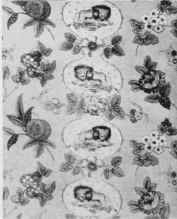
LION CREST.
PLATE 44. Danersk Block Prints And Chintzes.
Made in France and England from old designs Sold by Erskine-Danforth Corporation, New York.
A number of small pieces of furniture and household ornaments will be found pictured in Plate 43.
Two principles regarding furniture may be mentioned here. Where the furniture-coverings are plain it is frequently advisable, for the sake of individuality, to introduce ornamental coverings on a couple of small chairs or seating-stools. On the other hand, when there are several kinds of furniture and it is felt that the various pieces need pulling together in effect the employment of one furniture-covering for all will accomplish this result.
Continue to:


My Books

