


Chapter XII. Trick Stuff
Description
This section is from the book "It's Fun To Build Things", by W. T. R. Price. Also available from Amazon: It's Fun To Build Things.
Chapter XII. Trick Stuff
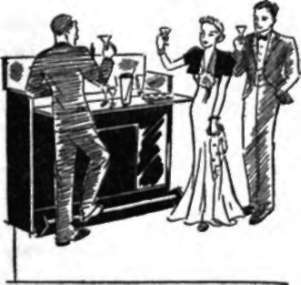
It's fun to have a concealed bar, but the cost of most of the ready-made ones takes a lot of the fun out of it for many of us. So it might be more fun to build one yourself, and if you have followed the increasingly fancy techniques so far described and illustrated, this dimensioned sketch ought not to phase you. Many of your friends don't mind having a drink under any circumstances, and all of them, except the few who hate the stuff, will think you are cleverer than they ever suspected- if a completely equipped bar suddenly turns up in a room where, the moment before, there was no bar.
Of course you could make it without the pieces of plate mirror, but there's no denying that the mirrors, put in as shown, make even the most ordinary glassware look smart and glamorous.
If you have a friend who can draw and paint (or better still, if you have these accomplishments yourself) you can have an amusing original picture to decorate the underside of the lid, showing when it's opened. Failing this, you can make a pattern of labels from various bottles, treating them with shellac and a finish coat of waterproof varnish. Or pictures from Esquire, or what have you. Best to lacquer the surface first, perhaps in Chinese lacquer vermilion-and the paste-ons should be done with thin glue.
The brass foot rail, which folds back on a hinged strip, is easily made of a brass-covered z" curtain pole, which the store will cut for you to the required length. It is nailed or screwed in through the end supports, which had better be of 1 1/2" thick wood, and the nails or screws 23/4" long. Screws, of course, will be less likely to split the end supports-and it's never any fun to split some part of anything that you have carefully cut out.
The same surprise bar can be built into a closet, in which case the dimensions are altered to fit the existing conditions, and a two-door cupboard may be built above the space needed for the opened lid. This not only gives you the storage use of the upper part of your closet, but gives the bar, when opened up, more the appearance of compact design and generally smart effect. With changed dimensions, too, the same kind of a concealed bar may be made to the height of three of the "units" illustrated in Chapter V (Cupboards), and of the right depth to line up with them in any kind of a combination grouping you may fancy.
Another trick surprise for the guest is a concealed "powder-room," which consists mainly of building a dressing table in a closet. To do this properly you need to buy a triple mirror, and nowadays most department stores have them, or the glass and mirror store. The smartest ones have no frame, and stand alone when the side panels are opened obliquely.
The table itself, with three shallow drawers, can easily be built of 3/4"x 3" lumber, with 11/2" square sticks for legs, and the top, of plywood or masonite, should be finished either with a mirror cut to size, or plate glass over a piece of the same fabric you use for the draped effect.
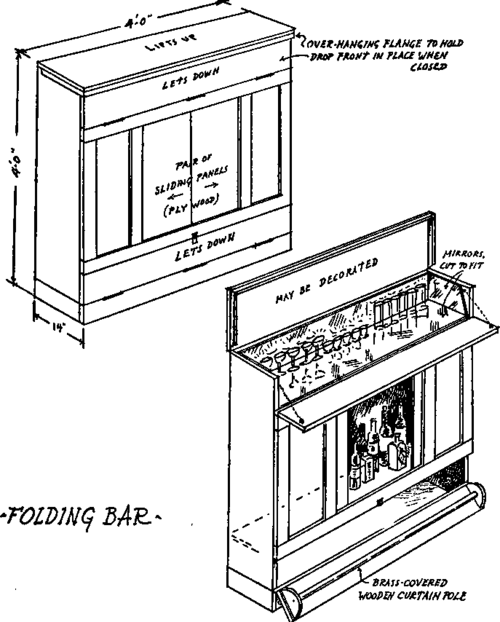
Closed and open views of a concealed bar which is not beyond human ability to build.
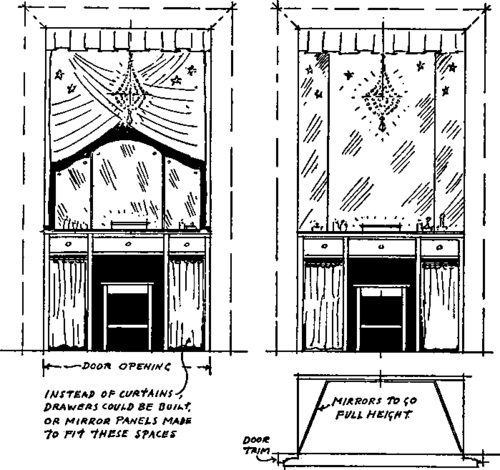
Two schemes for a "powder room" built into a closet.
The draperies consist simply of a valance tacked in box pleats on a strip of wood, and pulled back side draperies. Far be it from us to get involved in suggesting your choice of draperies, which should be what and how your personal taste dictates, but if you were to ask us we would highly recommend a small-figured toile, any kind of drapery taffeta or light silk repps. Figured chintz would be too fussy for such close quarters.
If you don't care what you spend for mirrors, a stunningly impressive effect can be achieved by running tall ones up the whole height of the door opening, either with the sides set obliquely or at right angles. The oblique set is more practical, the right angle set more architectural and no end smart. The background and table of the first one illustrated may be done in dark blue enamel or lacquer, with a few (very few) silver paper stars, such as come ready made. Put them on with thin glue, however, if you don't want them to curl up and fall off some time while you're not looking. Antique Venetian green is another good background color.
A finishing touch to make the powder niche the tons qu' il-y-a de Versailles, and give you and your friends definite delusions of grandeur would be a very small crystal chandelier, with a fairly high watt frosted bulb in it, to snap on with a switch when you open the door. The whole niche springs into a glow of mirrored light-and the guest is rendered properly speechless.
The contrivance of one of these crystal powder niches may leave you so exhausted that you will gladly go out and buy a little stool to shove in under the dressing table, finishing it, of course, to match the color of lacquer or enamel you use on the dressing table itself.
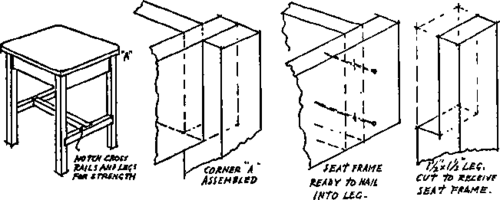
Construction details for dressing-table stool.
But if, by this time, you still think it's fun to build things, of course you can build the stool. Get enough 11/2" square sticks and some more 3/4"x 3" strips. (All this lumber for such an elegant affair as the powder niche certainly needs to be No. 1 quality, entirely free from knots or blemishes.) When you have fitted up the powder niche with a few tricky little bottles and some of those mirror boxes (which even the five-and-ten has, nowadays), you have something that strikes the note called glamour.
Continue to:


My Books

