


Getting Ambitious. Part 3
Description
This section is from the book "It's Fun To Build Things", by W. T. R. Price. Also available from Amazon: It's Fun To Build Things.
Getting Ambitious. Part 3
Don't be discouraged by this seemingly foreboding account of drawer-making. Drawers will come out very satisfactorily if they're made carefully, and will vastly enlarge the scope of your handiwork in furniture-making. The units shown in Chapter V (Cupboards) will look better and be more useful if some of them are fitted with drawers, and in the "Portfolio of Ideas" in the back of the book we have suggested many drawers in the happy belief that making them won't get you down. Certainly they are a great help in improving the looks and utility of many pieces of furniture.
When it comes to fitting locks to drawers, it wouldn't be too great a disgrace to put this up to a locksmith, though the hardware store will show you several comparatively plain types that simply screw on the inside of the drawer front. The kind that have to be neatly fitted into mortices cut with a chisel aren't so easy, and suggest caution and a definite degree of confidence in your own skill and handiness with tools.
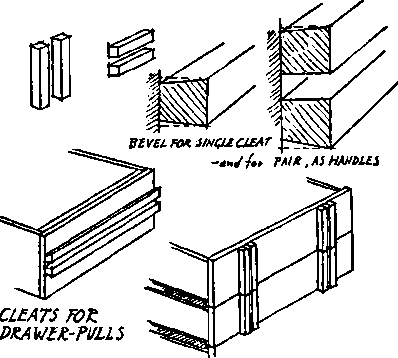
There are plenty of knobs, handles and pulls that are easily applied, and you may have noticed that the moderne designers are strong for the use of plain square cleats, either singly or in pairs, horizontal or vertical. Done in a contrasting color, or with the face matching the whole piece and the sides darker, they are undeniably effective.
The cleat form of drawer pull gives a better grip if it is slightly beveled-both sides for a single cleat and the two outside sides if they're used in pairs. A 1/16" bevel would be sufficient for a 3/4" square cleat pull. You do it with the plane, and anybody can think of color schemes that would add to the effectiveness. If you want to use vertical cleats on the faces of the drawers in a chest of drawers, you have only to make the face of the drawer-rest short by the thickness of the drawer-front, then overhang the bottom edge of the front to cover the drawer-rest and meet the top of the drawer below. Nice work, but it can be done.
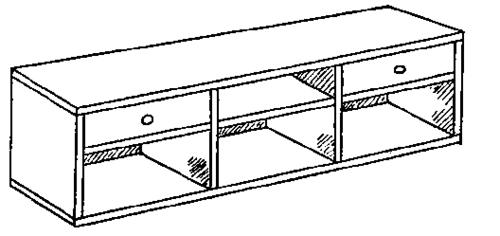
There are, moreover, plenty of places where a drawer or two are not only good-looking but also very convenient. To enumerate a few -at the base of a bookcase, in the lower tier of units, at the base of a chest, in the face of a window-seat-not to speak of the possibility of making a desk or a chest of drawers. Small chests of drawers make very handy end tables, and such a design as below vastly enhances the use of a flat top desk or writing table against the wall.
Continue to:


My Books

