


Foreword
Description
This section is from the book "It's Fun To Build Things", by W. T. R. Price. Also available from Amazon: It's Fun To Build Things.
Foreword
The first thing you have to overcome before you enjoy the fun of building things is the notion that you must have some sort of special skill. Another alibi frequently used is the lack of an elaborate kit of tools or a workshop. It's true that plenty of good tools and a workshop make it much more easy to do a job of carpenter work, and might even be necessary if you wanted to make something complicated or fancy.
This little book is dedicated to the proposition that anybody can make a surprising number of things with less in the way of tools than you would believe, and that it is no longer necessary for you to wish you had some bookshelves over in that corner, or a place to keep magazines. If you really wish you had something like that-make it. Robinson Crusoe did, and he had more and better alibis than you have.
You can make all kinds of shelving, window seats, cupboards, closet-fittings, and simple pieces of movable furniture. You can amazingly multiply the conveniences of your house, often improving its appearance-and have fun doing it. And an important thing to remember is that no great outlay of money is required.
Lumber, in the small quantities you would use for shelves and things, is not expensive; nor are paints and other finishes. The estimate you get for the making of a simple bookshelf seems staggering because of the charge for labor, plus a profit on all materials used. You can save up to 50 per cent by doing it yourself.
It is seldom that the usual furniture of a room takes care of all your needs, unless you are one of those moderns who gives away every book as soon as it is read and who fairly snatches a magazine out of a reader's hand in eagerness to throw it out. By such rigorous and relentless clearance the home may be kept as tidy as a hotel room-and about as homelike.
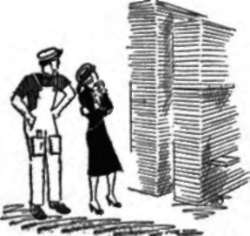
But there are many people who like to have books and magazines around-not untidily, to be sure-and there are any number of rooms with places where furniture will not fit, where nothing, indeed, would be half so attractive as built-in bookshelves, for instance, or a window seat.
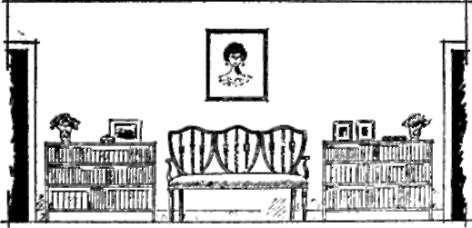
Apartments, particularly, are likely to be a little more bleak in this respect than your own home. They have some of the impersonality of hotel rooms, having been planned for any tenant. Here is a sketch which shows what was done to create an illusion of homelike charm on one wall of an apartment house living room. The whole thing is removable, and can be fitted to a similar room in another apartment. And such simple bookcases as the pair in the next sketch, built as movable furniture, can be used in a variety of arrangements.
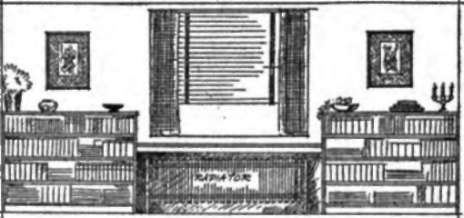
Such things are so easy to build that it's a wonder more people don't have them instead of wishing they had.
Now that modern furniture is getting more and more popular, there is more harmony in the interior which combines its straight-line forms and plain surfaces with the straight-line forms and plain surfaces of built-in shelves. Certain pieces of furniture in the modern manner may safely be achieved by the amateur, whereas the turnings and carvings and shapings of "period pieces" are possible only to the skilled cabinet-maker.
Virtually all the cuts in factory made furniture are made by precision machinery and by skilled artisans-many of them highly skilled. Turned legs, for instance, are made on a lathe: most carving is done by an amazing machine which does either the whole job, or prepares it for a little hand-finishing by an expert carver. It would be just silly to think of even attempting to make elaborate furniture, but anyone who is willing to try can acquire and practice the modest skills needed in building the various things described and illustrated in this book. Some of them are obviously more difficult than others, but none should prove impossible if a little planning and concentration are exercised.
It would be impossible to give step-by-step instructions on every cut and nailing in all the pieces of work illustrated. The first piece of work that is shown is discussed in considerable detail, and as you go on, the idea is to apply experience and a certain amount of ingenuity to the cutting and fitting needed to make similar pieces. Certain principles are largely the same in the basic skills that are called for in making shelves, doors and drawers, and with these three basic skills, an incredible number and variety of pieces at once become possible.
Yet no piece is so simple that it may not be botched by careless or absent-minded work. Unless a professionally accurate working drawing has been made, it is always wisest to check the exact mark on any part before cutting the wood. Most amateur carpenters find that a part had better be checked for exact size before cutting-but they usually learn this through finding out after cutting a few parts too small.
In this machine age most of us do not get or make enough opportunities to do things with our hands, and so never experience the fun of making things or the satisfied feeling that comes from realizing the finished product. It is fun to build things-more fun than anyone imagines who hasn't tried it.
Matlack Price
Continue to:


My Books

