


Cottingham Chest
Description
This section is from the book "English Furniture", by Frederick S. Robinson. Also available from Amazon: English Furniture.
Cottingham Chest
A very good example of the unpanelled chest exists at Cottingham Church, Northants. This, as will be observed in Plate XXIV., is unlike any other of our types. It is large and massive, top and front being composed each of one huge plank about 1½ inches thick. The length of the chest is about 5 feet 2 inches. From back to front it is about 26 inches, and in extreme height about 33 inches. The ornamentation, confined entirely to the front, is curious. Upon the main part it runs in three bands, the uppermost of which is a species of Tudor cresting, formed chiefly of single four-petalled roses, which are also sowed between, three in a row, one above the other. Next comes a waved trail, the spaces on each side of which are filled with double five-petalled roses and triplets of leaves. The lowest and broadest band is composed of three large five-petalled double roses, three double-headed spread-eagles, and two 'whorls.' These last may remind us of one of the circular ornaments of the Stoke d'Abernon chest. Besides these details, which are somewhat promiscuously arranged, there is still a small space left; and this, to be seen next to the rose on the end of the chest on the spectator's right, is filled up with rough window tracery of a perpendicular character.
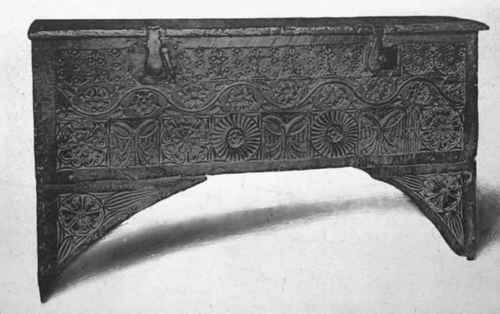
Plate XXIV. Oak Chest 16th Century
XXIV. Chest, oak. Sixteenth century. Reasons are given in the text why this might be of the date given on the plate; but it is more probably of the fifteenth century. Cottingham Church, Northants.
Approximate dimensions : Length 5 feet 2 inches, Width 26 inches, extreme height 33 inches. By kind permission of the Rector.
The design, thus quaintly eked out, is not that of a great artist, but is, so far as the writer is aware, decidedly unique. The date seems to be of the late fifteenth century, when the eagle is found upon embroideries, e.g. a frontal from Baunton. It also appears upon the arms of Mary and Philip, 1553-1558, to which date the rather debased style of carving might incline some to assign the chest.1 It is of interest to note that schoolboys have tried their knives upon the lid, leaving initials and dates, E. S., 1619, and W. C, 1725.
The present rector of Cottingham, to whom the credit is due of rescuing this interesting object from the rubbish-heap, discovered in it two small documents, both dated. One referred to a transfer of a plot of land on April 14, 1602; the other to a rate for the repair of the church, dated 1664. The list of names includes a majority still belonging to inhabitants of Cottingham. The presence of these documents is of course no evidence of the date of the chest, but the dates cut on the lid leave little doubt, even if the style of the ornament did not lead us to the conclusion, that the sixteenth century was not very old when this chest was made. Of the two locks, that on the left has a keyhole cover similar to those on another chest belonging to the same church. This is of the iron-bound type, with crossing straps, heavy handles at each end, and three locks, each with keyhole covers. It is interesting to verify from this chest, which has all its ironwork complete, the custom of covering these iron-bound chests with leather. Similar chests exist at Hambleton Church and South Luffenham Church, both in Northamptonshire. The latter is a very massive 'tree-trunk' example, with a flat top, and bound round with five strong bands of iron, which show as uprights on the front.
Another is in Garway Church. Such uncouth objects are probably not earlier than the sixteenth century. A chest, plated with iron and iron-bound, at Rockingham Castle, has flowers and the arms of England and Nuremberg upon it, and is said to belong to the reign of Henry v. The more famous one in the same place, locally known as 'King John's money-box,' has a domed top, like some of the tree-trunk chests. It is quite undecorated.
1 Considerations of general shape and construction point to the earlier date, and the style of carving may be due to a village carver.
Continue to:


My Books

