


Profile Heads
Description
This section is from the book "English Furniture", by Frederick S. Robinson. Also available from Amazon: English Furniture.
Profile Heads
A somewhat problematical chest in the Victoria and Albert Museum (No. 833), said to be of the first half of the sixteenth century, offers an example of the fashion of carving heads in profile upon panels of rooms, cupboards, and chests. This style, as we have seen in the chapter on panelling and bedsteads, was in vogue in the reign of Henry VII. and Henry VIII. A very fine early example exists at Louth Church in Lincolnshire, carved with the portraits of Henry VII. and his wife on each of the cupboard doors of what is known as 'Sudbury's Hutch.' It is very interesting from various points of view as retaining its original ironwork, and having also something of a history. It is particularly noticeable that the heads are carved in round arches, with exactly the same style of ornament in the spandrels as may be found upon later work. We have there, in fact, a precursor of the arched panel which was to become so prevalent at the end of the sixteenth and in the seventeenth centuries. The chest in the Victoria and Albert Museum has very grotesque and roughly carved heads, not comparable for character with those of the Louth cupboard, or to be mentioned in the same breath with the excellent profiles in circular medallions upon the panelling from Waltham Abbey. Profile heads are found upon Elizabethan and Jacobean furniture, but are very rough.
An example may be seen on the head of the bed illustrated in Plate xx., and belonging to Mr. J. E. Clifton, with which those on this chest may usefully be compared (Plate xxv.).
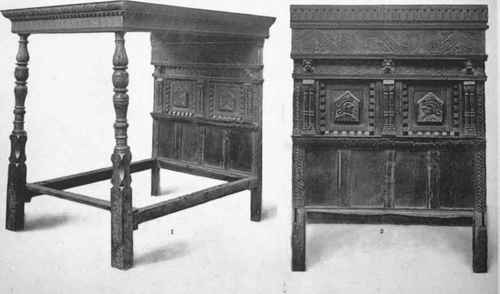
Plate XX. I - Oak Bedstead 17th Century 2 - Head Of Bedstead

Plate XXV. Coffer First Half Of 16th Century
xxv. Coffer, oak. First half of sixteenth century. The words 'coffer' and ' chest' may be regarded as synonymous, but 'chest' is preferable for anything but a really ' strong box.' V. & A. M.
In the most grandiose style of English carving is the chest with symbolical figures, 'Fides' and 'Patiencia,' belonging to Mr. Seymour Lucas, R.A. This has its arches containing the figures divided by terminal busts. The shortness and heaviness of these, and the fruits in relief, suggest a Flemish or German influence, but the arches and their spandrels are characteristically English. Exceptional features are the decoration of the ends and the solid iron handles. There is a massive, architectural character about this specimen which entirely differentiates it from the flatter-fronted incised chests of the seventeenth century. Its date is probably much the same as that of the Courtenay bed, and the other one with flattened capitals in the Victoria and Albert Museum, about 1590. The illustration of it speaks for itself. On the long, inscribed panel, between the lions' heads, is to be noticed a fleur-de-lys shape, which is a common ornament of panels of the end of the sixteenth and beginning of the seventeenth century; and to break the long line of the edge of the panels are small raised semicircles completely characteristic of the method of filling up the pattern in a certain type of S-curve panel.
It may be seen upon No. 2 in the series of S-curve illustrations, whilst the fleur-de-lys may be noticed upon No. 4 (Plate viii).

Fig. I.

Fig. 2

Fig. 3
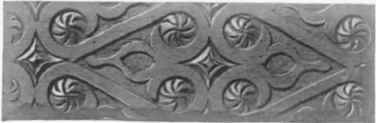
Fig. 4

Fig. 5

Fig. 6

Fig. 7
Plate VIII.
Fig. I. - From The Upper Rail Of A Chest „ 2. - Typical Panel - S Curves Opposed In Pairs
„ 3. - Typical Treatment - A Small Panel From A Chair Back, And A Pilaster
„ 4. - Coarse Version Of S Curve
„ 5. - S Curve On The Top Of A Chair Back
„ 6. - S Curve On The Side Of A Chair Back - As A Bracket
„ 7. - S Curves As They Appear In Charles II. Chairs Specimens Of Semicircle And Arch.
viii. Specimens of the S-curve.
(1) From the upper rail of a chest.
(2) Typical panel. S-curves opposed in pairs.
(3) Typical treatment: a small panel from a chairback and a pilaster.
(4) Coarse version of S-curve.
(5) S-curve on the top of a chair-back.
(6) S-curve on the side of a chair-back - as a bracket.
(7) S-curves as they appear in Charles 11. chairs,
The lighting of the reproduction is to be remarked. It would be impossible to set off better the bold effect of relief and the vigorous carving of this important example, which has been photographed under the happiest circumstances. A piece of furniture, like a picture, appears at its best in a certain light and shade, and in many cases the carver intended it so to do. This consideration will account for the disappointment which observers of this point experience when they see a fine chimneypiece or cabinet taken from its original situation and placed in a new light - full facing a window, for instance - which conceals instead of revealing its inherent beauty.
It is rather difficult to assign a date to the somewhat rare type of chest owned by Mr. Seymour Lucas, R.A., and called a 'Nonesuch' chest. The front of this is entirely covered with marquetry of the most beautifully mellow tone. It recalls the appearance of those faded straw boxes which have become brown with age, and are more aesthetically pleasing than they ever could have been when they were new. When we proceed to consider the subject of this marquetry, we perceive that the whole is architectural in character with the exception of certain borderings. A central stile divides the front into two panels, each of which has three subdivisions. Each of these subdivisions, six in all, contains a quaint building, with a pedimented porch, tall castellations, and a high-pitched roof, surmounted by a cupola and steeples. A flagstaff on the summit of the cupola shows a triangular flag or vane blowing out straight in the wind. On the three stiles are octagonal towers, fancifully chequered, and with eight-sided steeple roofs. They are in very acute perspective, being drawn as if viewed from high above. As an edging above and below the main panels there are rows of windows with triangular pediments.
A border, intended perhaps to represent round billets, like those of Norman architecture, strung through their centres with a cord which shows between them, each billet being alternated with a disc, separates the subdivisions of the panels, and also runs along the edge of the lid and of the outer stiles. There is also considerable use of a bordering of small chequers. The decoration of this extremely quaint and beautifully toned chest is meant for a rough representation of the wonderful palace of Nonesuch, built by Henry VIII. in 1537. Lady Castlemaine, to whom Charles 11. gave it in 1670, pulled it down. Both Pepys and Evelyn saw it, and describe some of its features. To judge from Hoefnagle's print, it must have been an extremely picturesque place. There are huge octagonal towers at each end, the upper parts much overhanging the lower, and these are crowned with numerous steeples, and flags or vanes, as in the chest. The proportions of the building are not adhered to in the marquetry, but it seems obvious that it is meant for a representation of this lost palace.
We shall perhaps not be far wrong in assigning this chest to the extreme end of the sixteenth century and a date of 1580 or 1590 (Plate xxvil).
Continue to:


My Books

