


Drawing Tables
Description
This section is from the book "English Furniture", by Frederick S. Robinson. Also available from Amazon: English Furniture.
Drawing Tables
This particular example was known as a 'drawing' table, that is, one which could be extended by means of its double slabs on the top. 'Two ends are made to be drawn out by main force, which then become supported by sliders, while the centre previously held by these in a higher position falls to its place from its own weight.' This is the description in Shaw's Specimens of Ancient Furniture, where a very similar one to this is illustrated from Leeds Castle, in Kent. The short piece between the lower slabs of the Museum example is stationary; the ends when drawn out are caused by the sliders to come up to the level of the upper slab. At Birts Morton, Worcestershire, there is a ' drawing' table resembling the Museum specimen, though not inlaid. The short piece between the lower slabs is part and parcel of the upper piece. When the end sliders were extended, and the lower slabs drawn out upon them, these would rise to the level of the top slab. In tables with no fixed central piece the top slab sinks to the level of the lower ones. The whole of the frame is inlaid chiefly with chequers, triangles, and rhomboidal border shapes of dark and light wood. The smallness of the design seems hardly quite in keeping with the massive proportions of the legs and slabs.
The legs, it will be seen, have somewhat flattened capitals similar to those on the bed of 1593, in which they are so pronounced a feature. Mr. G. T. Robinson, in the course of articles upon furniture published in the Art Journal of 1881, illustrated a 'drawing table' with the very plain 'acorn' legs, perhaps of 1660 circa, devoid of gadrooning or acanthus carving. It had its top inlaid with broad, geometrically placed straight lines of pear-wood stained to imitate ebony. These and other tables were very generally covered with a 'carpet' - such as may be seen in innumerable pictures of the little Dutch masters, a tablecloth formed of a rug of Persian or Turkish pattern - 'Turkey work' - as it was generically described. It is quite the exception to find in these interiors a table unconcealed by its covering. The various names of 'standing,' 'joined,' and 'dormant' tables were applied to these successors of the board and trestle. Those with one top slab, and either four or six legs, according to their length, are not uncommon.
The four-legged variety is to be found in many a parish church, where it has served as the communion table, which took the place of the 'altar.' The example illustrated in Plate lii.i is from Montacute Church, and belongs to Mr. W. R. Phelips, of Montacute. It is unfortunately much ruined, having lost a considerable part of its length, as the position of the date letters will show. Something, too, is missing from the top of the legs - perhaps capitals like those on the Victoria and Albert Museum specimen. The moulding of the top slab also seems to belong rather to the end of the seventeenth century or the beginning of the eighteenth, and we should expect a greater thickness in the wood. Yet withal it is a very interesting specimen, nicely carved, and with particularly good work on the frame. It may be noticed that the prisms and elliptical shapes enclosed by the usual strap-work of alternate 'round and square' are carved each with pretty details. There is in Gillingham Church, Dorset, a monument which may be compared with this table of 1622 in this respect. Pretentious, with obelisks or truncated steeples at each end and at the top, it was erected in memory of various members of the Jesop family, the last of whom died in 1625, three years after the Montacute table was made.
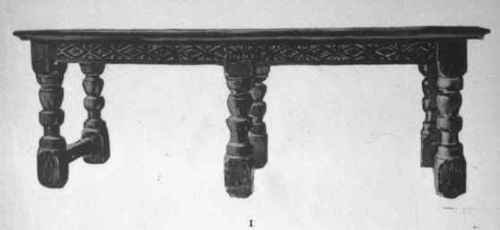

Plate LII. 1 - Table, Oak 17th Century 2 - Table, Oak Dated 1622
LII. (1) Table, oak. Seventeenth century. E. Hockliffe, Esq.
Dimensions: Length 88¼, Height 31¼, Breadth 30⅞ inches.
(2) Table, oak, dated 1622. From Montacute Church. W. R. Phelips, Esq. Upon the table is a ' Bible' box, the property of Sir Thomas Wardle.
Under the cornice, which has a dental course, there is a frieze with just such alternating highly relieved oblongs and rounds or prisms and bosses as appear upon this table. Examples in which these appear as a feature may be reasonably placed in this decade of 1620-1630. It is much more usual to find the flat strap-work without the highly relieved shapes. Tables lacking these may probably be regarded as later, especially as they very generally have more slender turned legs than those of the beds of Elizabeth and the tables of James 1. The stretchers of seventeenth-century tables are usually four-sided in section, and occasionally beaded. Tables of the earliest sixteenth century have a T-shaped section to their stretchers, which is not characteristic of the later types.
Continue to:


My Books

