


Later Bedsteads
Description
This section is from the book "English Furniture", by Frederick S. Robinson. Also available from Amazon: English Furniture.
Later Bedsteads
In the 'Queen Anne's State Bedchamber' is her very tall, straight - canopied four-poster, completely covered with silk velvet, worked with an elaborate pattern of architectural designs, and conventional vases and flowers in orange and crimson on a white ground. On the corners of the canopy or tester are two great urns also covered with velvet. In the Private Dining-Room are now placed the beds of William and Mary. William's is in crimson damask, and has urns on its handsomely shaped canopy. The bed-head is formed to match. Mary's bed is crimson velvet with a straight top and urns, with the huge dust-collecting feathers characteristic of the time. Between them is a much smaller bed, four square, with straight canopy, and covered with crimson damask. This belonged to George II. Beds such as those of William owe their design probably to Daniel Marot. At Warwick Castle there is said to be a bedstead of Queen Anne's reign, and a marquetry one of the same period has been mentioned as existing at Brigstock Manor, Northants, in 1883. Two stuff-hung earlier beds should be noted. At Hardwick Hall is a Bed of State with cloth of gold and silver, velvets of different colours, lace fringes and embroidery.
The hangings, as described by the author of Vitruvius Britannicus, consist of figures representing the virtues and vices embroidered on grounds of white and black velvet. In the 'Spangle Bedroom 'at Knole, containing furniture presented by James I. to the Earl of Middlesex, there is a tall upholstered bed with a straight-topped tester.
Of the early slung form of cradles, mention has been made in Chapter II (Early Oak Chests). In the seventeenth century the preference seems to have been for a box shape on rockers. There may or may not be a gabled hood. Of those illustrated, the most elaborate belongs to Mr. R. D. Radclifife, Old Swan, Liverpool, and has up to the present time been lent to the Victoria and Albert Museum. It is said to have been the cradle of the Earl of Derwentwater. It has a pentagonal hood finished with rather plain turned finials, which are repeated on the cradle foot. The panels are incised with a species of interlacing semicircle pattern. Various interesting additions seem to have been made of later date. The ornamental 'foliation ' moulding which runs along the upper rail and down the uprights is perhaps an after-thought, as also seems to be the pierced carving which supports the Prince of Wales's feathers above the hood. At the cradle foot is a large escutcheon formed of cherubs supporting a coronet, and having a monogram and fruit carved in the field, all of which is apparently subsequent to the execution of the original cradle.
The hood has open sides (Plate XXII. I).
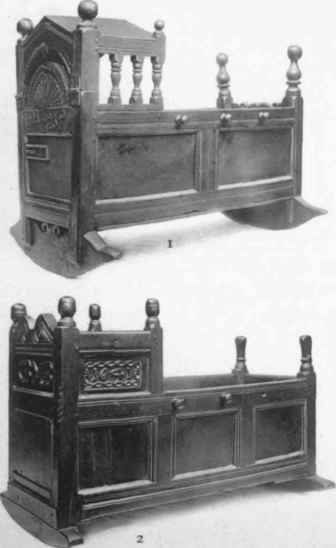
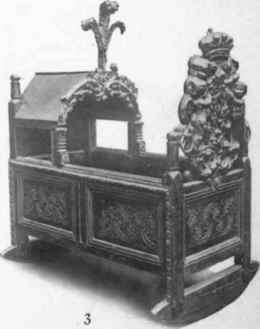
Plate XXII. 1 - Cradle, Oak Early 17th Century 2 --Cradle Of Oak 164i
XXI. Bedstead, oak. About 1640. Hangings of crimson velvet. Miss Evans. Forde Abbey. XXI. (1) Cradle, oak. Early seventeenth century. R. D. Radcliffe, Esq.
(2) Cradle, oak. 1641. V. & A. M.
(3) Cradle, oak. 1691. V. & A. M.
Another (Plate XXII.2) in the Museum collection has closed sides but no top. The panels are plain except on the hood, where are ornamentally carved, on the back, the initials G.B.M.B., on one side ' October 14 Dai,' and on the other' 1641.' A special interest attaches to cradles by reason of the precise information of ownership and date so often carved upon them. In the Dorchester Museum is a rather plain one lent by Mr. Albert Bankes, which came from a house at Corfe. Its inscription is a very full one: John vppill borne November 11th ano dom 1674. Its hood is missing.
The third illustrationl (No. 596, V. and A. Museum)
1 Plate XXII. 3.
A 17TH CENTURY BEDROOM has a gabled hood with balusters at the sides. This hood, it may be noticed, is hinged for lifting up, and the panel below is also fitted with a bolt. A very well carved 'fan' pattern appears on the gable end, and below it are the initials E. M. G., 1691. Assuming this to be an authentic date, we have here a good example of the persistence of the traditional shapes and ornament of old oak furniture. Except, perhaps, for the shapes of the turning, this example might have been made at least fifty years before. Cradles of later date than these may be discoverable, but they would not appear to be very common. The writer has not met with anything in the shape of a cradle upholstered like a bed of Queen Anne's time.
As to the general furnishing of bedrooms in the seventeenth century, a good idea may be obtained from the following extract from an inventory of the household goods Mr. Serjeant Newdegate left with his son at Arbury, Warwickshire, in March 1666. I am indebted for it to Lady Newdigate-Newdegate's Cavalier and Puritan. 'The great chamber was hung with 5 pieces of Landskipp hangings,' and there was 'a very large Bedstead with embroidered curtains and valence of broadcloth, lined with carnation-coloured sarsenet, and 7 plumes of feathers in the bedtester.' This shows that the feather-furnishings were anterior to the reign of Queen Anne or William 111., when they are supposed to have been introduced. There were also 'two embroidered carpets' (tablecloths), 'two armed chairs, four stools embroidered, suitable to the bed .. a looking-glass embroidered with gold, and another looking-glass, six flower-pots, two stands, and a hanging shelf, all gilt; a pair of brass andirons, .. a picture over the chimney, and carpets round the bed. . . .'
Continue to:


My Books

