


Mahogany
Description
This section is from the book "English Furniture", by Frederick S. Robinson. Also available from Amazon: English Furniture.
Mahogany
The demand for lighter, more elegant furniture, which, as we have seen, has been, and will remain to the end of this narrative, the rule of evolution, was admirably met by the introduction of mahogany. Forests untouched were ready to hand giving the eighteenth-century joiners an advantage over their later rivals. The tree is a slow grower, and the inroads made upon the supply are difficult to repair, when two hundred years are required to bring the tree to perfection. Though there are many attractive exotic woods, there is none which can be obtained at once of such size, such a warm glow of colour and interest of grain. It is scarcely a cause for wonder that the prosaic nineteenth century should have been content with mahogany almost entirely unadorned, or that some of its clumsiest inventions are almost redeemed by their splendid material. But Chippendale was not satisfied with the mere natural beauty of mahogany. He did justice to its merits by the conscientiousness of his constructions. His frets were no mere pierced planks, but consisted of several thicknesses glued together in different ways of the grain, until the result was ornament capable of withstanding climatic changes and the effects of time to an astonishing extent.
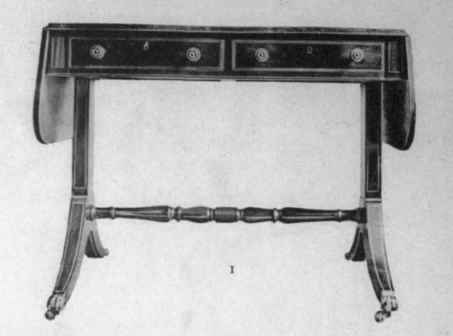
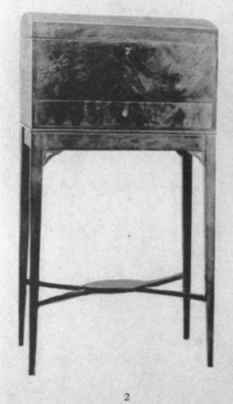

Plate CXXXIV.
I - Pembroke Table, Mahogany Inlaid Late Sheraton
2 - Work-Box On Stand Satinwood Veneered And Inlaid
Sheraton 3 - Table, Mahogany, Bordered With Satinwood Sheraton
CXXXIV. (1) Pembroke Table, mahogany inlaid. Late Sheraton. Mrs. C. W. Cobb.
(2) Workbox on Stand, satin-wood veneered and inlaid. Sheraton. James Orrock, Esq.
(3) Table, mahogany bordered with satinwood. Sheraton. The Earl of Ancaster.
Further, his best carving was admirably suited to the material. It is not the heavy grandiose chairs with rams' horn ends to their bowed backs, and profuse decoration elsewhere, to which we look for his standard of excellence; any more than we judge him by the extravagances of his merely contemplated and probably never executed bedsteads. The best of Chippendale, as is so often the case with masters in other branches of art, is found in those examples which are most national, and in which the artist has kept a reserve of force. Admirable contrasts are found in the smooth lengths of pleasantly beaded legs and backs of chairs varied at their ends by light and crisply cut foliage, the very scantiness of which lends it artistic value. If he uses 'rocaille' work, or 'coquillage,' the best examples are those in which it shows least above the edges. When the 'rocaille' work is too much in evidence it disturbs the easy sweeping lines of the general scheme, and makes the top of a riband-backed chair, for instance, look as if it were composed of the vertebrae of some animal. Those rare examples in which the splat is joined to the side uprights by other curves which make the entire back one arabesque, are to be deprecated for the same reasons.
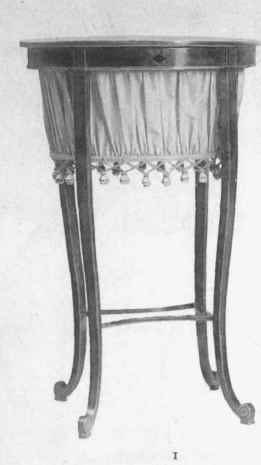
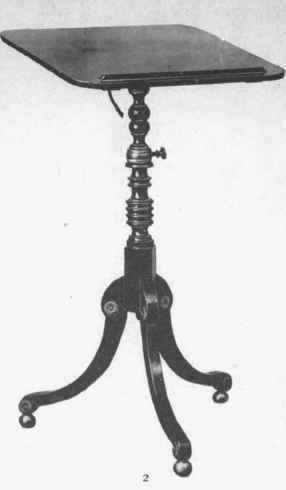
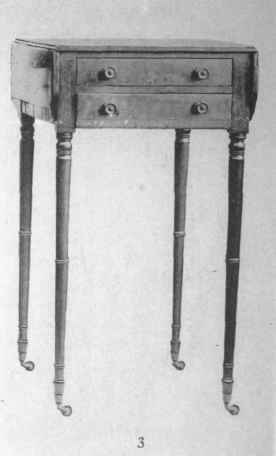
Plate CXXXV.
I - Work-Table, Satinwood, Painted With Black Stripes Sheraton
2 - Tripod Reading Table, Mahogany Late Sheraton
3 - Table, Walnut Inlaid Late Sheraton
CXXXV. (1) Work-Table, satin wood painted with black stripes. Sheraton. The Earl of Ancaster.
(2) Tripod Reading-Table, mahogany. Late
Sheraton. J. E. Clifton, Esq.
Dimensions: Height of stand 27¾, Length of top 16½, Depth from front to back 14 inches.
(3) Table, walnut inlaid. Late Sheraton.
C. H. Talbot, Esq. Lacock Abbey.
The four or five places where the curve ends touch the typical smooth side of the back, tend to make the chair too ' busy' in appearance. An excessive use of fretwork is also not to be desired upon the heavier furniture. It is as out of place as it appears to be upon those too florid Flemish oak court cupboards or cabinets which sometimes are mistaken for English. In the very light occasional tables, on the other hand, Chippendale's fretwork seems an altogether desirable feature. For the heavy arm-chair, unambitious, and with straight legs, nothing is more suitable than the undecorated moulding running along its entire length.
It is, however, not necessary to spend time upon what is largely matter of opinion. Riband chairs, Chinese, French, and English style chairs, the various types of tables and screens which he has left us, will all have their admirers. What has been said is sufficient to indicate that the ratio of our admiration may often vary inversely as the ratio of the artist's exuberance. Nil admirari is a bad principle for critics, but nimium is undesirable also, where the design oversteps the limits of modesty.
Continue to:


My Books

