


Manwaring's Bombast
Description
This section is from the book "English Furniture", by Frederick S. Robinson. Also available from Amazon: English Furniture.
Manwaring's Bombast
In the preface Manwaring mentions the Five Orders of Architecture, which he lugs in because Chippendale, whom he describes as 'a late very ingenious Author,' had done it before him. 'I have made it my particular study,' he observes, 'to invent such Designs as may be easily executed by the hands of a tolerable skilful workman ; if any of them should at any time be thought impracticable, I shall always be ready to set in a clear light any objection that may appear to be reasonable and rational.' Mr. Manwaring, that is, has no objection to be judge in his own case if any one hints that the rural chairs are impossible and absurd.
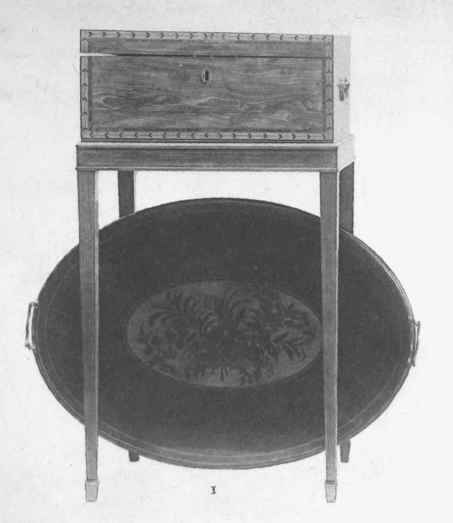
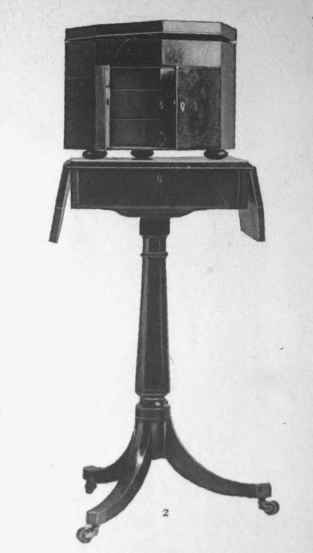
Plate CXXXIII.
I - Chest Cabinet, Satinwood Veneer Sheraton And Tea Tray, Mahogany Inlaid 2 - Workbox, Satinwood, With Mahogany Top Inlaid Sheraton And Work Table, Satinwood,
Inlaid With Ebony Sheraton
CXXXIII. (1) Chest Cabinet, satin-wood veneer.
Sheraton. The Earl of Ancaster; and Tea-tray, mahogany, inlaid. V. & A. M. (2) Workbox, satin-wood, with mahogany top, inlaid. Sheraton. W. H. Spottiswoode, Esq.; and Work-Table, satin-wood inlaid with ebony. Sheraton. The Earl of Ancaster.
'The Hall, Gothic, and Chinese Chairs,' he continues, ■ though they appear so very elegant and superb, are upon a simple construction, and may be very easily executed.' As to many of the other designs, ' the Author has the Boldness to assert that should the ornamental parts be left out there will still remain Grandeur and Magnificence behind, and the Design will appear open and genteel.' It is a little difficult to see what the 'ornamental parts' were intended to do, if even without them there still remained 'grandeur and magnificence behind.' I have also no opinion to offer as to the precise meaning of a combination of 'openness and gentility.'
The Five Orders come first, and take up about seven pages. After them follows 'the true Method of striking out all kind of Bevel Work for Chairs by Strait lines as explained in the Plate next following the Five Orders.' Plates 1-3, hall chairs, some with acanthusleaf backs carved and pierced in the Dutch style of 1690 circa, and one with a huge scallop-shell back, are conclusive proof that not everything was borrowed, as some writers would have us believe, by Manwaring from Chippendale, though the following plates, 4-9, are certainly in the ordinary Chippendale style. These are followed by Chinese and Gothic chairs, ' Dressing chairs' in Louis xv. style, and ' Grand French Settees,' these last all with carved and pierced acanthus leafage. Plates 24-28 contain the rural chairs. One is in a rococo style with flowers and landscapes carved on it. Another has rockwork with a waterfall in the back - than which absurdity of design can no further go, unless perhaps in the next, where a fountain spouts up instead of a cascade falling down. Amongst the garden seats or settees is one with a back consisting of five uprights with wreaths hanging straight down between. Along the front rail are 'swags' of flowers. There are three rectangular legs in front with wreaths upon them.
This is a by no means ugly design, and as far as I am aware is Manwaring's own. It is followed by another quite respectable garden seat in lattice-work and C-curves. The rest of the plates are chair backs, including one riband back in the Chippendale style.
On the whole this is Manwaring's best work; the rustic chairs are perfectly impossible, but many of the others are not to be despised. His perspective and leg drawing are bad.
The next year, 1766, saw The Chair-Maker's Guide published. This also is an octavo book, not to be compared in style or sumptuousness with the folios of Chippendale or Ince and Mayhew. There is no preface. The author has put himself at a disadvantage through his economisation of space. It is impossible to judge fairly of the designs, as they stand, because they are so much mixed. Half of one design for a chair is attached to half of another, and the left hand leg being different from the right gives an unpleasant sense of lop-sidedness. We can get no just conception of any one chair, and economy has ruined the effect of the book. Manwaring would have said that it was meant for the practical use of the chair-maker, who would draw out a complete design for himself, but the particular copy to which I refer in the Victoria and Albert Museum happens to have the book-plate of 'Mr. Horatio Walpole,' one of the chief arbiters of taste and amateurs of the period.
Continue to:


My Books

