


Yorkshire Chairs
Description
This section is from the book "English Furniture", by Frederick S. Robinson. Also available from Amazon: English Furniture.
Yorkshire Chairs
With both of these features we meet in the Yorkshire chair, which is the least English-looking of all the chairs of the old oak period. This is due to the curious horseshoe-shaped cut in the centre of the cross rails of that which we reproduce (Plate Lix.3), No. 232 Victoria and Albert Museum. This somewhat resembles the Moorish arch, broad above and contracted below. It accounts for the somewhat exotic appearance of these chairs, more marked when, as in the case of a pair in the possession of Sir Charles Robinson, there are three cross rails, each with two horseshoe cuts. Above each horseshoe cut is a solid semicircle, but not scalloped with smaller ones as in the Museum specimen. A rudely incised human face is a characteristic to be found in the centre of the cross pieces of these Yorkshire chairs, and in our example the spiral ornamentation incised upon them is suggestive of a Celtic reminiscence. Generally the Yorkshire chair has a slightly sunk seat, and though it is sometimes of large size, its open, railed construction has made it a very much lighter object than its solid-backed forerunner.


Plate LIX. I - Chair, Oak 17th Century
LIX. (1) Chair, oak. Seventeenth century. Derbyshire. V. & A. M.
Dimensions : Height 44½, Width 17¾ inches.
(2) Chair, oak. Seventeenth century. Derbyshire. V. & A. M.
(3) Chair, oak. Seventeenth century. Yorkshire. V. & A. M.
(4) Chair, oak. Seventeenth century. Derbyshire. V. & A. M.
A mercantile connection of Yorkshire with Scandinavia may have something to do with the design of this class of chair.
To the intermediate stage of half-solid backs belongs a remarkable set of very high oak chairs (Plate lx.i), Nos. 406-408 in the Victoria and Albert Museum. These have solid backs, except for about a foot above the seat. The upper frame of the back has a small arcade of six incised arches, the back has two panels, the lower of which is sunk more deeply in its frame than the upper. This arrangement is not uncommon, and gives a certain variety to the surface of the back. The top of the back is fairly straight, but is shaped with a jutting semicircle to break the straight in the centre, and curves to serve the same purpose at the ends. In the upper panels of these chairs are the arms of Thomas Wentworth, 1st Earl of Strafford, a crown and shield with motto incised 'En dieu est tout.' This serves to give us an approximate date for the chairs, as his execution took place in the year 1641. Dating, then, from perhaps 1630 circa, these chairs, which have some little inlay upon the lower part of the back, and decorated front stretchers between turned front legs, seem to offer very early promise of the transition to the style of the Charles 11. chair which we shall shortly have to deal with.
The wave of austerity brought by the Commonwealth, 1649-1660, probably did something to check the natural evolution of English furniture. That a change was taking place in the style of oak chairs, those of Strafford seem to indicate. Then came the death of Charles 1. and the Puritan ascendancy, which enforced plainness even upon furniture-makers. The complete change of tone in morals and manners which the reaction against the Puritans, and the Restoration, brought about, marks such asudden difference between Cromwellian and Charles 11. furniture, as to incline the casual observer to fancy that there was no intermediate step. Indeed the general use of cane for backs and seats, and the lightness of the open scroll-work of the period of Charles II., does make a great, and apparently sudden, difference between the latter style and its forerunners. As usual, however, we may conclude that even in this case there is no strict dividing line. Cane was perhaps expensive at first, and old fashions held their own in the country. This would be enough to account for the existence of such a chair as that at Newton Manor, Dorset, here described. This chair (Plate LX.3) has a high, though solid, back. In the centre of the top of the back appears the favourite crown of the Charles 11. chair.

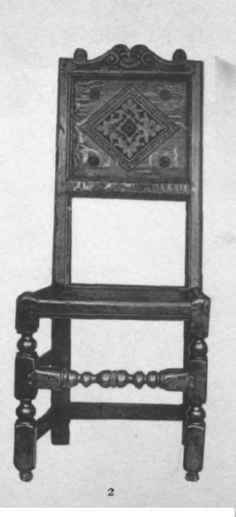

Plate LX.
I - Chair, Oak Early 17th Century
2 - „ „ 17th Century
3 - Arm-Chair, Oak Late 17th Century
lx. (1) Chair, oak. Early seventeenth century. With arms of Thomas Wentworth, first Earl of Strafford. This chair has been restored. V. & A. M.
(2) Chair, oak. Seventeenth century. V. &< A. M.
(3) Armchair, oak. Late seventeenth century.
Transitional from the old oak type to that of Charles II. Note the crown on top of back, and the extra cross-rail. Sir Charles Robinson, C.B.
Dimensions : Height 48, Width 21 3/9, Depth from front to back 23 inches.
There are two crossed wheat-ears below it and acanthus-carved curves on both sides. For finials there are round knobs. The main panel has a poor incised pattern of a rectangle with a diamond - its poverty symptomatic of a change which was to be to the prejudice of the earlier fine incised work. Below this panel is a sunk arch - blunt pointed - and for that reason somewhat peculiar. The arms are rounded and curved, ending in elementary volutes similar to those on the typical Charles 11. arm-chair. The legs are turned, and it is to be noticed that there are three cross rails, of which the two front ones are turned, and the third, which joins the back legs, plain rectangular. This extra rail is another reminder of the Charles 11. chair, in which the front one is often too elaborate a piece of carving to be properly called a rail. Its function is chiefly ornamental, but behind it may often be seen two simple turned ones, one low down and joining the centre of the side rails, which stretch from front legs to back, the other higher up, and connecting the back legs at a few inches below the seat.
In this hybrid chair the ornamental rail, or rather stretcher, of a Charles 11. chair has not yet been arrived at, and the extra cross rail is on the same level as those between the front legs and also between the back leers. It is, however, the only solid-backed oak chair in our selection which has an extra cross rail, and its other peculiarities, which seem to anticipate the Restoration style, render it a most interesting link.
Continue to:


My Books

