


Seats. Part 2
Description
This section is from the book "Furniture", by Esther Singleton. Also available from Amazon: Furniture.
Seats. Part 2
The diphros was a low stool without a back. It had four legs, either upright or crossed. The cross-legged diphros had a webbed seat, and could be folded. The legs often were carved and gracefully curved. A separate cushion was sometimes added for greater comfort.
The klismos was a chair of quite modern type. The four legs had a graceful curve; the back inclined comfortably and ended in a semi-circular bar that fitted the line of the shoulders.
The diphros with upright legs was lengthened to form a couch (kline), which at first had no head or footboard. Afterwards, in addition to these, a back was added to one of the long sides, and a sofa was produced, the form of which was familiar in every home two generations ago. This kline was made of maple, box and other woods, plain and veneered. The legs were carved or turned, and the framework was often inlaid with gold, silver or ivory.
The Romans had several forms of chairs. Most important was the sella curulis which dates from the days of the kings. It was a folding-stool with curved cross-legs. Originally, it was made of ivory and later of metal. It was used as a judgment seat.
"The simple folding-stool with crossed legs, the backless chair with four perpendicular legs, the chair with a high or low back, and the state throne were all made after Greek patterns. The word sella is the generic term for the different classes of chairs comprised in the Greek diphroi and klismoi; only the chair with a back to it is distinguished as cathedra. The form of the cathedra resembles that of our ordinary drawing-room chairs but for the wider, frequently semi-circular curve of the back, which greatly adds to the comfort of the seated person. Soft cushions, placed both against the back and on the seat, mark the cathedra as a piece of furniture belonging essentially to the women's apartments; the more effeminate men of a later period, however, used these fauteuils in preference. The legs of the chairs were frequently shaped in some graceful fashion, and adorned with valuable ornaments of metal and ivory; tasteful turnery was also often applied to them. Different from these chairs is the solium, the dignified form of which designates it as the seat of honor for the master of the house, or as the throne of rulers of the state and gods; it answers, therefore, to the thronos of the Greeks. The richly decorated back rises perpendicularly sometimes up to the height of the shoulders, at others above the head of the seated person; two elbows, mostly of massive workmanship, are attached to the back."1
1 E. Guhl.

Roman Chair And Stool
As an article of decorative furniture, the chair was scarce in Europe throughout the Middle Ages and during the early Renaissance. It was a seat of dignity and honor, the distinctive sign of authority and lordship, and was reserved for the aged, the master of the house and important personages. Its place was between the bed and the chimney, fixed with its back to the wall. Its decoration was in keeping with the rest of the carved wood-work of the room. This chair, of which many examples exist in public and private collections, had a tall, straight back surmounted by a dais and the arms. The seat was a box or chest with a lid. It was raised rather high above the floor and had a step in front of it. This is sometimes called the prie-dieu chair, probably because devotional books were kept in the seat. The ordinary seats, however, consisted of chests and benches; and the chair proper is not common till the Fourteenth Century.
In Germany in the Thirteenth Century, sexagonal and octagonal seats, with a leg at each angle, were common. The requirement that the seat of justice should have four legs dates from this period. The Gothic chairs are often quite light and graceful, but most of them are of plain form and ornamented with very shallow carving. In this century also originated chairs with light iron frames; the seat was a cushion on webbing. During the Fourteenth and Fifteenth Centuries the carving of the high chairs was highly developed.
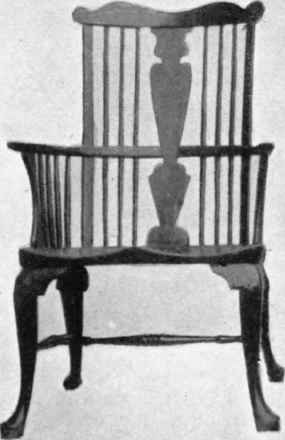
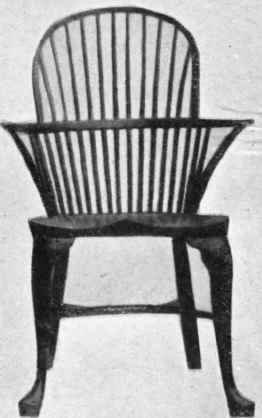
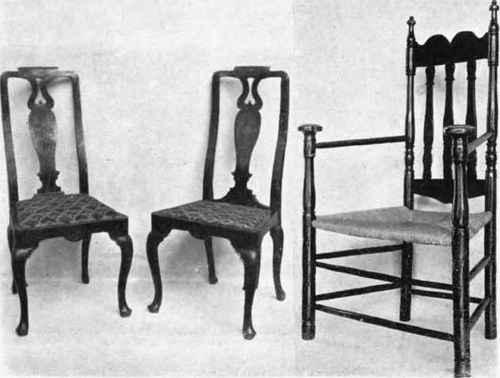
Plate LXXXVI - Windsor Chairs Anglo-Dutch Chairs - American "Colonial" Three-bar, or Banister Back, with Rush Seat - Metropolitan Museum
In Germany as elsewhere during the Middle Ages, the chair was reserved for the lord or distinguished guest, while the rest of the household sat on benches, faldstools, camp-stools, settles and chests. Splendid chairs were ornamented with gold, silver and ivory and inlaid woods, and covered with fine woven stuffs and cushions. The legs were sometimes bowed, massive and strong, and sometimes straight and slender. They were often turned. The backs were higher than the arms, which often consisted of two posts joined with leather or other material. After the Tenth Century, the legs and posts of the arms and back were often turned. The back was then often no higher than the arms, and the posts had their ends carved to represent heads of lions and other animals. If the seat was in the form of a chest, it was often broad enough to accommodate several persons. The fronts and high backs of these benches or settees were rilled with bar and lattice-work, and the feet were carved like those of animals. About 1100 A. D., stools with high backs came into general use; and about a century later, we find them with woven material filling the space between the back posts.
The oldest piece of furniture is in Germany, in Salzburg.
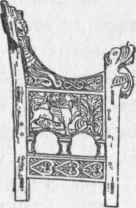
Carved Wood Chair, Scandinavian, Twelfth To Thirteenth Century
This is a folding-chair of wood, painted red, with heads and feet of lions of ivory decorating the side supports and bas-reliefs of ivory also forming a decoration. The seat is covered with stamped leather. It was said to have been given by Eberhard II., Archbishop of Salzburg, to the Abbess Gertrude II. (1238-1252).
Continue to:


My Books

