


Seats. Part 3
Description
This section is from the book "Furniture", by Esther Singleton. Also available from Amazon: Furniture.
Seats. Part 3
The illuminated manuscripts show that chests were largely used as seats during the early Middle Ages. Of the rare pieces of furniture of earlier date than 1300, the majority belong to the service of the church, and when the big carved chairs came into general use, their decoration was similar to that of the Gothic choir-stalls. The chairs of the Fourteenth Century had carved human and animal figures, Gothic tracery, flower and leaf work and bas-reliefs of scenes of Biblical history. At this time, also, a new decoration for panels was introduced which reached its highest development during the Fifteenth Century. It was used universally on the panels of walls and furniture. This is known as the linen fold, and is supposed to have originally been meant to represent folded parchment.
Sauval, the historian of ancient Paris, says that in the Louvre at that date there were no low chairs, nor folding seats, nor stools, that convenient kind of furniture not yet having been invented. In the king's chamber and in the queen's, there were only trestles, benches, forms and fau-teuils; and to make these more superb, the wood-carvers loaded them with a confusion of bas-reliefs and other ornaments; the carpenters surrounded them with panels and the painters painted them red.
About this time, however, a light, X-shaped, folding chair must have been coming into use. It appears in scenes of social life in the illuminated manuscripts.
An example of Italian workmanship of the Sixteenth Century is given on Plate LXXX.
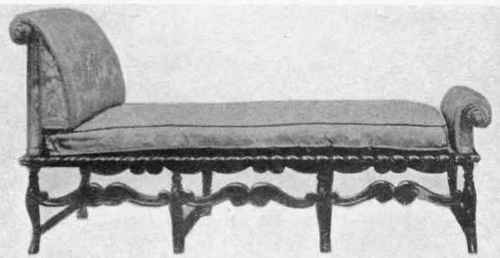
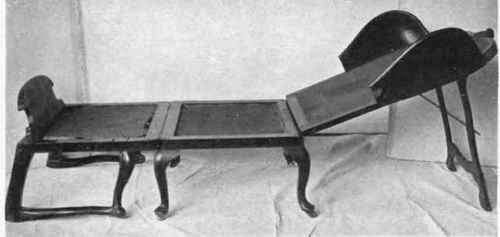
Plate LXXXVII - Seventeenth Century Lit de Repos - Early Eighteenth Century Folding-Chair - Metropolitan Museum
Oak and cedar were the woods most generally employed in making these chairs which were often gilded as well as carved and decorated with painting by the best artists. Towards the middle of the Sixteenth Century, the form of this chair was modified. The new model was lighter and broader in the seat. Color was abolished, and the carving was sometimes accompanied by marquetry and inlaid marble.
There were several kinds of low chairs. The principal ones mentioned in French inventories are the chair with arms, chair without arms, table-chair, three-legged chair, chair with back for sitting beside the fire; woman's chair, child's little easy chair and vertugadin chair. The tour, or revolving, chair is frequently met with also.
In addition to the stiff and splendid seats of ceremony, there were more modest seats for the use of women and youth in ordinary life. The tabouret was a little low seat covered with velvet or some carpet stuff of bright color and varied pattern which was used by women as they sat and chatted together and did their needlework. It was also called a placet. Cotgrave defines the tabouret as "a cushion stool, or a little, low stool," and the placet as "a low stool."
In England, as on the Continent, coffers and benches formed the usual seats before the Tudor period. The Renaissance was slow in crossing the Channel, notwithstanding the encouragement given to foreign artists and workmen by Henry VII. As abroad, however, the tendency of the seats was towards lightness. The great panelled chairs gave way to smaller ones with turned legs, called "thrown" chairs, for use in bedrooms. About 1530, the curule-shaped chair became popular. The seat was of leather and leather bands joined the back posts.
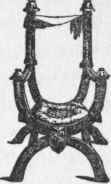
English Chair, Fifteenth Century
The high-backed bench (see Plate III.) was merely the chair enlarged to accommodate several persons at once. It had a high, panelled back usually surmounted by a dais, a coffer seat, arms and a step. This high bench began to disappear together with the high and massive carved chair at the Renaissance, giving place to folding-seats and chairs with low backs.
The dais of the Middle Ages called canapeum had disappeared from the bench before the close of the Valois period, but the name was continued. The canape became one of the most important seats under Louis XIV. and his successors. It came into fashion about 1689 according to Furetiere, who wrote: "Canape, a kind of chair with a very wide back, capable of seating two persons. This word is new in the language, and some people call it sopha."
Of the French chairs of the Sixteenth Century, De Champeaux writes: "The imitation of the Italian masters who had returned to the ancient traditions, forgotten for many centuries, troubled the production of the French school for a short time; but, in a few years, the French workmen had assimilated these new models, and the art of the cabinet-maker shone in France with a splendor that it had not known in Italy. The chairs of the reigns of Charles VIII. and Louis XII. (1483-1515) unite the evident characters of the two currents running in opposite directions and ending by mingling. Some of these chairs show the national style in a very pronounced manner, while others are very sensibly influenced by foreign principles. The latter belong to a school sure of itself, that knows antiquity but does not slavishly follow it. Several French provinces attained great celebrity in this art, and produced chairs the harmonious proportions and delicate carving of which can not be too highly admired. Burgundy and the Lyonnais, so skilful in the art of wood-carving, produced very remarkable examples; but they were surpassed by Auvergne, which seems to have made a specialty of high-backed chairs, enriched with arabesques and medallions, treated with a supple and vigorous chisel."
Continue to:


My Books

