


Seats. Part 4
Description
This section is from the book "Furniture", by Esther Singleton. Also available from Amazon: Furniture.
Seats. Part 4
The escabeau was a stool for sitting at the table only, and always accompanies the table in the inventories. It differed from the tabouret, which had four legs, by having board supports at each end; the surfaces of these were usually ornamented with carving. It was probably the same as the English buffet stool. Another seat of a commoner kind was the selle, which Cotgrave described as "any ill-favored ordinary or country stool of a cheaper sort than the joined or buffet-stool." There was also the sellette, which was a very low stool.
During the Renaissance, chairs were not used by womankind to the extent that they are to-day. Cushions placed on the floor were extensively used as seats by young women especially. The carreau, or quarreau, lasted as a seat till the Louis Quatorze period. In 1606, Nicot describes it as "a pillow of tapestry or other stuff, filled with wool, cotton, hair or straw, on which people kneel in church, and women sit at home, busy with the needle as they gossip." The porte-carreau was a little piece of furniture with bulb feet, on which pillows were piled. Moliere owned one "of varnished wood in the Chinese style."
In Italy upholstered chairs came into vogue as early as the Fifteenth Century. Velvet was the favorite material, and neither the style of upholstery nor form of the chair changed until the Seventeenth Century. These luxurious chairs were seats of state and not in general use. They often appear in portraits. For instance, Pope Sixtus IV., by Melozzo da Forli, sits in one, as does Pope Leo X., by Raphael.
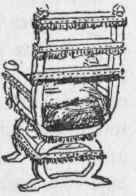
Fifteenth Century Chair
In the Treasury of Saint Mark's in Venice there is a carved walnut chair, with a high back, which is said to have been used as the Doge's throne from the time it was made, - at the beginning of the Sixteenth Century. It is of beautiful proportions and beautifully carved. The decoration is much like the marriage-coffers of the period and also the armoires.
The chairs at the beginning of the Sixteenth Century were painted, as they were in the Middle Ages, to match the rest of the furniture. The high-backed chair was the same in France as in Italy. The low-backed chair was square, or in the form of a trapeze, either with or without arms, and with a narrow or straight back.
During the greater part of the Sixteenth Century the favorite seat was what is known as the Spanish Chair. It is a square chair with high back, carved arms, turned legs and connecting rails, the front bar being broad and variously carved and decorated. The back posts and arms usually terminate in heads of lions or other animals. The seat and back were frequently covered with some rich woven and embroidered stuff, fixed to the frame with large-headed nails. The more correct material, however, was stamped Spanish leather.
The faudesteuil swarms in the inventories of the rich in the Seventeenth Century. Being upholstered with leather or woven stuff, it was not carved except on the arms, the framework being decorated with painting and gilding, and in Italy and Spain with marquetry.
The Spaniards of the Renaissance made considerable use of the Italian tarsia methods of decoration, but still more of marquetry, produced by mauresque artists. Spanish cathedrals and churches still possess numerous folding-chairs of this period. The ornamentation consists of delicate geometrical patterns of inlaid wood, bone, white or stained ivory, and tin. Similar chairs were made in Venice in imitation of the work imported from Egypt and Syria.
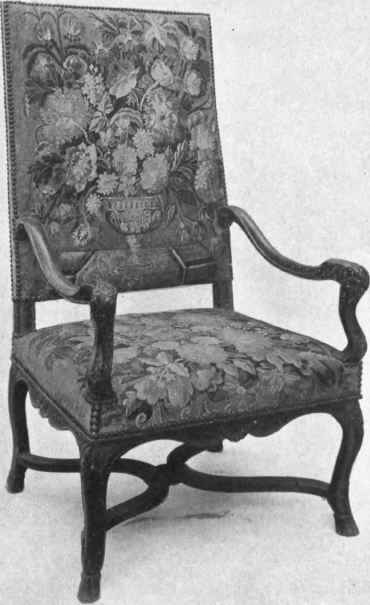

Plate LXXXVIII - Regency Arm-Chair, Covered with Tapestry and Chaise Confessionale - Metropolitan Museum
As is the case in other countries, we have to turn to the choir-stalls of the Spanish Cathedrals for the beginning of the modern chair. It is supposed from the Germanic style of the figures and ornamentation that the earliest wood-carvers that worked in Spain were from the Low Countries; but about the beginning of the Sixteenth Century the carvers seem to have been entirely Spanish. On Plate LXXVIII. Italian choir-stalls of the Sixteenth Century are represented.
Large arm-chairs, four square in form, with the seat, back and arms covered with leather or embroidered stuffs, were used. Low stools were also common.
Although the Spaniards, during the Renaissance, frequently used tarsia like the Italians in colored woods, in a great number of cases their marquetry work resembled rather the style of the Moorish artists. A great many X-shaped chairs, still in existence, are covered with delicate geometrical designs of wood, white or tinted ivory, and even metal. Some are in the Cathedral of Toledo.
The fald-stool came into vogue in the middle of the Sixteenth Century. Cotgrave (1611) defined it as "a low, large and easy folding chair, having both a back and elbows." In France it was known as the faudesteuil, and was also called chaise brisee, ployante, a tenailles, and a molette. In Italy, it was called a forbid; and, in Spain, de tijera, or scissors, on account of its X-shape. (See Plate LXXX.)
In French inventories it appears often and in considerable variety under the Valois. In 1556, we read of ten chaises a tenailles for seats for the princesses at the table; in 1572 a chair of walnut wood folding with hinges, and high back, back and seat covered with black velvet, the nails gilt; and in 1589, the Isle des Hermaphrodites says that the "King and his two followers sat at the table in velvet chairs made in the style called brisees. The rest of the troupe had chairs which opened and shut like waffle-irons."
Lyons was famed for the caqueteuses or caquetoires made there. Cotgrave defines the word as the "seat whereon women used to sit at a meeting where they prattle together."
Continue to:


My Books

