


Seats. Part 5
Description
This section is from the book "Furniture", by Esther Singleton. Also available from Amazon: Furniture.
Seats. Part 5
Trevoux describes it as a "low chair with a very high back, and without arms, on which people gossip at their ease beside the fire." It came in about the middle of the Sixteenth Century.
One authority says that the chaise caquetoire, or chaise perroquet, described all chairs of this age with open backs, whether composed of two, three, four or five horizontal rails or carved or turned backs.
Whether the word perroquet was taken from the old French mast or whether it was called parrot chair on account of it serving for gossip (caquetoire) is a subject for conjecture. At any rate perroquet is used for the folding-chair. Saint Simon says: "Mon-seigneur himself, and all who were at the table had seats with backs of black leather which could be folded up for carriage use and which were called perroquets." In 1690, we read that "folding chairs which are supported by bands or strong canvas, to make them more flexible, are called folding chairs; and when they have a back, they are called perroquets and they are used at the table."
A good description of this kind of chair is given in Catherine de' Medici's inventory. The famous Queen had "two little chaises caquetoires covered with tapestry and trimmed with fringe of green silk and fringe of gold threads, tufted."
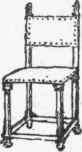
Flemish Low Leather Chair, Chaise Caquetoire, Seventeenth Century
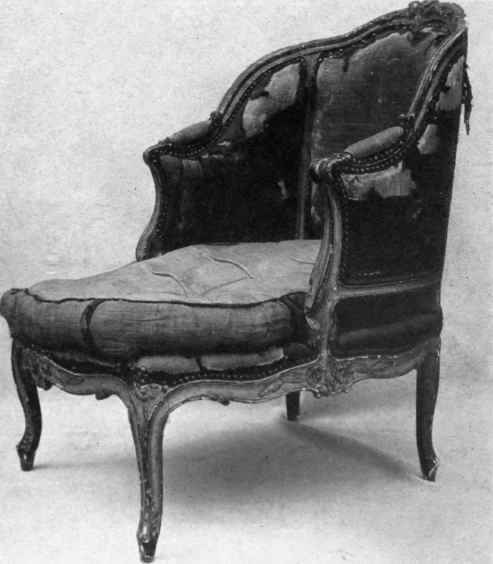
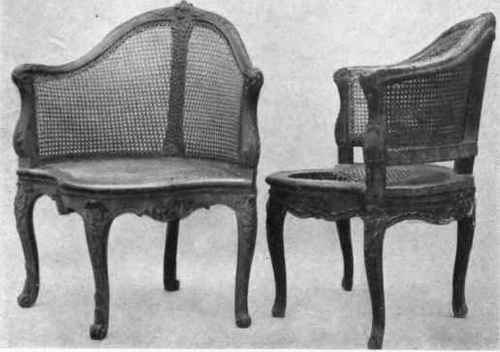
Plate LXXXIX Louis XV. Bergere - Louis XV. Gondola Chairs with Cane Seats and Backs - Metropolitan Museum
Cardinal Mazarin had in 1661 twelve chaises a perroquet, the frames of walnut wood and covered with red crimson velvet trimmed with silk of the same shade.
The chaise voyeuse seems to have been introduced in this reign. The side supports were continuations of the back legs, and the top rail was covered with a cushion. The back of the chair was shaped like a violin, and on the seat, which was very high, the gentleman sat astride, resting his arms on the top rail, as he observed the card-table, play, or the company. The voyeuse reappeared with up-to-date alterations in the days of Louis XVI. (See Plate XCI.)
There were several varieties of the chair with a low back. It was made with and without arms, with solid and with open back; sometimes it was upholstered, and sometimes plain; the back was sometimes straight and sometimes slanting; and the seat was sometimes square, and sometimes broader in front than at the back. These chairs that were relatively light and comfortable in comparison with those of the preceding period, are numerously represented in the great collections.
The typical Flemish arm-chair of the early Seventeenth Century is shown on Plate LXXX. The uprights are turned, the double rails grooved, and the back posts terminate in carved lions' heads. It is upholstered with leather; the nails have large brass heads.
Contemporary with this is the French chair (Plate LXXX.), which is similar in form and general construction. It shows, however, the change from heaviness and solidity towards grace and lightness.
Two Flemish arm-chairs in the Louvre are represented on Plate LXXIX. The one with the drawer under the seat is attributed to the end of the Sixteenth Century. The other, with caned back and seat, is a remarkably fine model of the chair that was so popular in England and the Low Countries from 1660 to 1700. The modern name for it is the "Charles the Second Chair."
"The Flemish chair was imported in 1690, was weak in construction - and is generally to be met with in a 'sprung' condition as to its back - at the plane of the seat; the badly chosen woods in which it was all too often executed, have perished at the hand of Time, aided by the 'worm.' In character, it was ambitious, but painfully hybrid. Let us examine one. Portuguese scroll-turned pillars at back; legs and possibly stretchers of the same feeling; Spanish feet; brace of under-frame and back splat Flemish, with Louis Quatorze under-framing, the whole upholstered in some brilliant Flemish wool-work. Replicas of this chair were produced in England by the imported Flemish artisan, but a change came over the scene when our workmen began to assert themselves. Portuguese turning below the seat and the Spanish foot disappeared, together with the Flemish brace, in favor of well-ordered turning, built up more on the lines in vogue in France. Native wool-work took the place of foreign, and construction received more attention. Experts differ in fixing the absolute time at which the transition took place, but the more chaste the leg and stretcher, the better the building and the more homely the upholstering scheme, so much the more likely that we have before us an example of English handiwork." 1
1 O. G. Wheeler.
Marot kept to the term-shaped legs and flat, curved stretchers. His chairs are large and heavy, and usually have enormously high backs especially adapted for showing off the beautiful materials that he also designed. Sometimes the bases were decorated with swags of drapery or scallops, edged with braid or fringe. He often used the acorn or the flattened bulb for feet.
Mahogany was now coming into favor as a cabinet wood; and chair frames were made of it as well as of walnut. The new Anglo-Dutch styles presented the following characteristics: The leg was cabriole, ending in a hoof foot, and later in the ball-and-claw. Sometimes the legs were connected with stretchers, but as time progressed these were discarded altogether. The solid curved splat was jar or vase shaped, and there was little carving except on the spring of the knee. There was a tendency towards greater lightness. (See Plate LXXXIV.) Two chairs placed together formed the double chair or settee. (See Plate LXXXV.)
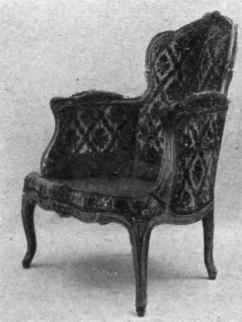
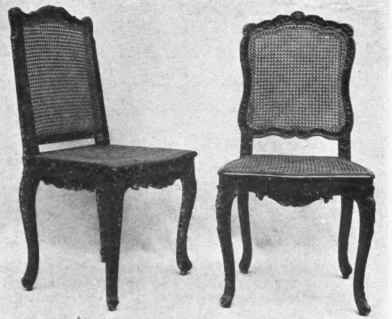
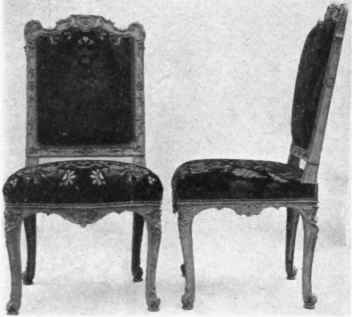
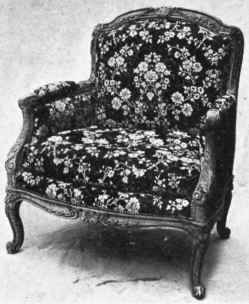
Plate XC - Louis XV. Bergere, Cane Chairs, Upholstered Chairs and Arm-Chair - Metropolitan Museum
Continue to:


My Books

