


The Cabinet
Description
This section is from the book "Furniture", by Esther Singleton. Also available from Amazon: Furniture.
The Cabinet
Generally speaking, the cabinet is a chest placed on a stand; and, like the buffet, its upper part, or chest, is closed by two doors. The interior is composed of a series of drawers usually concealed behind doors, or wings. The drawers are frequently of different sizes and each is locked independently of the other. Often, too, there are secret drawers and compartments. In the huche, as we have seen, people kept their small treasures; and many a huche for the sake of convenience was made to open on the sides; and, as time wore on, the huche was placed on a stand with feet, and was opened by means of two front doors, behind which drawers, or shelves, now replaced the little boxes with which the huche had occasionally been furnished. In this form, it was used as a marriage coffer; and, when a high stand was added, it was called a cabinet.
Thus, a development of the simple huche, the cabinet became one of the most sumptuous and ornate pieces of furniture; and the wood cabinet-maker was employed to describe the artisan who made fine furniture, while the common joiner made the simpler pieces.
Some authorities insist that this form of furniture is of Oriental origin; and certainly the examples produced in some countries show Eastern influence in both form and decoration. Venice, Spain and Portugal received many cabinets from the East; and in Spain and Portugal the cabinet was made in great numbers, especially in Vargas, a province of Toledo, from which some authorities say the word varguenos, or barguenos, is derived. Where these cabinets were ornamented with marquetry or pierced metal-work, or made of exotic wood, carved or incrusted with ivory or ebony, they were of a special fashion that did not cross the Pyrenees. Cabinets of tortoise-shell, incrusted with ivory or mother-of-pearl, were made in Lisbon by Prabro Fibrug; and one signed Jeronimo Fernandez, 1661, is in the South Kensington Museum.
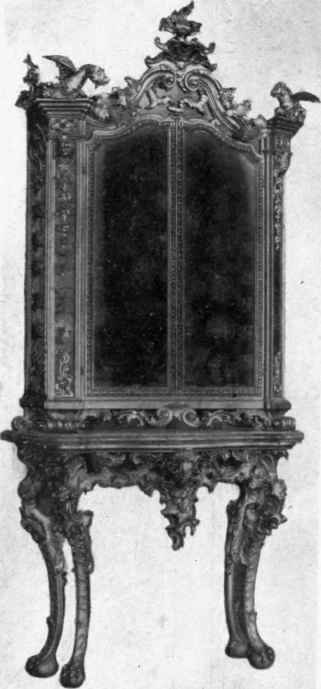

Plate LX - Eighteenth Century Italian Carved and Gilt Cabinet on Stand Eighteenth Century English Carved and Gilt Cabinet on Stand Lucca
In the varguenos the adaptation of the coffer is very evident. The long box is placed on a stand consisting of two legs strengthened by a balustrade. The outside of the simple box is ornamented with iron-work. The flap lets down and is held by supports pulled forward from their invisible hiding-place. The interior, then seen, is divided into a number of little drawers, or closets enclosed by wings. The interior of these Spanish cabinets is exactly like the Italian and Flemish cabinets, the only difference being in the style of decoration for the faces of the drawers and shutters. In an old dialogue published in 1669, the following questions are asked and answered: "How much has your worship paid for this cabinet?" "It is worth more than forty ducats." "What wood is it made of ?" "The red one is made of mahogany from the Habanas, and the black one is made of ebony and the white one of ivory. You will find the workmanship excellent. Here you will find a finer cabinet." "Where was it made?" "It was brought with these chairs from Salamanca."
Cabinets decorated with pietra dura were imported into Spain, for Madame d'Aulnoy, when describing the house of a grandee of Spain in her Voyage en Espagne (1643), speaks of "fine cabinets enriched with stones, which are not made in Spain." " What I find most beautiful," she adds, " are the escaparates, a species of small cabinet, shut with one door and filled with every imaginable rarity."
Among a list of Spanish wood-carvers of the Sixteenth and the Seventeenth Century, the names occur of Francisco, master-maker of cabinets in ebony and ivory (1617), and Lucas de Velasco, master in painting and gilding cabinets (1633).
Cabinets and armoires were also covered with tortoise-shell and gilt-bronze, and enclosed by glass doors. Cabinets of ebony, inlaid and covered with repousse silver-work must have been very generally made in Spain. Silver was used to so great an extent after the conquest of America that a law was issued in 1574 prohibiting with the utmost rigor the making and selling of this kind of merchandise in order not to increase the scarcity of silver. "No cabinets, desks, coffers, braziers, etc., shall be manufactured of silver," was one order issued.
Cabinets of inlaid ivory, or different colored woods, were brought into Spain from Italy and Germany; in fact, so many cabinets and escritoires were imported that a petition was presented to the King by one Pedro Gutierrez begging for protection for this industry. We also learn that "The cabinets and escritoires (contadores y bufetes), which were worth 500, 600 and 700 reales when brought from Germany, are now made in Spain for 250 and 300 reales each; " and in 1603 Philip III. issued an edict in which "cabinets of every kind coming from Nuremberg are not allowed to enter the country."
Escritorios de la Chine, described by De Laval (see page 38), were probably the same kind of articles that Catherine of Braganza took with her sixty years later when she went to London as the bride of the king; for Evelyn tells us that:
"The Queen brought over with her from Portugal such Indian cabinets as had never before been seen here."
Flanders excelled in making cabinets; and Antwerp was especially famous for them. French noblemen had such a fancy for collecting Flemish cabinets that Henri II. sent French workmen to the Low Countries to learn the art of making them and of carving in ebony. On their return, he established them in the Louvre. One of these was Laurent Stabre; another, Pierre Boulle, the uncle of Andre Charles Boulle; and another, Jean Mace of Blois, who was given a lodging in the Louvre "on account of his long practice of this art in the Low Countries, and the skill he has shown in his cabinet-work in ebony and other woods of various colors that he has presented to the Regent Queen."
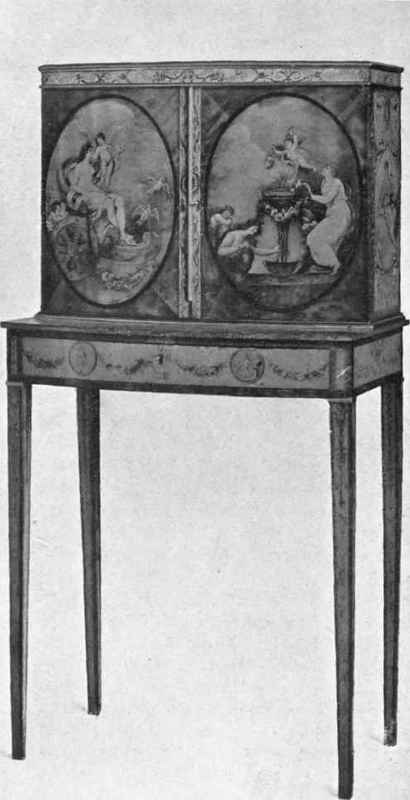
Plate LXI - Eighteenth Century English Painted Cabinet on Stand
Continue to:


My Books

