


Henri II. Style
Description
This section is from the book "Furniture", by Esther Singleton. Also available from Amazon: Furniture.
Henri II. Style
"The Style Henri II. is more severe and geometrical than that of Francois I. The ornamentation of the projections shows more restraint, and the general shape of the object is more rectangular. The vertical dominates the horizontal. Columns with long shafts finely fluted take the place of the human figures that acted as supports in the preceding period."1
The grand lit a baldaquin of the period of Francois I., reproduced on Plate XIII., is one of the treasures of the Cluny Museum. It was carved by French artists, and is greatly admired for the elegance of the details of its decoration. The baldachin is supported in front by columns, and at the back by figures of Victory and Mars. The ornamentation of the headboard is elaborate, consisting of a ducal crown, fruits, mascarons, rosettes and dolphins. The hangings and coverings are of later date than the bed, having belonged to Pierre de Gondi, Bishop of Paris.
1 P. Rouaix.
A handsome armoire made in the Ile de France in the middle of the Sixteenth Century, reproduced on Plate XIV., is of unusual construction. The lower part is open: the upper part consists of cupboards and drawers. The central door is decorated with a figure of Hebe in a medallion surmounted by genii. The side doors have niches containing pyramids.
For the characteristics of the furniture of the second half of the Seventeenth Century there is no higher authority than M. Bonnaffe, who says:
"With Charles IX. and Henri III. the type still remains excellent, but is richer and more effective. The carving is abundant, the mouldings graved, the ornaments strapped, and the reliefs are more strongly accented. It is the reign of caryatides, terms, satyrs and chimaeras which the artists multiply with inexhaustible imagination. Du Cerceau designs for the workshops new arrangements and combinations which are sometimes singular, but always of great ingenuity. Gilding and silvering were lavishly employed. A contemporary says that people wanted all their furniture to be gilded, silvered and inlaid.
"Checked by the civil and religious wars, the furniture industry revived under Henri IV. The designs are somewhat heavy and overloaded, but still of grand appearance and fine execution. The over-long columns, joined or surrounded by foliage and rising as high as the cornice, the panels adorned with cavaliers, the moustached terms, and the inlays of fine copper thread and mother-of-pearl belong to this period."
The greatest name of this period is that of Androuet Du Cerceau, who was born about 1510 and who travelled when young into Italy, where he fell under the influence of Bra-mante. On his return home, he issued designs that were practically taken from that architect. His idea was to make popular in France the forms and designs of Italian art. Among the engravings that he published was an album containing seventy-one designs for furniture, including twenty-one cabinets or dressoirs, twenty-four tables, eight beds, a choir-stall, two brackets, a panel, an overmantel, three terminals and eight socles or pedestals.

Plate VI - Gothic Press from the Tyrol (about 1500) - Nuremberg Museum
"The complicated prodigality of lines and ornaments in these designs is perfectly astonishing," a modern observer remarks, and arouses a doubt as to whether it would be possible to reproduce them exactly; but this was evidently not the intention of the author, as proved by the works executed during and after his time. All he wished was that his book should be, so to speak, a mine of ideas, from which craftsmen might borrow architectural combinations and decorative motives, to be arranged according to their own individual taste. Hence the overloading of every engraving with superfluous detail, which no one, we should imagine, would be so unreasonable as to attempt to copy servilely." 1
1 Andre Saglio.
The French readily assimilated the new Italian ideas and soon formed schools of their own. The most famous of these is the Burgundian, which was largely indebted to the work of Hughes Sambin, an architect and master carpenter, who was about ten years younger than Du Cerceau and who died in 1602. He studied under Michael Angelo and published between his architectural works an album of designs for caryatides and made and superintended the construction of a number of pieces of furniture.
"In these minor works the Burgundian artist gave proof of a very prolific and powerful imagination. He lavished carvings of figures, fruit and foliage on the surface of the wood with a view to giving a general impression of richness, whilst Du Cerceau gave more attention to grace of line, and relied for effect chiefly upon the wealth of beautiful but often minute detail. The former delighted in carving lions' heads, eagles with mighty wings, voluptuous women and muscular satyrs with merry faces. The latter was a fervent admirer of the long-limbed, elegant-looking goddesses which Jean Goujon borrowed from the Italian artists who worked at Fontainebleau, and which became widely popular through the work of the school that took its name from this favorite residence of Frangois I. and Henri II." 1
1 Andre Saglio.
De Champeaux says: "It is the taste for caryatides and grotesque figures surrounded by garlands, and supporting broken pediments that predominate in all his compositions. The result is a certain character of heaviness and bizarrerie that is more conspicuous in the buildings contributed by him than in his furniture, for the material of the latter, less cold than stone, allows more scope to the original fantasy of the artist. The furniture inspired by Sambin's designs does not exhibit the ponderous grace of the armoires and buffets made in Paris; the lines are not traced with the same tasteful harmony; but it must be recognized that no school equals the vigor and the dramatic expression of the Burgundian artists of this period. The figures of the caryatides and chimerical animals that support the various parts of their furniture and conceal the uprights, are animated with a brutal energy that only skilful chisels can create. Moreover, the walnut wood of which they are carved has been clothed with a warm tone that sometimes equals that of Florentine bronzes."
Another cabinet-maker of the period was Nicholas Bachelier, who was also an architect, engineer, sculptor and designer of furniture.
The carved wood chair on Plate XV. shows that this form of the high-backed chair of honor of the Middle Ages continued in favor during the Renaissance. Apart from the motives used for the decoration, the only development noticeable is the breaking up of the sides and arms of the seat into legs and posts. The smooth columns and plain bulb feet are a welcome relief from the riot of carving of much contemporary work. This chair was superseded by others of lighter form before the close of the Seventeenth Century.
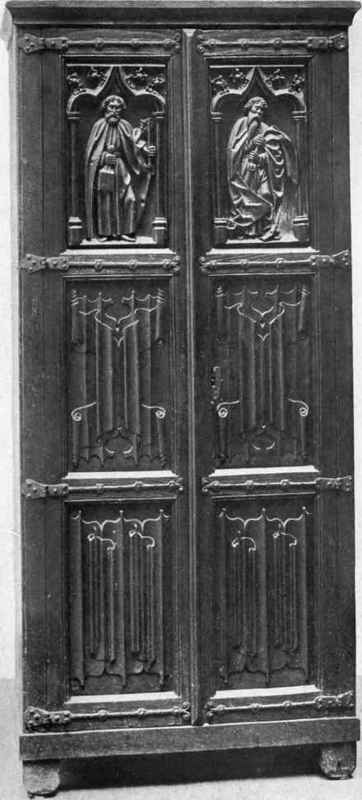
Plate VII - Gothic Cupboard with Linenfold Panels - Nuremberg Museum
Continue to:


My Books

