


The Dressoir
Description
This section is from the book "Furniture", by Esther Singleton. Also available from Amazon: Furniture.
The Dressoir
The dressoir, chest and bed were the three indispensable pieces of furniture in the Middle Ages; they are found alike in princely homes and in the dwellings of the middle-class people. The dressoir is often wrongly called a credence, of which it was a development.
The Italian word is creance, meaning dressoir; and credenza described in Italy in the Sixteenth Century as a porcelain or metal table service, was, by extension, used to designate the piece of furniture on which it was exhibited.
The word credence had, however, passed into currency in other countries to describe a shallow cupboard supported on legs, and sometimes rendered still more useful by means of a shelf. The credence was placed near the large table at meal-times, covered with a cloth, and used as a serving-table, or sideboard.
On Plate VIII. we have the early type. This is really nothing but a chest placed on legs with doors cut in the front panels; and this is the primitive sideboard. It is a handsome piece for its day with its carving of the ever-pleasing grape-and-leaf design which decorates the panels and the linen fold that adorns the doors. This piece is in the Metropolitan Museum, New York. More developed pieces appear on Plates LIV. and LV.
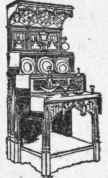
French Dressoir, Fifteenth Century
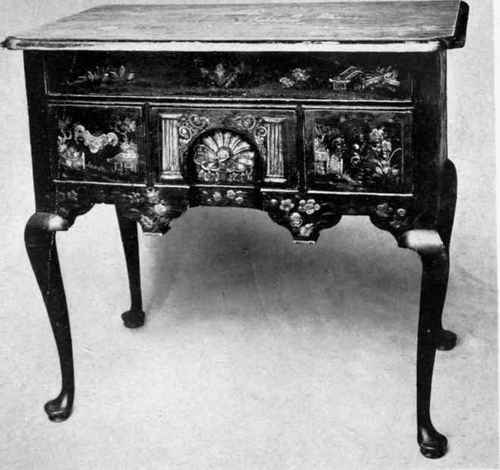
Plate LII - Low-boy, Lacquered - Metropolitan Museum
By the Fifteenth Century it had become of greater importance, was delicately carved and frequently adorned with a canopy or dais. Upon its tier of shelves, pieces of handsome and massive silver (and sometimes gold) were displayed. At this date, the credence was placed against the wall and never moved. It was now a piece of furniture intended as much for show as utility. In short, the credence had become a dressoir, for the dressoir makes its appearance at the beginning of the Fifteenth Century. On the shelves the handsome plate was displayed; and in the drawers were kept the delicacies and the linen cloths that were placed on the shelves during meals. From its advent, the dressoir was a luxurious piece of furniture, the fine proportions of which lent themselves to delicate and ornate carving.
In the castles the dressoirs were surmounted by shelves, the number of which was regulated by the rank of the owner; and on these shelves, which were covered with embroidered cloths, were exhibited handsome vessels of silver and gold, so massive and so abundant in the Fifteenth Century.
The form and arrangement of the dressoir, or dressoir-buffet that are to be seen in the miniatures of the illuminated manuscripts of the Middle Ages are very simple. It is little more than a chest supported on legs and supplied with doors having iron hinges. As luxury advanced, the dressoirs of the Fourteenth Century became more artistic in character; and the legs were grooved and carved with foliage and the doors were carved with tracery like the church windows. The iron-work of the locks and hinges was handsomely pierced and was set off by a background of red cloth. Above the shelves there rose a kind of baldachin, or dais, which, towards the end of the Middle Ages, was carved in the Flamboyant Style. The decorations of the panels were usually religious in subject; but the principal motive of the decoration of these dressoirs was the fleur-de-lis, the national emblem of France, which the menuisiers-huchiers always knew how to use in the most elegant manner by arranging it in the centre of the Gothic arches. The background of the lower part was generally a series of panels representing scrolls of parchment, half unrolled, - a special form of decoration used for two centuries. In the reign of Louis XL, when carving played the chief role in furniture, figures entered largely into the ornamentation of the dressoir-buffet, which, heretofore, had exhibited only foliage and details of architecture. At this period, the old French School admitted pilasters with arabesques and antique medallions of the Renaissance, though holding to the Gothic pinnacles, while the new school founded on the borders of the Loire by the Italian artists of the court, cheerfully used all the arabesques and trophies and forms of ornament brought over the mountains from Milan and Florence.
The form of the dressoir also changed - it ceased to be four-square and became a trapeze. The two uprights of the front were cut out in such a way as to form supplementary panels, which rested on two pillars formed like Gothic columns or balusters. The old French workmen habitually carved on the doors of these pieces the story of the Annunciation, while those who fell under the Italian influence covered the doors and panels with a whole vegetation of arabesques, fleurons, and trophies of exquisite elegance. Moreover, it is not rare to find dressoirs in which these two styles are mingled; and it is impossible to say to which School they belong. After a time, the fusion was complete and the workshops of Ile-de-France, Touraine, Normandy, Auvergne, Burgundy and Lyons produced works in the new style, but which were absolutely French in character. The work of Jean Goujon and Germain Pilon inspired the wood-carvers of Normandy and 1'Ile-de-France, while Hugues Sambin was influenced by the sculptors of the Rhone valley and the arabesques designed by the printers of Lyons.
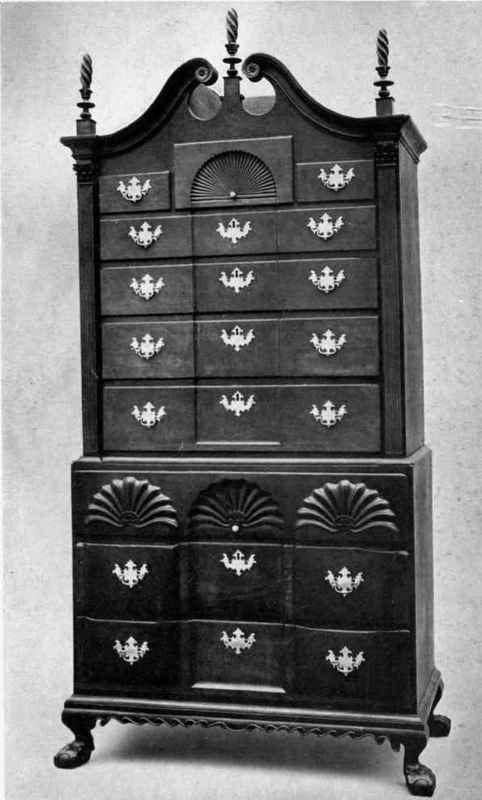
Plate LI11 - Double Chest of Drawers, or Chest-upon-Chest, Mahogany - Metropolitan Museum
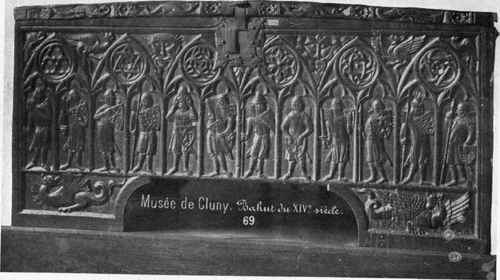
Plate I - Bahut. Fourteenth Century - Cluny Museum
The dressoir, or buffet, of the Sixteenth Century differed little in form from previous models. In some examples, however, both parts were open, and neither contained a cupboard; in others, the armoire was in the lower part. Some of them might be compared in form to the modern upright piano. Magnificent carving characterizes the Burgundian examples as well as those of the Lyonnais School. The panels are frequently carved with mythological or classic subjects, and chimaerae or satyrs issue from the graceful and abundant foliage in the style of Goujon and Du Cerceau.
In the museums and private collections a great number of dressoirs are preserved. The oldest examples, dating from the beginning of the Fifteenth Century, are very simple in their decoration. Those dating from the reign of Louis XI. are frequently carved with the Annunciation. Beautiful examples, on which sometimes the monograms of Louis XII. and Anne of Brittany, are seen, were made by the School of Touraine. Less delicately carved but splendid examples were produced in Germany and Flanders; but perhaps the handsomest of all were made by the joiners of Burgundy and Lyons.
A Burgundian dressoir is shown on Plate XII. It is made of carved wood, furnished with two doors and two drawers, and supported on a console with two pillars. The back of the console is carved with two cartouches, one bearing a coat-of-arms, and the other the date 1570. The base rests on flattened ball feet. The carving is elaborate, consisting of caryatides, foliage, palmettes and scrolls. The panel of the door on the left represents the Sacrifice of Abraham and the one on the right, the Blessing of Jacob. Above the one is a figure of Justice; above the other, a figure of Charity.
Continue to:


My Books

