


V. Tables
Description
This section is from the book "Furniture", by Esther Singleton. Also available from Amazon: Furniture.
V. Tables
EGYPTIAN tables were quite simple in form and their ornamentation consisted of painting and inlay. In the ordinary home they were scarce, because people who use the floor for a seat have little use for tables.
"The old Greeks and Romans did not sit at table as we moderns do, but like the eastern races of to-day, reclined on couches each long enough for three guests, for there were always three or nine at table, the number of the Graces or Muses. Their tables were much lower than those of the following ages, for there was no necessity to provide space for the accommodation of man's extremities, neither did the tops of the table project as do those of later times. The couches occupied three sides of the table, the fourth was left free for the convenience of serving. The tables themselves were sometimes quite simple; but costly materials were often used for those belonging to the rich Romans, whose love of luxury and magnificence extended not only to the table ornaments and utensils but also to the tables themselves, the supports of which were sometimes of precious metals, the top being formed of a marble slab. Nor was this extravagance confined to the Romans, for we read that the Emperor Lothar (A. D. 842) had one of his magnificent tables, which was made of gold, cut up into pieces and divided among his followers. Mosaics of tortoise-shell and ivory were also used for the adornment of the tables of the ancients; indeed, here, as in all things, thought and artistic skill were brought into juxtaposition to produce noble work. Costly woods were brought from afar for their use, the glorious Thuja arbor vitoe from the forests of the Atlas Mountains was used for the profile, which was formed from a single piece cut as near as possible to the root of the tree where the markings were most beautiful, resembling the eyes of the peacock's feather or the richness of lines and coloring of the skin of a tiger. In this as also in the following ages metal was used for tables, which were round or oblong in form, the former being used as now when the number of diners was limited. But more often they were of oak, pine, chestnut, pitch-pine, or other scented woods; while the trestles were made of simple wooden laths, in contradistinction to those of the Romans, whose trestles were elaborate monuments of art."1

Roman Table
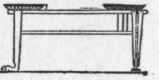
Greek Table
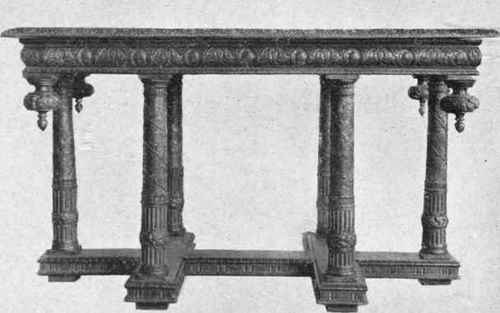
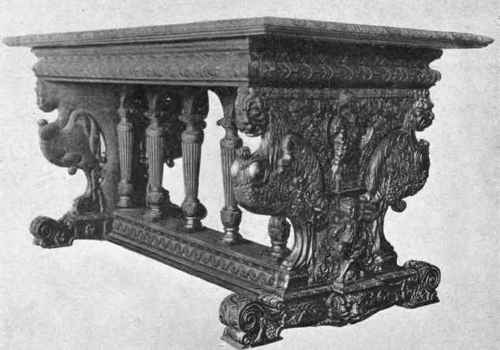
Plate CIV - Sixteenth Century Flemish Table (Sambin School) - Table a Veventail
The Byzantine tables had columnar legs and sometimes lions' feet. Some also were small and round and stood on one support ending in three feet. The tables for meals were very low.
The tables at which the Germans and Scandinavians feasted were very massive and had four strong legs. There were also sideboards supported by saw-bucks. The Franks also had big, heavy rectangular tables, and small, light round ones. Charlemagne had three silver tables and one of gold. These were engraved with a map of the heavens, and with plans of Rome and Constantinople. In the Tenth Century, the dining-tables were sometimes rectangular and sometimes semi-circular, and rested on upright legs or on X-shaped supports that could be folded up. Round and oval tables came into fashion about 1150; but the rectangular shape returned to favor in the Thirteenth Century.
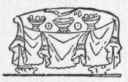
Anglo-Saxon Table
1 A. S. Levetus. 217
Until the Sixteenth Century the word "table" was not used in its present sense. Board was the word in use; and it was perfectly descriptive, for the dining-table consisted of a simple board supported on trestles. In the great hall, the board was large, consisting of a great oaken plank, or planks. Sometimes this board was hinged and could be turned against the wall? It was always supported by trestles.
Besides wooden tables there were great banqueting-tables of stone in the halls of princes and kings. Froissart mentions one in describing the festivities on the entry of Queen Isabella into Paris in 1389. "You must know that the great table of marble, which is in the hall and is never removed, was covered with an oaken plank, four inches thick, and the royal dishes placed thereon. Near the table, and against one of the pillars, was the king's buffet, magnificently decked out with gold and silver plate, and much envied by many who saw it. Before the king's table, and at the same distance, were wooden bars with three entrances, at which were sergeants-at-arms, ushers and archers, to prevent any from passing them but those who served the table; for in truth the crowd was so very great that there was no moving but with much difficulty. There were plenty of minstrels, who played away to the best of their abilities."
The table at which the king was sitting was a very famous one. In Sauval's Antiquites de Paris, we read:
"At one end of the hall of the Palace was placed a marble table that filled up almost the whole breadth of it, and was of such a size for length, breadth and thickness, that it was supposed to be the greatest slab of marble existing."
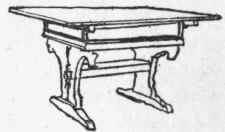
German Table, Fifteenth Century

Plate CV - Gate-legged Table - Metropolitan Museum
It served, for two or three hundred years, very different purposes: "at one time for a theatre, on which the attorneys' clerks acted their mummeries, and at another for the royal feasts, where only emperors, kings, and princes of the blood were admitted, with their ladies: the other great lords dined at separate tables. It was consumed by fire in 1618."
Continue to:


My Books

