


Tables. Part 2
Description
This section is from the book "Furniture", by Esther Singleton. Also available from Amazon: Furniture.
Tables. Part 2
The other tables were evidently the usual board and trestles; if they had been of heavy, solid oak, they would have been pushed aside by pressure instead of being upset. Froissart, who was present at the above-mentioned feast, tells us: "There were two other tables in the hall, at which were seated upward of five hundred ladies and damsels; but the crowd was so very great, it was with difficulty they could be served with their dinner which was plentiful and sumptuous. There were so many people on all sides, several were stifled by the heat; and one table near the door of the chamber of parliament, at which a numerous company of ladies and damsels was seated, was thrown down, and the company forced to make off as well as they could."
In the Fourteenth Century Jean of Burgundy had "two dining-tables," one with folding leaves, and both with feet of ebony and ivory.
The Renaissance tables are only rich elaborations of the board and trestles. The workmen had only to connect the struts of the trestles in the centre of the table in order to produce a rough model of the richly-carved tables in vogue from the days of Henri II. to Louis XIV.
The usual model was a table standing on four feet joined by stretchers, or standing on two rails, also united by a cross-piece. In very ornate tables, however, the end supports, which spread out in the shape of a fan, were carved in a very complicated style. From the stretcher, or crosspiece, slender columns or pillars rise to support the centre of the slab, while the ends are supported by the elaborately carved scrolls or fan, on which appear masques, satyrs, mermaids, dragons, or rams' heads garlanded. Each of these ends in turn stands on a foot, terminating in a horse's head, lion's foot, or a scroll. The slab of the table is ornamented with a decorative edge of gadroons or scrolls, or marquetry, and the corners are decorated with mascarons or the muzzles of lions, and, perhaps, a drop ornament. These tables could be lengthened by means of a sort of sliding shelf that was concealed at each end. Thus the surface of the table could be doubled. All these tables stood much higher than the modern tables, just as the chairs of the same period did. Several beautiful examples by Hugues Sambin and his school are still in existence in museums and private collections. One by Sambin, in the Museum of Besancon, is always held up as a model of his work. It is decorated with foliage and carved ornaments, and upheld by two fan-shaped supports consisting of great scrolls ending in lions' claws at the base and rams' heads at the top, and framing the head of a grinning satyr. From this head hangs a swag of flowers.
A table belonging to the Sambin School appears on Plate CIV. It has a long stretcher on which the supporting columns rest, and these columns are further connected with arches at the top. The side supports are very massive, and are heavily carved with Renaissance figures and chimaerae.
On the same Plate is shown a beautiful table of the Sixteenth Century resting on six legs, joined by one long stretcher and two cross-pieces, and decorated at the four corners with four large acorn-shaped drop ornaments that add a graceful touch to the severity of the design. This is a typical and beautiful specimen of Louis XIII. furniture.
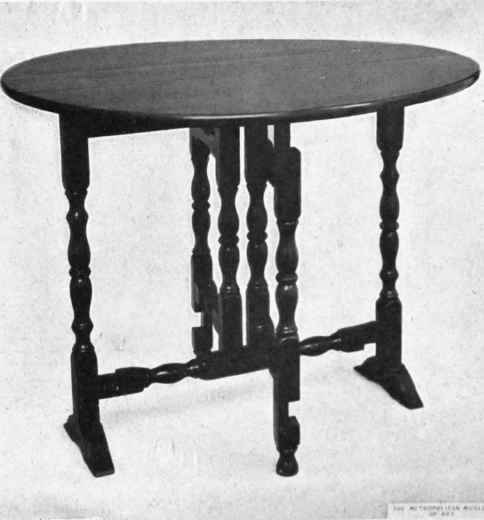
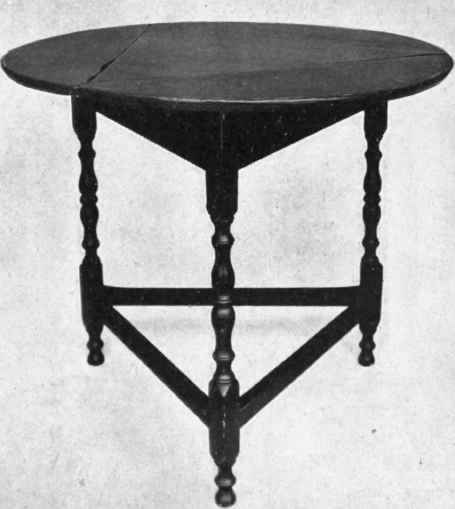
Plate CVI - Gate-legged Table and Oval Table Metropolitan Museum
When the Florentine mosaic work, composed of precious stones, semi-precious stones, or pebbles from the bed of the Arno, and mosaics of wood of different colors became the rage, succeeding the tarsia-work of the Fifteenth and Sixteenth Centuries, tables were considered especially appropriate for this kind of decoration. On a big figure, or slab, of marble or slate - usually dark in tint, though sometimes of pure white - the small pieces were arranged according to a pattern or picture, and then the whole was polished. The famous table of the chateau de Richelieu (6 feet by 4 feet), valued at 900,000 francs, now in the Louvre, was made in Florence when this kind of work was most fashionable.
Francesco de' Medici ordered a splendid library table from Bernardo Buontolenti, which is described by Vasari as made of "ebony, veneered with ebony, divided into compartments by columns of heliotrope, oriental jasper and lapis-lazuli, which have the vases and capitals of chased silver. The work is, furthermore, enriched with jewels, beautiful ornaments of silver, and exquisite little figures interspersed with miniatures and terminal figures of silver and gold, in full relief, united in pairs. There are, besides, other compartments formed of jasper, agates, heliotropes, sardonyxes, cornelians, and other precious stones."
When the new styles of the Seventeenth Century supplanted the sumptuously carved furniture of the Valois period, the table disappeared beneath its cover, which, garnished with fringe, touched the floor. The tables of this period stood on spiral legs connected by a spirally turned cross-bar, or stretcher, that ran directly through the centre, or that connected all four legs. If the stretcher was not spirally turned, it consisted of a flat bar that lay very close to the floor, joining the four legs, each of which terminated in a small flattened ball-foot. The table cloth fitted tightly over the slab and touched or swept the floor. The cloth was, in fact, a kind of case. This table was sometimes furnished with drawers and often decorated with inlay. The top slab could be lengthened at will.
A white cloth spread over the heavy cloth or rug that covered the slab, and a mirror hung on the wall above, appear in the pictures and prints of the period, show that the ordinary table served for the toilet. About 1640, the "drop leaf," or "hang ear" tables came into vogue. Many of these were made of solid walnut, or sacredaan wood.
Continue to:


My Books

