


Louis XIII. Style
Description
This section is from the book "Furniture", by Esther Singleton. Also available from Amazon: Furniture.
Louis XIII. Style
In the Seventeenth Century, the sculptured furniture of the time of Henri IV. was superseded by the simpler styles of Louis XIII. which we see in the engravings by Abraham Bosse. The carver and sculptor was succeeded by the joiner and turner (menuisier), finely carved columns were supplanted by uprights, every piece of furniture was rectangular, or nearly so; and draperies became of the utmost importance. Everything was hidden: the curtains of the bed completely covered the framework; and, when drawn, made the bed a perfect square. The curtains were often decorated with braid or lace applied so as to form little squares. The table, likewise, disappeared beneath the cloth, which was put on very tightly across the slab and then flowed in ample folds at each corner. The cloth not only reached but often lay upon the floor. Many of the chairs of the day were described as "in the Italian taste," - that is, covered with velvet and trimmed with lace, or fringe.
The monumental and ornate cabinets, imported from Germany, Italy and Flanders, were a novelty; and the Italian taste brought to France the vogue of incrustations of mosaics, hard stones, painted plates, mother-of-pearl, ivory, and amber. Brass inlay and tortoise-shell work on a background of wood mark the beginning of the style that was soon to bear the name of Boulle.
Regarding the general form of the furniture of this period there is a tendency to divide pieces into two unequal parts (the upper part being the shorter), by means of a cornice, shelf, or some decorative line: cabinets, armoires, etc., are monumental and architectural, surmounted by a broken pediment. In many cases, the mouldings frame panels in which the square form predominates. Chairs are square, as are the bedsteads; the twisted column, spiral leg, and the baluster grow ever in popularity; console-tables and gueridons increase in favor; and heavy mirror-frames become an important feature of decoration.
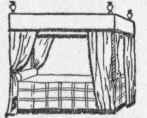
Bed, Abraham Bosse
The hexagon, which was so much used in the Henri II. period, is now supplanted by the octagon: the cartouche is a favorite ornament; is wider than it is high; and swells out into an exaggerated convex curve. Balusters also become corpulent, as do vases. The latter, moreover, stand on small bases.
Of the Style Louis Treize, Rouaix says: "At the beginning of the Seventeenth Century, Marie de' Medicis brought to France the Italians of the Decadence, with their bizarre taste, their abuse of theatrical and complicated decoration and their passion for ebony and colored woods. The value of the work no longer consisted in the modelling of the reliefs, the variety of the planes, and the play of light and shade, but in the variety of color and the variety of the material. The art of furniture suffered a complete change of physiognomy; assembled panels were given up in favor of smooth surfaces that would allow the inlay of tiny leaves, making the most of costly woods and their coloration. Forsaken by fashion, furniture of walnut wood rapidly declined. The antique column, straight and strong, became bent and twisted; the used-up, commonplace ornament had no longer any youth or energy. The carver yielded first place to the inlayer.
"The faces of the mascarons are chubby and expressionless and the cornucopias, which are so much used, are very slender, although they are overflowing with fruits. Apples and pears are the favorite fruits. The garlands are composed of fruits and leaves and very seldom are any flowers used."
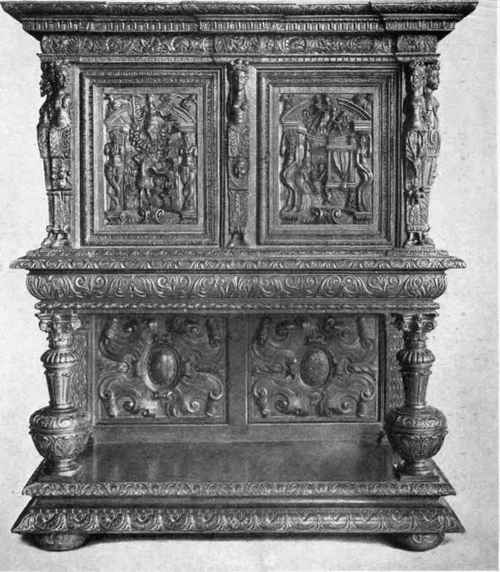
Plate XII Burgundian Dressoir (1570)
The Louis XIII. Style is dominated by the Flemish spirit. Rubens was called to Paris by Marie de' Medicis in 1625 and set the fashion in decorative art. Simon Vouet was the chief of the French masters. The compositions of Abraham Bosse, Delia Bella, Mitelli and Legare also illustrate the style. "The characteristic impression is one of heaviness and weariness. The furniture is sombre. Dark tones prevail and the marquetry of this period, consisting of metal, wood and tortoise-shell, is somewhat severe and cold. The ornament comprises round, inflated cartouches, massive balusters, twisted columns, heavy garlands (of large fruits, apples and pears, with few leaves), and strong mouldings almost bare of ornament."1
1 Rouaix.
Continue to:


My Books

