


The English Renaissance Or Elizabethan
Description
This section is from the book "Furniture", by Esther Singleton. Also available from Amazon: Furniture.
The English Renaissance Or Elizabethan
The characteristics of the English Renaissance furniture, known as "Elizabethan," are carved human figures or medallions, masks, fruits, floral and chimerical animal forms, strap-work, bulbs, arabesques, nail-heads and gadroons. Sometimes the linen-fold, or tracery of the old style, accompanies the medallions of the new on the same piece of furniture. The carving as a rule is not so delicate as the contemporary French or Italian. Oak still predominates, but walnut is more common and marquetry of native and foreign woods is in great favor. The principal woods used in inlaying were walnut, ebony, rosewood, pear, cherry, apple, box, ash, yew and holly. Pear-wood was often stained black to imitate ebony.
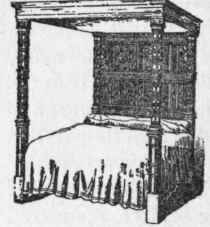
English Carved Oak Bedstead, Sixteenth Century

Plate IX - Gothic Chairs - Munich Museum
In England the Renaissance made slow progress. Henry VIII. imported able Italian artists and workmen for decorating Nonsuch House and other mansions, but the foreign novelties did not bear fruit quickly. "The English School does not possess that unity and assimilation of those schools that know exactly what to select among the new elements and combine them skilfully so as to form a new, rejuvenated and yet national art. Its character is sometimes Germanized Italian, sometimes bastard Flemish, with a touch of Anglicism in the heads and costumes; for, as M. Laborde remarks, the Englishman is always insular, and exclusively copies the types and faces of his own country.
"At the very height of the Elizabethan style, it is still a hard matter to distinguish between native wood-work and that produced by the Flemings who took refuge in England during the Spanish oppression. The English School is ruder and more material. The figure drawing is very inferior; and there is a liking for grotesque attitudes, odd composition and excessive ornamentation. There is, however, a style about the whole; it has a certain air of sumptuous grandeur which we cannot despise. Its favorite wood is oak; sometimes it employs pear, ebony, and marquetry. The old inventories also mention works in cypress-wood."1
1 Bonnaffe.
Plate XVI. shows a typical court-cupboard of this period, of carved oak with the bulb ornaments as supports. A later court-cupboard, also of carved oak and American make, appears on Plate XVII. The date attributed is 1680-1690. Both pieces are in the Metropolitan Museum.
In Flanders, the Renaissance appeared early, and made rapid progress. A French authority thus describes its features :
"Gothic by race and a carpenter par excellence, the Fleming remained faithful to the oak. He knew how to make the most of it and to relieve its somewhat rude and severe aspect by an abundant and varied imagination, an ingenious appropriateness of form, spirited tool-work and correct design. His somewhat short and squat figures do not possess the realism of the German, the distinction of the French, nor the grand bearing of the Italian; they are full, well-fed, smiling, expressive and of exquisite naturalism. The Flemish Renaissance speaks Spanish, German or French, according to the fashion, and so fluently that we do not always distinguish the country accent on first hearing. But in the evil days of the Decadence, the national temperament resumed its rights; the school, full of life and sap at the start, broad and luxuriant in its maturity, grew dull and heavy in its old age. Vredeman de Vries laboriously imitated the delicacies of Du Cerceau; Goltzius closely follows him with his puffy, corpulent figures. The artist works by rule; the decoration is monotonous; we find everywhere leather, cut, scooped, shrivelled imitations of carved wood. Soon ebony and colored species of wood imported from the Indies arrive in the market, and trade produces those immense works, monuments of massive carpentry, covered with diamond points and guilloche mouldings. The Sixteenth Century has spoken its last word."1
1 De Champeaux.
The first Flemish designers who adopted the style of the Renaissance were Alaert Claas, Lucas van Leyden and Cornelis Bos. Claas (painter and engraver) worked in Utrecht from 1520 to 1555. Lucas van Leyden (painter and engraver), whose family name was Damesz, was born in Leyden in 1494 and died in 1533. Cornelis Bos (glass painter, architect and engraver), was born in Bois-le-Duc about 1510. Another artist and engraver of the same school of decorative art was Martin van Heemskerck (1494-1574). Then came Cornelius and James Floris, whose family name was De Vriendt. Cornelius had four sons: John, a potter, who settled in Spain; Frans Floris (1518?-7o), a painter; James (1524-81), a celebrated glass-painter; and Cornelius (1514-74), a sculptor and architect.
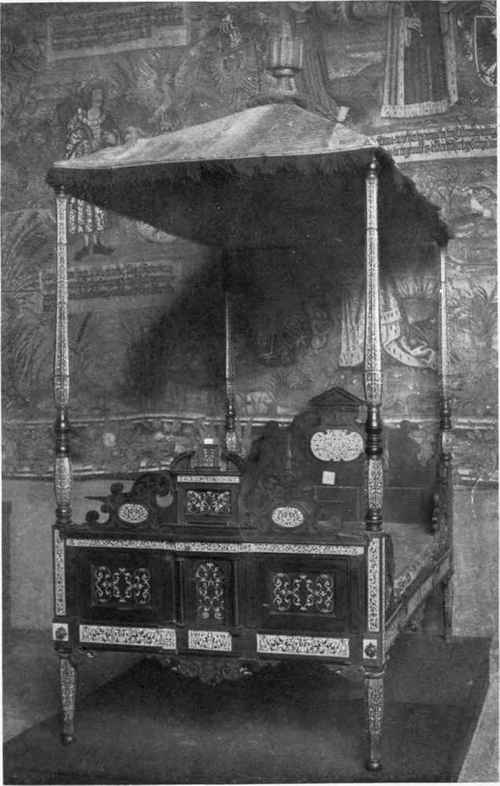
Plate X - Bedstead, dated 1530, owned by the Princess Palatine Susanna - Munich Museum
James was also a skilful engraver and was particularly noted for his panels, or compartments, which in his day were such favorite designs.
Cornelius and James Floris developed a new style, still known as the Floris style. Contemporary with Floris were Hans Liefrinck (1510-80); Cornelis Matsys (1500-56); Jerome Cock (1510-70); John Landen-spelder (b. 1511); Adrian Collaert (b. 1520); Hans Collaert (1540-1622); and Vredeman de Vries (1527-?). The designs consist chiefly of grotesques, cartouches, "cuirs," panels, compartments, friezes, trophies, "pendeloques" and other goldsmiths' motives. About 1580, De Vries published Differents Pourtraicts de Menuiserie a scavoir, Portaux, Bancs, Tables, Escabelles, Buffets, Frises, Corniches, Licts de camp, Ornements a prendre a l'essuoir les mains, Fontaines a laver les mains. De Vries was the pupil of Peter Coeck of Alost (1502-1550), who was a follower of Serlio, and owing to his varied knowledge and versatility may be said to sum up in himself the whole period of the Flemish Renaissance. In his own country, De Vries was called the "king of architects." He was contemporary of Du Cerceau and was either influenced by that great French master, or, what is equally probable, both derived their style from the same Italian source. Hans Vredeman de Vries, however, is not so light and graceful as the French Jacques Androuet du Cerceau. De Vries still preserves the old forms which, however, receive new ornamentation. His furniture still seems designed for the room it occupies and the tables, benches, bedsteads and chairs are still extremely heavy. The old linen-fold pattern dies hard, panelling is still in vogue and little upholstery occurs in his plates.

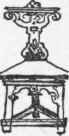
Venetian Chair, 1500, And Flemish Chair By De Vries, 1560
The works of Sebastian Serlio of Bologna were much studied in the Low Countries; and Peter Coeck of Alost was largely instrumental in making them popular because he translated Serlio's books into French and Flemish, and engraved all the plates with his own hand, besides teaching his theories to enthusiastic pupils.
Serlio eventually became the leading spirit of the School of Fontainebleau, established by Francis I., to which so many other Italian artists were attracted, and to which the Flemings flocked.
Other designers of this period were Jacques van Noye; Mark Gevaerts (1530-90); Hendrick Van Schoel; Martin de Vos (1531-1603); G. Tielt (1580-1630); Cornelius Grapheus (1549-?); Baltazar Silvius (circ. 1554); Guil-helmus de la Queweelerie (circ. 1560); Peter Miricenis (1520-66); Hans Bol (1535-93); Abraham de Bruyn (1538-?); Crispin de Passe, the Elder (1536-?); Peter van der Borcht (1540-1608); Peter Baltens (1540-79); Paul Van Wtanvael (circ. 1570); Nicholas de Bruyn (1560-1635); Clement Perrete (circ. 1569); Assuerus Van Londerseel (b. 1548); Jerome Wierix (b. 1551); John Wierix (b. 1550); John Sadeler (1550-1610); Raphael Sadeler (1555-1628); AEgidius Sadeler (1570-1629); Dominic Custode (b. 1560); Ger. Groningus; Cornells Galle (1570-1641); Philip Galle (1537-1612); Theodore Galle (b. 1560); Cornells Dankherts (b. 1561); John Sambuci (circ. 1574); Francis Sweert (circ. 1690); Judocus Hondius (1563-1611); James Hannervogt.

Plate XI - Italian Renaissance Chest - Metropolitan Museum
Continue to:


My Books

