


The Buffet
Description
This section is from the book "Furniture", by Esther Singleton. Also available from Amazon: Furniture.
The Buffet
The dressoir, which was sufficient for the needs of the life of the Middle Ages, did not suffice for the luxuries that developed in the Seventeenth Century, and the great buffet took its place. At the end of the Seventeenth Century the dressoir disappeared.
The buffet a deux corps was usually a massive and elegant piece of furniture. It may be described as two boxes, placed one above the other and opened by means of four doors, two in each part. These doors were carved with trophies, cartouches and chimaerae, and the panels separated by handsomely sculptured terms, or caryatides.
Du Cerceau and Delaune designed many of these buffets, the various parts of which are not always clearly defined; and sometimes it is hard to tell whether they are armoires, buffets, or dressoirs. In searching for what was novel, these designers often became eccentric. However, the superiority of the execution often atoned for the inferiority of the form.
The dressoirs by Du Cerceau are of three varieties; one is divided into two compartments; another into three; and the third, a chest with folding doors placed on a hollowed-out base or stand, and the top adorned with some architectural ornamentation. During the last period of the Sixteenth Century, the general heaviness increased; and the buffet-dressoir grew to resemble the models in favor in Germany and the Low Countries. They were sometimes supported on swelling balusters and ornamented with many columns; and, after a time, carving was given up for inlaid woods. The colossal Flemish armoire of Vredeman de Vries was the favorite model. In the Seventeenth Century, however, the buffet took its definite shape, - a piece of furniture in two parts, enclosed by two doors in each, the upper part being slightly smaller than the lower and placed a little back. The armoire, on the other hand, was enclosed by two long wings.
The use of the buffet-dressoir was to hold the dishes and dessert and table utensils. There are few dining-rooms in which this piece of furniture does not appear, but it was forced to become smaller for the smaller dining-room. In modern buffets, the old shelves have been restored.
In England the court-cupboard gave way to the buffet towards the close of the Seventeenth Century. In 1710, "buffet" is described as "in a vestibule or dining-room, a large table with stages in the style of a credence upon which are displayed the vases, basins and crystal for the service of the table and for magnificence. This buffet, which the Italians call credence, is with them usually placed in the great salon and closed in by a balustrade breast high."
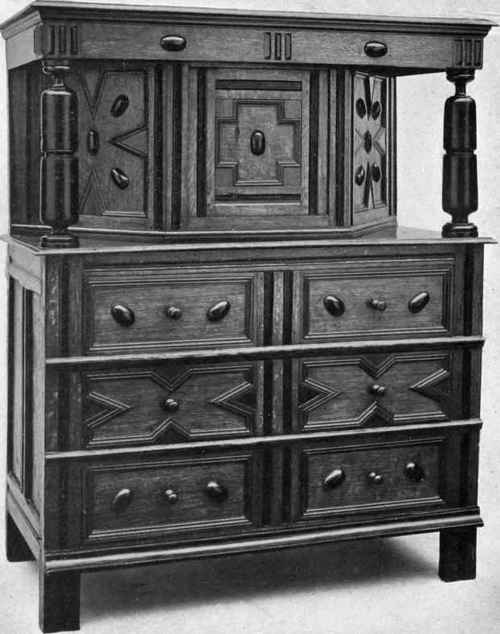
Plate LV - Court-Cupboard with applied Ornaments. Jacobean - Metropolitan Museum
In England the buffet was also the little corner-cupboard fixed to the wall. In 1748, Dyche defines it as "A handsome open cupboard or repository for plate, glasses, china, etc., which are put there either for ornament, or convenience of serving the table."
This buffet soon went out of use for the dining-room, for, in 1751, Chambers writes: "Beaufait, Buffet, or Bufet was anciently a little apartment separated from the rest of the room by slender wooden columns, for disposing china and glassware, etc., also called a cabinet. It is now properly a large table in a dining-room, called also a sideboard, for the plate, glasses, bottles, basins, etc., to be placed." The sideboard, therefore, was now nothing but a plain table, without drawers, or cupboards, or upper shelves. Chippendale gives designs only for what he calls sideboard-tables.
In France also during the first half of the Eighteenth Century, the sideboard was only a table, usually of stone or marble. In 1710, the architect D'Aviler thus describes the buffet: "The buffet can be incrusted with marble or Portland stone, or wainscotted with woodwork. It consists of a recess which occupies one entire side of the room; here you place a table of marble or stone supported on consoles, beneath which you may stand a small stone basin for cooling the wine bottles. On each side of the table is a deep niche, ornamented with aquatic attributes, such as tritons, dolphins and mascarons of gilded lead, which throw water into the little basins below, from which it escapes, as well as into the basin underneath the table. The back of the buffet is ornamented with a little gallery of consoles, above which is hung a picture, usually representing fruits or flowers, a concert of music, or other pleasant subjects."
Again, in designing a dining-room, he says: "The chimney-piece faces the two windows; the angles are rounded, and in them I have placed niches for marble tables, on which can be set the silver, crystal and dessert, during the repast, and afterwards be put away in the closet next to this room."Evidently, the carved-wood dressoir, in all its forms and developments, has gone out of fashion.
The buffet and the sideboard were entirely distinct during the Eighteenth Century. In 1803 Sheraton writes: " Buffet, anciently an apartment separated from the rest of the room by small pilasters or balusters. Their use was for placing china and glass-ware, with other articles of a similar nature. In houses of persons of distinction in France the buffet is in a detached room, decorated with pictures suitable to the use of such apartments, as fountains, cisterns, vases, etc. These ancient buffets seem in some measure superseded by the use of modern sideboards, but not altogether, as china is seldom, if ever, placed upon them, and we, therefore, think that a buffet may, with some propriety, be restored to modern use, and prove ornamental to a breakfast room, answering as the repository of a tea-equipage. Under this idea, we have given a design of one. The lower part is to be enclosed with doors, having silk curtains, with worked brass or wire before them. The upright border on the top of the lower part is of brass, together with those round the china shelves. These shelves are supported at each end by four brass columns, made very light. The lights on each side are of brass, and may be unscrewed and taken away occasionally. As these buffets would suit well to be placed one on each side of the fireplace of a breakfast-room, they might very conveniently hold such branches with the addition of one on the top. Under the cornice is a Gothic drapery and fringe above it."
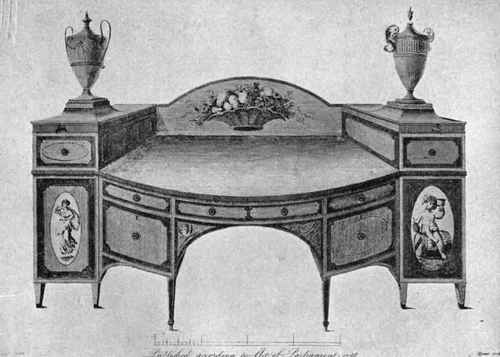
Plate LVI Shearer Sideboard (1748)
Continue to:


My Books

