


The Sideboard
Description
This section is from the book "Furniture", by Esther Singleton. Also available from Amazon: Furniture.
The Sideboard
Thus the cupboard, or dresser with drawers, - the buffet-sideboard - disappeared for a time and the sideboard, instead of being a storing place for linen, wine, silver, dishes, etc., became merely a serving-table or carving-board. An oak sideboard in the South Kensington Museum, given to the period of William III., seems to indicate that the sideboard-table belongs to the Dutch period of English furniture. In Chippendale's day, however, even the drawers beneath the top were omitted. Chippendale made sideboard-tables and not sideboards. His earliest form was in the Louis Ouinze Style and varied from four to seven feet in length. The legs were heavy and frequently cabriole in shape, ending in the claw-and-ball foot. The upper edge supporting the top was frequently carved, and the spring of the knee was also often carved. The acanthus leaf, the egg-and-tongue, the gadroon edge and shell and the Vitruvian scroll are the patterns usually employed.
"The top was sometimes of mahogany, but generally consisted of a large slab of finely figured marble, occasionally of some coarse slate or other medium, with a veneer of fine marble over it. The master eschewed the use of wood because it was liable to be marked by the hot dishes placed upon it. . . It is quite exceptional to find one of these 'boards' with a drawer or other fittings; but now and then one comes across an example with a single drawer, more commonly a slab to pull out and increase the area upon which china, glass, or silver could rest." 1
1 Wheeler.
Later in his career, Chippendale used Chinese fretwork as decoration for his serving- or side-tables, and placed large carved brackets at the angles where the legs joined the slab. Very rarely he added a low rail of wood on the edge of the slab next the wall. He also very often introduced some Gothic ornamentation into his Louis Quinze or Chinese treatment.
Chippendale's sideboard-table differed little if at all from his pier-table.
"There is considerable doubt as to the origin of the sideboard, as we now know it. It will be remembered that the original sideboard was a large side-table, and in Chippendale's time, this used to be crowned with a more or less beautifully figured marble in order that the hot dishes and plates resting upon it should leave no marks. The brothers Adam supplemented this model by two pedestal cupboards which stood one at each end of the 'board,' and these were in turn crowned by knife-urns, or rarely by a wine-urn and knife-urn. Presently we find these wing additions being incorporated with the 'board'; but who was responsible for the new idea? It may be laid down at once that the brothers Adam, Heppelwhite, and Shearer were all at work when the change took place. Successful as the Adams had been with their original tables and pedestals, they were far from happy when the new sideboard came in. Shearer seems to have been the first illustrator of the complete sideboard, and very charming examples he gave us, even though the majority of them were somewhat plain in quality." 1
Constance Simon holds Robert Adam responsible for the invention of the pedestal, or cellaret sideboard. She says: "Robert Adam's sketches for sideboards with pedestal cupboards, surmounted by urns, are the earliest examples that have come down to us of this type of furniture. It is very likely that he was the first to conceive the idea of thus elaborating the simple serving-table of the earlier part of the Eighteenth Century. The pedestals were sometimes fixed to the centre framework and sometimes detached. The sideboards were often fitted with a brass rail at the back in order to support the silver plate. The chief wood of which the sideboards were made was mahogany; the ornaments were wood inlay, carving, stucco and brass. Adam's dining-rooms frequently had a carved recess at one end with a concave vault above, and he then designed a sideboard with a curved back exactly to fit this recess."
1 Wheeler.
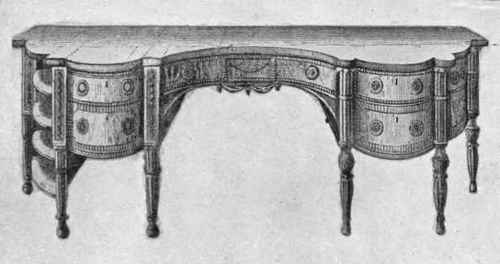
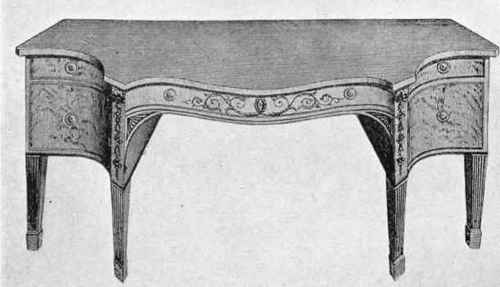
Plate LVII - Sheraton Sideboard. Sideboard designed by Heppelwhite
Heppelwhite's sideboard generally contained one long central drawer and a short drawer at each end, beneath which was a deep drawer. The legs were often ornamented with a fall of bell-flowers in satin-wood and terminated in the "spade" foot.
Heppelwhite speaks as if this form were new. He says:
"The great utility of this piece of furniture has procured it a very general reception; and the conveniences it affords render a dining-room incomplete without a sideboard." In explaining its features he tells us that "the right hand drawer has partitions for wine bottles. Behind this is a place for cloths or napkins, occupying the whole depth of the drawer.
"The drawer on the left hand has two divisions, the hinder one lined with green cloth to hold plate, etc., under a cover; the front one is lined with lead for the convenience of holding water to wash glasses, etc.; there must be a valve-cock or plug, at the bottom, to let off the dirty water, and also in the other drawer to change the water necessary to keep the wine, etc., cool; or they may be made to take out. The long drawer in the middle is adapted for table-linen, etc. They are often made to fit into a recess, but the general custom is to make them from 5 1/2 to 7 feet long, 3 feet high, and 28 to 32 inches wide."
However this may be, we find Heppelwhite making sideboards with and without drawers, i. e., the old sideboard-table, pedestals and vases, which held their place on each side of the sideboard, and sideboards which were elaborately fitted up with conveniences for the butler. The vases that surmounted the pedestals were intended to hold iced-water for drinking, water for the butler's use, or they were knife-cases. The height of the pedestal was the same as the sideboard, and the pedestal was sixteen or eighteen inches square. The vase stood two feet, three inches.
The vase knife-case was, as a rule, made of satin-wood, or of copper, painted and japanned. A small spring fixed to the stem supported the top of the case.
Shearer's sideboards are somewhat lighter in general effect than Heppelwhite's except in the case where the pedestals are joined to the body of the piece.
"Whether Shearer influenced Heppelwhite or Heppelwhite Shearer is a question to which we are not likely to find a definite answer; yet as a considerable portion of Sheraton's style was founded on Shearer's lines, the presumption is that if a man of such very decided personality was affected, Heppelwhite was no less indebted to this great but practically forgotten designer." 1 (See Plates LVI. and LVII.)
"Cellarets," says Heppelwhite, "called also gardes de vin, are generally made of mahogany and hooped with brass hoops lacquered; the inner part is divided with partitions and lined with lead for bottles; may be made of any shape. These are of general use where sideboards are without drawers."
1 R. S. Clouston.
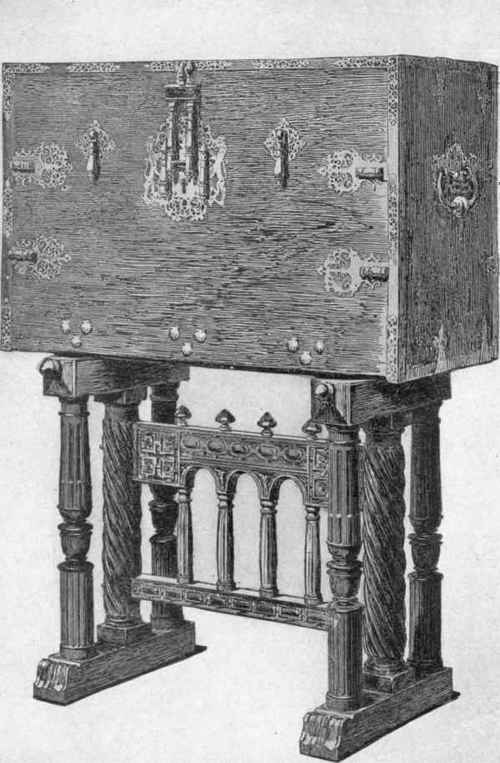
Plate LVIII Seventeenth Century Spanish Cabinet {Varguenos)
Sheraton informs us that they were made in the form of a sarcophagus and "adapted to stand under a sideboard, some of which have covers and others without." He thought it a good idea to have rings at each end of the cellaret so that the servants could move it about. He also wanted the rings, as well as the lions' feet or dolphins' heads on which his models rested, to be cast in brass and lacquered.
Sheraton continued to develop the models put forth by Heppelwhite and Shearer, but in his later period he returned occasionally to the old sideboard-table without drawers. Sideboards of this character were ornamented with a little brass rail and separate pedestals with vases stood at each side of the table.
In some Sheraton sideboards the pedestals were made separately and screwed to the sideboard, and the top slab was placed over all three parts and screwed down. The part beneath the long top drawer, curved from leg to leg, was supplied with a tambour-shutter, and, therefore, formed a little enclosed cupboard. The back of such a sideboard was decorated with a mirror or ornamental brass-work.
Although it required most delicate workmanship, the square knife-case was too well known for Heppelwhite to describe it. He merely said: "It may be made of mahogany inlaid, or of satin, or of other wood at pleasure."
Sheraton gave designs for knife-cases, both concave and convex. In his day a pair of these stood upon the sideboard. A tall vase or urn-shaped case was often made, especially for spoons.
Continue to:


My Books

