


Seats. Part 6
Description
This section is from the book "Furniture", by Esther Singleton. Also available from Amazon: Furniture.
Seats. Part 6
The two-chair back, or three-chair back, became popular in the reign of Queen Anne. This form does not consist solely in placing two or three chairs together, and adding arms, but is subject to certain laws of proportion of its own. The back of the chairs in the settee is always wider than that of the arm-chair. These two-chair back, three-chair back, and even four-chair back settees, appear in all styles, from the early jar-shaped splat and cabriole leg, through those that were pierced and carved in the Gothic, Chinese or Louis XV. style. Ladder-backs also occur in this form and shield-backs in the Heppelwhite period.
In the reign of Queen Anne, the Windsor chair came into use, and remained in popularity for about a hundred and fifty years. It was made of the cheaper kinds of wood. (See Plate LXXXVI.)
In inventories of the early Eighteenth Century the "crown-back chair" is often mentioned. It appears so often in Hogarth's pictures that it is now generally referred to as a "Hogarth chair." (See Plate LXXXIV.) From this the famous Chippendale chair was developed.
Moliere's inventory (1673) mentions "six chairs of varnished and gilded wood with their cushions of taffeta striped with satin (35 livres); two arm-chairs of gilded wood covered with green satin (40 livres); and six arm-chairs with sphinx figures completely gilded and provided with cushions for the seat and back of flowered satin with a violet ground, finished off with green and gold silk fringe (200 livres)"
The lit de repos, or chaise longue (see Plate LXXXVIL), originated in the days of Louis XIV. It generally had a headboard, and, in some cases, a head and footboard, or a back. The seat was cane and the headboard was carved. Cushions added comfort. Sometimes the lit de repos was referred to as a canape.
The legs and feet of the chairs in this reign are usually cut in a tapering form, with four sides, and ornamented with marquetry, paint, or gilding. The straining-rail is usually present and crosses the four legs, diagonally forming a sort of X. (See Plate XXV.) At the point of intersection a little ornament is placed. Some chairs have a carved front rail; others are finished with braid or fringe. The arms frequently end in the scrolled acanthus. Some of them have a cushion (manchette) on the arm.
The arm-chair (fauteuil) was very general in ordinary homes. The back was more or less inclined, the arms more or less curved, and the seat was of cane, or covered with tapestry or velvet. The carved frame shows volutes, foliage, and figures of children.
The canape and fauteuil were reserved for those of highest rank. Prints of the end of the century show ladies sitting on them at court concerts. The canape was evidently a novelty of the end of the century.
The canape of this period had a wide seat with a high sloping back, stuffed seat and back, carved arms and baluster legs. It was upholstered with velvet or tapestry of floral and arabesque designs.
Towards the close of the reign of Louis XIV. a new arm-chair appears which exhibits the dawn of the coming style of Louis XV. The slightly curved back is arched, and the feet terminate in a carved leaf, or "leaf-shoe." Other typical chairs are shown on Plate LXXXVIII. The one on the right is the "Confessionale."
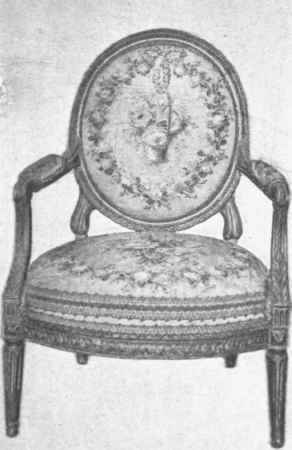
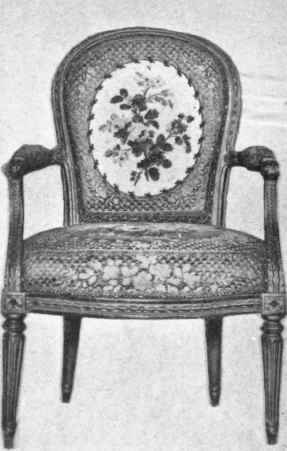
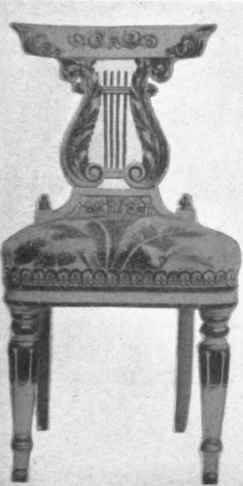
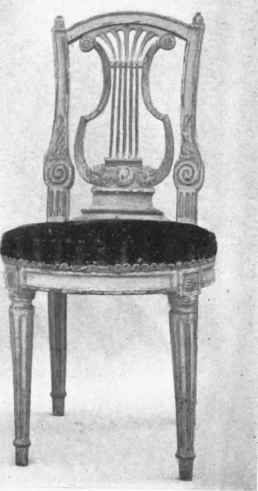
Plate XCI - Louis XVI. Chairs: Medallion Back, Covered with Tapestry; Lyre-back Voyeuse; and Lyre-back Chair
The chairs of the Louis XV. period are charming. The frames show beautiful play of line and sweeping curves, and the arm of the fauteuil is strong and finely placed. The little elbow cushion, called manchette, gives an additional finish, and is also agreeable for the occupant. The frames were not only carved and gilt but painted or lacquered. In painting one color was generally used, brightened by threads of gold or white; but again several colors were used, and even the painting known as camaieux. In less expensive homes, however, natural woods, particularly beech and oak, were more common than painted frames. In a drawing-room suite smaller arm-chairs, called cabriolets, were now introduced, and these were more arched and curved than the large ones. In the drawing-room and boudoir, it was customary to place a small arm-chair by the side of, or directly in front of, the big arm-chair, and the cabriolet had to be like the big one in form and upholstery. The materials were tapestry, representing AEsop's Fables or a Watteau picture, rich velvet or damask, with floral patterns and silk brocaded in colored flowers. "Persian," a kind of chintz, with bright designs on a white background, was frequently used for the boudoir and bedrooms. The material was tacked to the frames by means of gilt-headed or silver-headed nails placed so closely that they touched one another; and occasionally a braid or lace was used to hide the nails. A favorite pattern was called the "rat-tooth."
The causeuse is also an arm-chair of very comfortable appearance. In the Louis XV. period the angular form of the frame gave way to graceful curves. The wood-work was gilded and carved in flower and shell-work. The back and seat were then covered with Beauvais tapestry, decorated with flowers and mythological subjects and country scenes after designs by Francois Boucher and his school.
Continue to:


My Books

