


Seats. Part 7
Description
This section is from the book "Furniture", by Esther Singleton. Also available from Amazon: Furniture.
Seats. Part 7
The arm-chair, or fauteuil, with upholstered instead of open sides, makes its appearance in the set of drawing-room furniture. It was called chaise bergere. This chair was sometimes called marquise, and was frequently accompanied by the tabouret, which, placed immediately in front of the chair, made it a kind of chaise longue. The seat was not very high from the floor, and was wider than it was deep. The bergere became fashionable, and appears in the designs of Chippendale, Ince and Mayhew and Heppel-white, in whose books its name is often printed as "barjair." (See Plates LXXXIX. and XC)
The fauteuils have a wavy top rail, and curving arms with cushions (manchettes) on the elbows. Two of the period are described as having richly carved and silvered frames, the seats and backs upholstered with jonquil-colored brocade embossed with silver flowers. The fauteuil en confessional is another name for the bergere.
The gondola arm-chair (see Plate LXXXIX.) usually had a back and seat of cane, and the elbows were covered with a cushion upholstered in leather. One leg was placed under each arm and one exactly in front and a fourth in the back. A leather cushion was often added.
A fauteuil de commodite was also introduced, which had a little mahogany desk attached to the right of the chair by means of a gilded steel support; and on either side of the chair were two sconce-arms for candles. The chair and its comfortable cushion were often covered with blue leather.
Dining-room chairs followed the form of the drawing-room chairs, and were covered with leather, tapestry and "Persian," already described on the foregoing page. Leather was very popular for covering seats; and yellow and blue, as well as red leather, were greatly in evidence; but brocade and tapestry were the favorite materials for the drawing-room. The coverings of seats and backs were put on with braid of gold, silver, or a color to match the textile, nailed with gilt-headed or silver-headed nails placed close together.
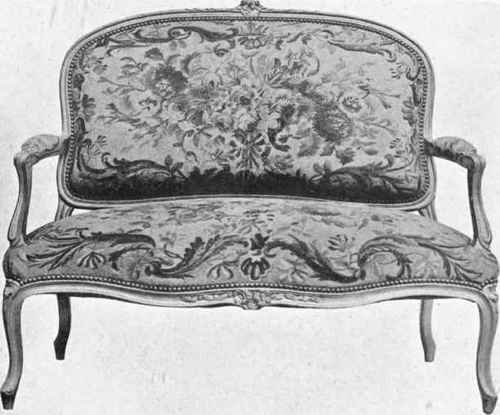
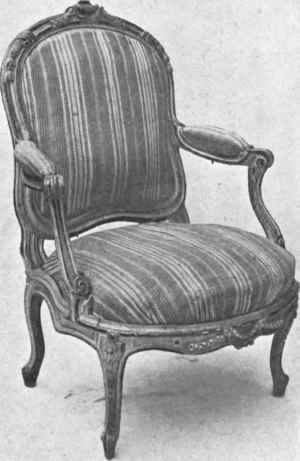
Plate XCII - Louis XV. Canape covered with Beauvais Tapestry, and Louis XV. Arm-Chair Metropolitan Museum
The first little gondola sofas, with two low seats and rounded form, that appeared in the reign of Louis XV. and were popular in that of his successor, were called ottomans. They were usually to be seen in the boudoirs, richly carved and upholstered with flowered silk. Bimont mentions them in his Manual du Tapissier in 1756.
The canape confident was a sofa consisting of from two to four seats, and at each end, by the arms, another seat at the corner was rounded off, and then there was another arm or elbow at the other side. It was very popular.
The chaise longue was now sometimes composed of two sections; the principal one looked like a large fauteuil and the smaller one a kind of tabouret. The seats of each were placed so as to touch each other, the backs facing one another. The favorite seating was cane, and handsome cushions were added at pleasure.
Those with gondola backs were called "duchesse."
The old form, called banquette, had not gone out of fashion. This name occurs as early as 1732; and as late as 1770 the King owned "nine banquettes covered with crimson plush, six feet long and seventeen inches wide, to be used at the grand convert" and "four banquettes, each having two elbows, covered with blue velvet, trimmed with gold braid nailed on with gilt nails, the wood painted blue, picked out with gold."
In 1736 we hear of "two banquettes of beech-wood, delicately carved and varnished, 24 inches long, 14 inches deep, and 15 inches high, with seats of cane, each supplied with a hair cushion, covered on both sides with crimson damask, tufted."
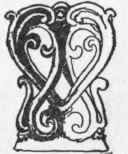
German Chair-Back, 1750
At the end of the Louis XV. period many of the chairs and settees show transitional features in the legs, framework and character of the ornamentation. The curves become more restrained, the straight line becomes more insistent, and the tapering grooved leg supplants the sweeping cabriole. In the silk covering, too, the stripe begins to take the place of the floral brocades and damasks; and garlands, shepherds' crooks, shepherdesses' hats, knots of ribbon and pastoral attributes appear in the tapestries that cover the seats.
During the transitional period between Louis XV. and Louis XVI. the backs of the chairs assume the medallion shape. The leaf-shoe is also removed from the foot by degrees, and the feet are of a console shape, ending in a scroll or a shell or a peg-top. The curves entirely disappear. The next change in the back of the chair frame is that of a sort of projecting square, then comes the shape of the handle of a basket, and finally a perfect square between two straight columns, each of which is terminated by a steeple ornament. The handsomest chairs are richly carved, though low relief is preferred. The ornament in the centre of the top rail is a bow of ribbon, or a bouquet, or garland, of flowers, or leaves. The frames are made of mahogany or walnut, but more popular is a plain wood carved and gilded, or painted, to suit the taste of the individual. Some mahogany and rosewood arm-chairs are brightened by gilded bronze ornaments. Many arm-chairs have removable cushions that fit into the frame of the chair.
Fauteuil De Bureau, By Lalonde
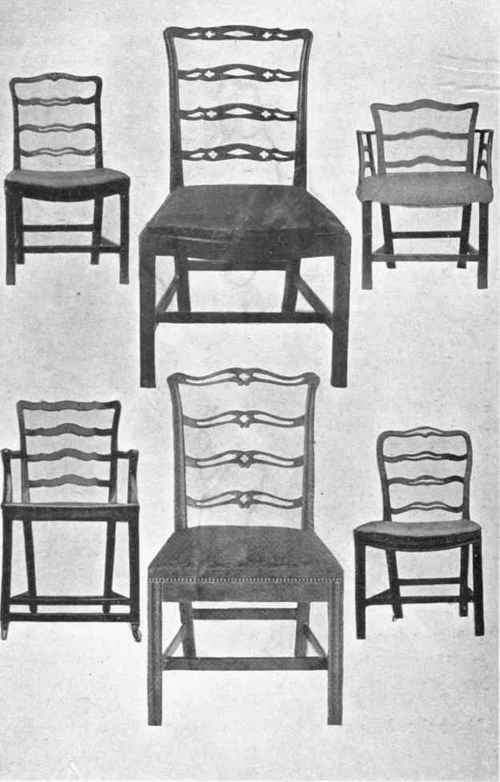
Plate XCIII - Eighteenth Century Ladder-back Chairs
Continue to:


My Books

