


Seats. Part 8
Description
This section is from the book "Furniture", by Esther Singleton. Also available from Amazon: Furniture.
Seats. Part 8
Occasionally the cushions are tufted. Cushions are also round, half round, or much flattened. Small arm-chairs are still called cabriolets. The tapestries of the Gobelins, Beau-vais and Aubusson manufactories were in high estimation as coverings for seats and subjects from Boucher, Fragonard and other artists of the period were reproduced on light backgrounds. Shepherds, shepherdesses, children at play, garlands, baskets and vases of flowers, knots of ribbon, Cupids, quivers hidden among blossoms, birds and birdcages, and many pastoral subjects and trophies were used alike in tapestries and in the figured and embroidered satins that supplanted the old figured damask. Then the stripe became the rage, although it had enjoyed a slight vogue in the days of Louis XV., when it was particularly favored by Madame de Pompadour and also Madame Du Barry. Winding ribbons, alternating with straight stripes, spangled with flowers, was a design called Dauphine, introduced at the time of Marie Antoinette's marriage with the Dauphin in 1770. Another favorite device was the feather which was also combined with the stripe. In every design the stripe appeared. At first it was hidden under branches and flowers and ribbons and feathers; but at length it triumphed over all other ornaments. All other designs were ignored and the stripe reigned alone. In 1788 Mercier wrote: "Everybody in the King's cabinet looks like a zebra."
The stripe appeared, of course, on all the velvets, silks, satins and chintzes used for furniture covering. Braids were popular and tassels and ball-fringe much used.
Chairs that were not stuffed in the back were often cut in the form of a lyre. Draped arm-chairs were called fauteuils a la polonaise, a la turque, a la chinoise, and probably matched the beds and sofas of the same name. Other arm-chairs had great wings that extended around the sides, making the chair almost square in form. The fauteuil bergere, with straighter lines than of yore, and a more aggressive arm, still holds its place in the drawing-room, and is sometimes also called fauteuil confessional. It was often supplied with an additional cushion for the seat. At this time cushions of both seat and back were frequently stuffed with hair instead of feathers or down, and were sometimes also tufted.
A peculiar chair, resembling the voyeuse (see Plate XCL), now appeared. It was called the voyelle.
The back was a lyre reaching from the seat to the top rail. The latter was stuffed. Men sat astride of the seat, resting their arms on the rail, looking over the back of the chair. The voyelle was a sort of lounging chair and had the advantage of showing off the immensely long coat-tails affected by the "Incroyables."
In the French dining-room the frames of the chairs were of oak or mahogany, with turned bars or carved splats. Sometimes the frames were painted. The removable cushions were covered with velvet or leather, or perhaps they had cane or rush seats.
Arm-chairs for the library desks were of mahogany or painted wood, of gondola form, and, as the back, and seats were frequently of cane, were rendered more comfortable with extra cushions.
The sofa, or canape, followed the style of the chairs; they were of the gondola, medallion, or basket form, and a little lower and deeper than those of the Louis XV. period. Sometimes they had high wings at each end, which gave them a cosy appearance, and sometimes they had an open space under each arm. The frames were, like the chairs, of carved and gilded wood, or painted and gilt and covered with tapestry, or with silk, or satin, or damask. The small, low and rounded sofa was called ottomane, and a certain kind of large sofa was called ottomane a la reine. With this, a square or round bolster was used. To this period belong many varieties of the draped sofa. We find lit de repos, chaise longue, duchesse, bergere, a la turque, a la polonaise, a la chinoise, and others, with and without canopies, so that the sofa merges into the bed, and the bed into the sofa. We also find plates labelled sofa bed a l'antique, a model very like the scroll-end sofas of the early Nineteenth Century.
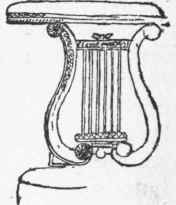
Voyelle, From Fon-Tainebleau
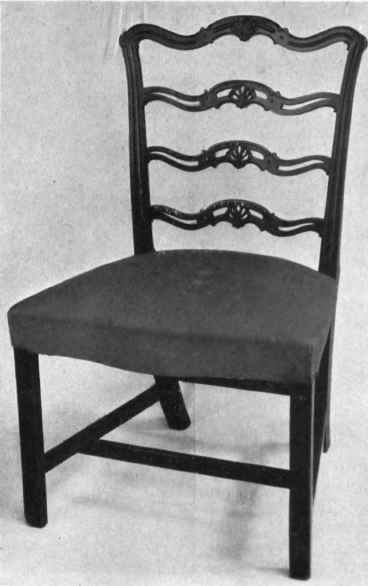
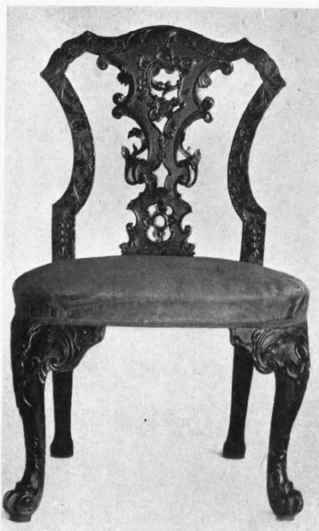
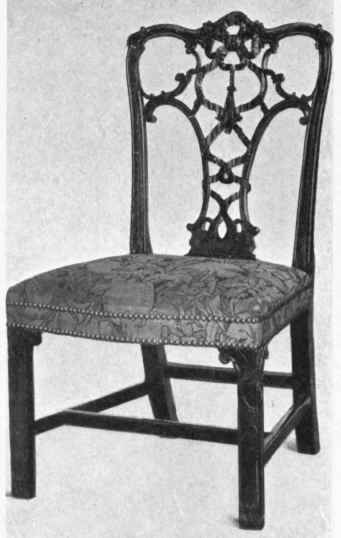
Plate XCIV - Chippendale Chairs
The duchesse is still a combination of arm-chair and stool; and is often made in three instead of two divisions.
The duchesse, the ottomane en gondole, and several varieties of the sofa-bed, appear in the boudoirs of the period. The sofa with three backs or sofa pommier, which became of such importance during the Directoire and Empire, now makes its advent.
Chippendale made Gothic chairs, French chairs, Chinese chairs, ribbon-back chairs, and chairs for the hall and the garden. He particularly excelled as an artist in his use of the ribbon, tying and twisting it in a very charming manner. The majority of the "Chippendale chairs" met with to-day have straight, square legs or cabriole ball-and-claw; but his designs show many varieties, among which are the cabriole, ending in a kind of scroll, resting on a leaf; the straight leg carved with husks; the leg composed of reeds wrapped with ribbon (anticipating the Louis XVI. Style, probably taken from some up-to-date French designer), leg ending in a hoof with ram's head on spring of cabriole knee, lion's claw on a flattened ball, and leg on which a dragon is climbing.
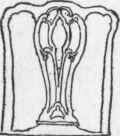
Chippendale Chair-Back, 1754
Ribbon-back chairs are, perhaps, Chippendale's favorite.
He says of them: "The length of the front leg is 19 inches; the rail of the seat (upholstered with small nails touching one another), is 22 3/4 inches; the seat is 18 inches square; and the back, from seat to top rail, 2 or 23 inches high." Chippendale adds: "If these seats are covered with red morocco, they will have a fine effect."
Continue to:


My Books

