


Seats. Part 9
Description
This section is from the book "Furniture", by Esther Singleton. Also available from Amazon: Furniture.
Seats. Part 9
A handsome ribbon-back chair appears on Plate XCV. Entwined ribbons and reversed scrolls form the splat; and in the centre of the top rail there is a large quatrefoil ribbon, from which hangs a cord and tassel. The legs are square, decorated with sunk panels carved with scrolls and rosettes at the corners. The front of the seat is slightly serpentine, and the cover is of needlework, studded with a double row of brass nails.
Chippendale is very particular in giving directions for the proper upholstery. Thus, for a set of eighteen chairs, he says:
"The seats look best when stuffed over the rails and have a brass border neatly chased; but are most commonly done with brass nails in one or two rows; and sometimes the nails are done to imitate fretwork. They are usually covered with the same stuff as the window curtains.
The height of the back seldom exceeds twenty-two inches above the seats."
Again for French chairs with elbows:
"The little moulding, round the bottom of the edge of the rails, has a good effect. The backs and seats are stuffed and covered with Spanish leather or damask, etc., and nailed with brass nails. The seat is 27 inches wide in front, 22 inches from the front to the back, and 23 inches wide behind; the height of the back is 25 inches, and the height of the seat 14 1/2 including casters."
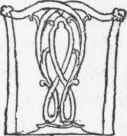
Chippendale Chair-Back, 1754
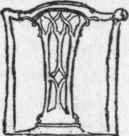
Chippendale Chair-Back, 1754
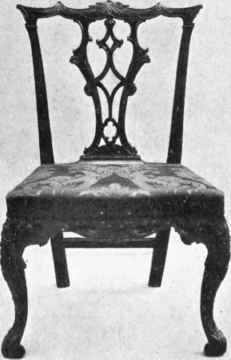
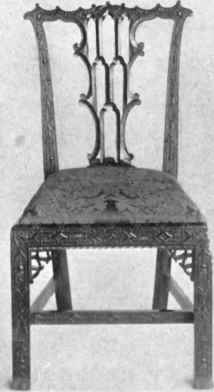
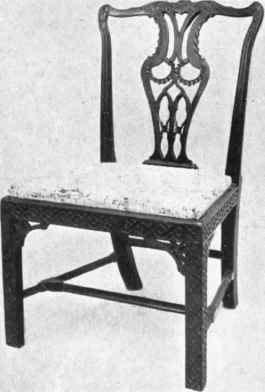
Plate XCV - Chippendale Chairs Metropolitan Museum
Chippendale also recommends tapestry or other sort of needlework for seats.
"Nine designs of chairs after the Chinese manner are very proper for a lady's dressing-room; especially if it is hung with India paper. They will likewise suit Chinese temples. They have commonly cane-bottoms with loose cushions; but, if required, may have slipped seats and brass nails. The backs and seats are of fretwork. The seat is 19 inches deep, 17 inches long; the back 20 inches high, and the legs, from floor to seat, 17 inches; and those made of pierced fretwork are 2 1/2 inches wide."
The dimensions of nine other chairs in "the Chinese manner" are as follows: Width of the square leg, 2 1/2 inches; seat front rail, 1 foot 10 inches; back of seat, 19 inches; depth, 17 1/2; height of back, 19 1/2 inches. Another had a leg 1 1/2 inches wide; 17 inches high, front seat rail, 22 1/2 inches; back of seat, 19 inches; depth, 17 inches; height of back from seat, 20 inches.
The old "crown-back" survives in the chair on Plate XCVII. though a Chippendale model. The back is massive, the side supports have splayed angles, and the top is wavy. Scrolls, foliage and blossoms run on both sides from a small central shell. The centre splat is of a tall vase form, carved and pierced with foliage, flowers and reversed scrolls. The legs are cabriole with, however, slight spring; and are carved on the knees with scroll foliage. The feet are spiral scrolls.
Chippendale's "sofa for a grand apartment" differs little from one designed by Meissonier for the Grand Marshal of Poland in 1735. Ornate as Meissonier's canape is, Chippendale's is even more elaborate, for the carving consists of shells and a Cupid on the centre of the top rail, with two large birds and bunches of flowers below him. "If gilt, with burnished gold," says Chippendale, " the whole will have a noble appearance. The dimensions are 9 feet long without the scrolls, the broadest part of the seat from front to back, 2 feet 6 inches; the height of the back from the seat, 3 feet 6 inches, and the height of the seat, 1 foot 2 inches, without casters."
When sofas are made large, " they have a bolster and pillow at each end and cushions at the back which may be laid down occasionally and form a mattress. The sizes differ greatly; but commonly they are from 6 to 9 or 10 feet long; the depth of the seat from front to back, from 2 feet 3 inches to 3 feet; and the height of the seat, 1 foot 2 inches with casters. The scrolls are 18 to 19 inches high."
Of the chaise longue Chippendale says: "This is what the French call Peche Mortel. They are sometimes made to take asunder in the middle; one part makes a large easy chair and the other a stool, and the feet join in the middle, which looks badly. It should have a thick mattress, 6 feet long in the clear, and 2 feet 6 inches to 2 feet broad." This is, of course, the Duchesse (see page 193).
Some of Chippendale's "Chinese sophas" could be converted into beds, and were supplied with canopies, curtains and valances, while others were sofas pure and simple. He gives one design which consists of a French canape covered with silk, depicting a " gallant scene " in the style of Wat-teau; and over it a pagoda-shaped canopy adorned with bells and formal draperies in festoons.
The open-back settee of two or more chair backs was also a favorite. (See Plate XCVI.)
A Chippendale sofa in the " French style " is shown on Plate XCVII., supported on seven legs, the four front ones cabriole, and carved with shells at the spring and ending in lions' feet. The arms terminate in carved lions' heads and spread out gracefully. The upholstery is old English needlework representing landscapes and pastoral scenes, put on with brass-beading. The arms are also partly covered with the tapestry. The piece is 5 feet 7 inches long.
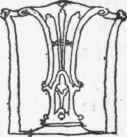
Chippendale Chair-Back, 1754
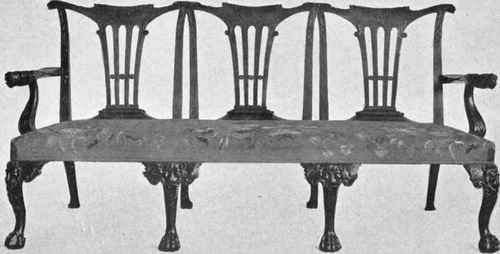
Plate XCVI - Chippendale Three-Chair Back Settee, Mahogany, Covered with Mortlake Tapestry
Continue to:


My Books

