


Seats. Part 10
Description
This section is from the book "Furniture", by Esther Singleton. Also available from Amazon: Furniture.
Seats. Part 10
Heppelwhite furniture is valued by collectors for its beautiful workmanship, durability and general lightness of effect; and, if the proportions are not always satisfactory, it must be remembered that Heppelwhite frequently made furniture - particularly chairs - "according to the size of the room or pleasure of the purchaser."
The Heppelwhite chair is very famous. Its proportions are: height, 3 feet 1 inch; height to seat frame, 17 inches; depth of seat 17 inches; and width of seat in front, 20 inches. The legs are straight and never connected by stretchers, but are frequently ornamented with the husk or bell-flower inlaid in pale satin-wood or carved in low relief. The tapering leg usually ends in the "spade" foot, sometimes called the "Marlborough" foot. The backs are usually shield, or heart-shaped, and are ornamented with the three feathers of the Prince of Wales, the urn (draped or undraped), swags of drapery, festoons of the bell-flower, the lotus, rosette and patera, and draped tazza.
Although most people associate mahogany with Heppelwhite, he did not by any means restrict himself to this wood for frames of seats. He writes:
"For chairs, a new and very elegant fashion has arisen within these few years, of finishing them with painted or japanned work, which gives a rich and splendid appearance to the minuter parts of the ornaments, which are generally thrown in by the painters. Several of these designs (his own) are particularly adapted to this style, which allows a framework less massy than is, requisite for mahogany, and by assorting the prevailing color to the furniture and light of the room, affords opportunity, by the variety of grounds which may be introduced, to make the whole accord in harmony, with a pleasing and striking effect to the eye."
Chairs with stuffed backs Heppelwhite calls cabriole chairs, and gives one "of the newest fashion." This has a shield-shaped back, a little cushion on the arm fastened by means of tiny nails, and legs representing reeds bound with ribbon. A square patera hides the joining.
Among the designs of twelve chair-backs, "proper to be executed in mahogany or japan," he says some of them are "applicable to the more elegant kind of chairs with back and seats of red, or blue, morocco leather; in these backs, which are sometimes made a little circular, are frequently inserted medallions, printed or painted on silk of the natural colors; when the back and seats are of leather, they should be tied down with tassels of silk or thread.".
It is noticeable that Heppelwhite generally uses the brass-headed nail for fastening his coverings to the frames of seats. These nails are placed very close together and are frequently arranged around the edge of the seat in the form of festoons or scallops.
For drawing-room chairs, he insists upon silks and satins, with printed oval medallions, or floral designs on light backgrounds; but he prefers the stripe to everything else. When blue or red morocco leather was used it was put on with ornamental brass nails. In some cases "the leather backs, or seats, should be tied down with tassels of silk or thread."
For the open back and curved chair, the seat covering was of silk, satin, leather and horsehair. The latter was plain, striped, figured or checked.
"Mahogany chairs," he says, "should have the seats of horsehair, plain, striped, checquered, etc., at pleasure, or cane bottoms with cushions, the cases of which should be covered with the same as the curtains."
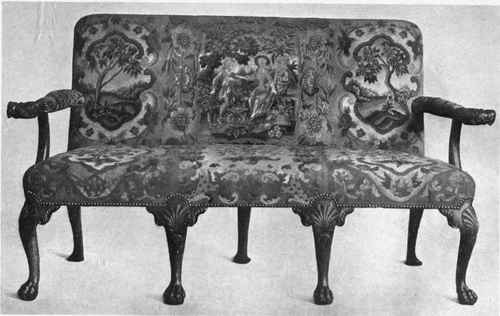
Plate XCVII Chippendale Settee, Mahogany, Covered with Needlework
"Stools," Heppelwhite remarks, "should match the chairs, the framework should be of mahogany, or japanned, and, of course, should be covered like the chairs."
Among Heppelwhite's most charming creations are his Window stools," in reality small sofas, the ends of which are alike. They are intended to be placed directly under the window and "their size must be regulated by the size of the place where they are to stand; their heights should not exceed the heights of the chairs." Their frames were like the chairs, of mahogany or painted in some light color, or japanned and covered like the chairs. Some of them had tufted seats ornamented with buttons, and some of them were finished with a festooned valance, decorated at intervals with a tiny tassel.
The proportion of Heppelwhite's sofa was usually from six to seven feet in length; the depth about thirty inches; and the height of the seat frame fourteen inches; height of the back, 3 feet 1 inch. "The woodwork," to quote from Heppelwhite's directions, "should be either mahogany or japanned, in accordance to the chairs, and the covering also must be of the same." The newest fashion was an oblong sofa, "the frame japanned with green on a white ground and the edges gilt; the covering of red morocco leather."
Of the confidante (see page 193), he says: "This piece of furniture is of French origin, and is in pretty general request for large and spacious suites of apartments. An elegant drawing-room, with modern furniture, is scarce complete without a confidante, the extent of which may be about nine feet, subject to the same regulations as sofas. This piece of furniture is something so constructed that the ends take away and leave a regular sofa; the ends may be used as Barjair chairs" (see page 192).
Of the Duchesse, he also says, "This piece of furniture is derived from the French. Two Barjair chairs of proper construction, with a stool in the middle, form the Duchesse, which is allotted to large and spacious ante-rooms; the covering may be various, as also the framework, and made from six to eight feet long. The stuffing may be of the round manner, or low-stuffed with a loose squab, or bordered cushion, fitted to each part. Confidantes, sofas and chairs may be stuffed in the same manner."
Continue to:


My Books

